21 March 2017

It seems like each day has its own ‘surprises’ that result in new challenges.  Today was no exception!

There were two surprises right at the start.  Although not related directly to the electrical installation, I became involved because of my involvement in keeping the overall building drawings up to date.  Daryl was wanting to install the MAD switch (a high power switch that routes the output of either the 400,000 watt AM transmitter or a smaller 5,000 watt transmitter to either the antenna or a dummy load).  Because it is located between two windows, it cannot be moved.  The output to the antenna goes through the wall into the phasor room which contains all the coils, capacitors and switches to properly divide the power between the four towers.  The phasor room has panels  to screen the sides and panels to screen the top.  These 4X8 foot panels consist of a screen with frames around the edge that bolt together in a configuration precisely laid out by the manufacturer.  It was discovered that the switch output to the phasor happens to pass through the wall exactly where two frames bolt together.  Normally a hole would be cut just in the screen, but now two frames will need to be cut that are part of the structure that holds up the ‘ceiling’ screen frames.  This will necessitate an on-site modification to maintain structural strength.

The second surprise came when we discovered the input from the transmitter to the MAD switch was closer to the wall than the drawings of the switch indicated.  This resulted in this rigid line needing to pass through a steel support beam, which is not possible.  As a result we had to shift the location of the transmitter on the drawings, which also required rotating the big supply transformer next to the transmitter.  I will need to do an extensive revision to the drawings.

In comparison to the above, the next surprise was relatively minor.  We began unpacking the power panels and found that  the top of the 800 amp breaker panel box had caved in about 1″ shearing off about 6 bolts in the process.  We think this happened before we packed it into the container in Niles, MI.  There was no obvious damage to the cardboard box in which it was packed and there was no shifting in the container that could have caused the damage.  We removed all the bolts holding the top and were able to use an hydraulic press to straighten the top.  We found some bolts on site to replace the ones that had been sheared off.

We went home for lunch and a short nap.  It is easy to understand why many Latin countries have their siesta time!  A short nap in the heat of the day revives one’s energy.

After lunch, Daryl took us to the site so the ladies could have a vehicle to do some shopping in the afternoon.  I was wondering which lady would be brave enough to drive the pickup which has a manual transmission.  Both have driven them in the past, but not recently.  Maryjane was the brave one.  Virginia’s turn is next!!

This afternoon, the cable for the generator was pulled through a 4″ underground pipe from the power room to the generator pad.  The cables required to carry the 530 amps pretty well filled the pipe and required the front loader bucket of the tractor to provide the pulling power.  Actually, there had been a ‘surprise’ on this as well.  In our drawings we specified two 4″ pipes to pull two separate 4 conductor 350mcm cables.  Unfortunately, the generator supplier told the construction crew that only one 4″ pipe would be needed and only one was installed without consulting us.  It is impossible to get two 2-1/2 inch diameter cables through one 4″ pipe!  The solution was to strip the jacket off each 4 conductor cable to provide 8 single conductors.  It was now possible to get them all through, but barely–with the help of lots of cable pulling lubricant!  The current capacity will be downgraded slightly, but fortunately we had overrated the cable some to start with.

Just as this cable pull was finished, a large truck arrived with the standby generator and the ATS (automatic transfer switch), which will automatically switch the power source to the generator when there is a power failure, arrived.  The crane on the truck was not long enough to place the generator on its pad, so it was set on the ground.  Tomorrow a larger crane is scheduled to come out with the air conditioning units to set all of them into place.   The ATS was transferred to the TWR truck which was able to back up to the power room for easy transfer to its proper location.

Fortunately, we opened the ATS and discovered another ‘surprise’.  There were no compression lugs for attaching our 24 large power cables.  Ralph and I began searching on the internet to find a source of suitable lugs.  It was then that we decided that it would be good to check the generator.  Sure enough, another ‘surprise’, we will need 12 more lugs for there, too!

Now it was 4 pm and Ralph contacted his supplier in Niles, MI via email.  Within minutes it was verified that the supplier had them in stock, and would have them on his counter waiting for Ralph’s grandson, Brian, to pick up.  Brian is one of the team arriving on Saturday.  These lugs will likely be here before we are ready to use them!  God is good!!

This evening, Jim decided to swim partway home from work.  It was just over a 1 mile swim and he anticipated arriving at Bachelor Beach at 5:30pm.  Ralph and I decided to drive to Bachelor Beach to meet him.  I did some ‘swimming’ to cool off while Ralph watched.  At 5:30 there was no sign of Jim, so we decided to go home to see if he had come ashore earlier and walked home.  Jim was not there, so I washed the salt water off and showered, then headed back to the beach with Ralph.  Partway there we saw Jim walking home.  He said that the swim started off fast enough but he then encountered currents that slowed him down considerably.  He said he saw a large variety of beautiful fish and coral at close range and that it was well worth the swim.

For supper we had hamburgers with all the fixin’s, mixed vegetables, oven roasted fresh cut potato ‘fries’ and apple sauce.  The ladies are getting in practice for the six grandsons that will be arriving on Saturday and staying for two weeks.

Thank you for praying!! It is obvious that God is at work in spite of the ‘surprises’.  Keep praying!!
2014/10/20 — Monday

The low this morning was 59F — almost cool enough to want a jacket, but I didn’t bring one with me.  After all, it is almost summer in Africa!

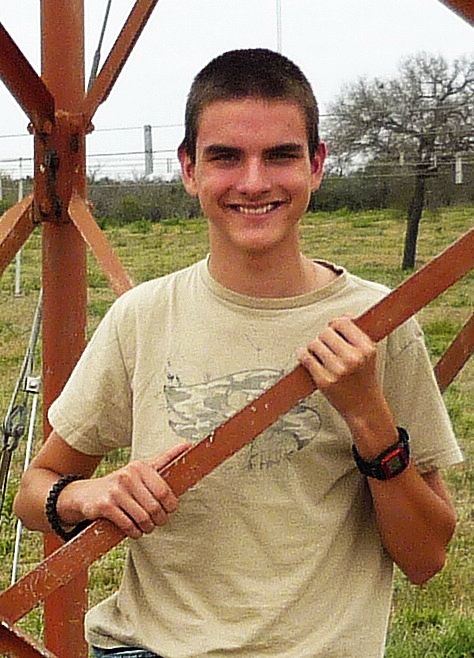
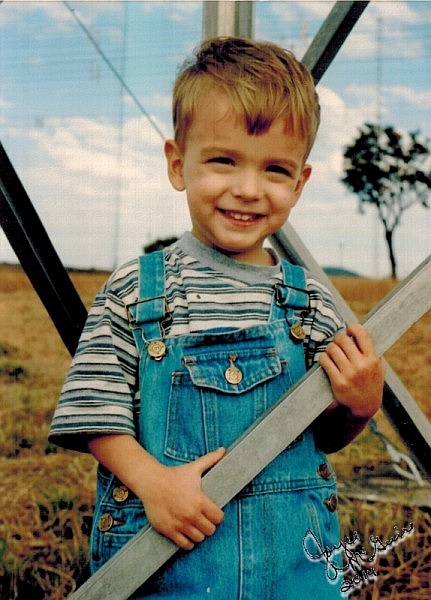
Today I needed to send the final copy of our McGuiReport, which we completed over the weekend, for proofreading.  Before doing so, I wanted to take a ‘recreation’ photo of Mark to include.  It has become popular these days to recreate photos taken years ago with the same persons today.  Here are the results of our efforts.

Mark at 2 years in Swaziland

Mark at 2 years in Swaziland

Mark-at-16d

Mark (almost 16) back in Swaziland


The tower in the original photo had been taken down, so we had to use another tower with a suitable tree in the background.

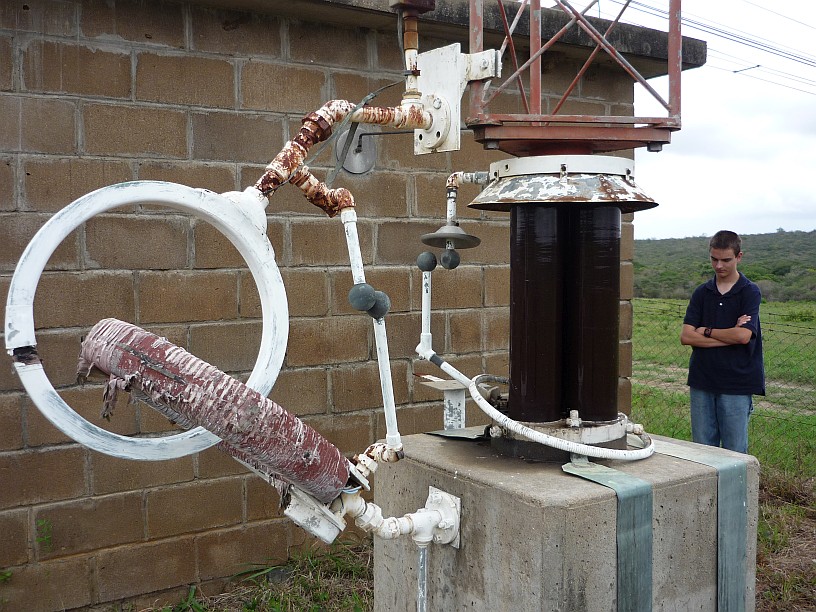
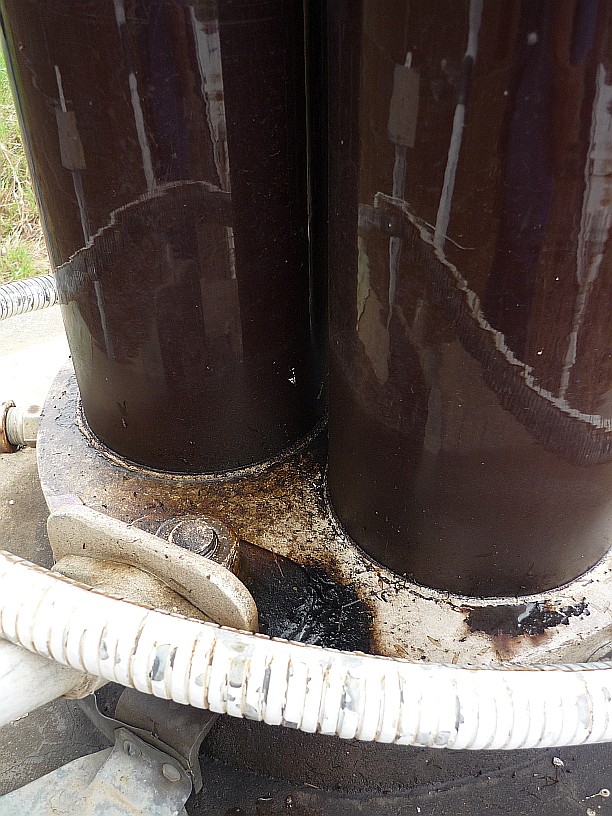
We checked out a base insulator of one of the two medium wave (AM) towers that showed signs of leaking oil after 30 plus years.  I did some research to locate the manufacturer, then emailed them to seek counsel about what, if anything, could, or needed, to be done be remedy the problem.

The base insulator at the bottom of one of the AM towers

The base insulator at the bottom of one of the AM towers

141020 -- BaseInsulatorLeak

Signs of oil leak from the left insulator


Answered and discussed some questions that Graham had about the HC100.  He had done some excellent reports on a couple of issues and I requested that he email them to me for forwarding to the other sites with HC100s.

We hipotted (tested with very high voltage — 20,000 volts) the VHF capacitor removed on Friday and it appeared to test good, as did the other one they had in stock.  This seems to indicate that the problem was actually a faulty arc detector on TX2, rather than the capacitor!  This leaves us a little confused because Tobi had physically seen the flash of light of an arc from the one that had been removed!

The high temperature in Manzini this afternoon was 75F.

2014/11/01 — Saturday — Hlane Game Park

Today we took our grandson Mark to Hlane Game Park.  He was the official photographer for this trip.  To see the photos that he posted go to:

mark.mcguireclan.org/?p=4663

For other photos Mark has posted of our time in Swaziland, check out:

http://mark.mcguireclan.org/

After Hlane, we drove through the sugar village of Simunye to the Umbuluzi river bridge, then turned back towards Manzini.  On the way, we made a 20 mile detour to the village of Stegi, located on top of the Lubombo mountain range along the border with Mozambique.  The views from there across the lowveld are amazing.  Unfortunately, it was a bit hazy and too near sunset to get good photos.  Where vast areas of undeveloped land existed 30 years ago, there are thousands of Swazi homes now spread out across the still rural plain.

It was dark by the time we got back to Singing Pines.

2014/10/31 — Friday — TWR Swaziland 40th Anniversay Celebration

We had a full day at the transmitter site with a little over 60 people present to celebrate the 40th anniversary of the start of TWR Swaziland broadcasts.  As far we know, Virginia and I, plus Samuel Masilela were the only ones attending who were present 40 years ago when the first broadcasts was aired.

We plan to provide photos and more details, but in the interest of getting something posted in a timely manner we’ll forego the photos for the time being.

As part of the program, I was asked to give a 10 minute testimony.  I was not told ahead of time, but was amazed to find out how well it meshed with the theme, “Remember the Marvelous Works which He has done….”  I Chronicles 16:12

Following is the text of that testimony (sorry for the length — there is probably a better way using a link):

Testimony for 40th Anniversary of TWR Swaziland

Larry McGuire

31 October 2014

First, let me say that Virginia and I feel privileged to have served with TWR for the past 47 years.  We both agree that the most memorable of those years were while living here in Swaziland from 1973 to 1989.  All five of our sons were born during that time and Swaziland still feels like home to us.  This transmitter site brings back so many memories of the “great things God has done.”

Today, I could spend hours telling you about details of the early history of TWR Swaziland.  Instead, I will try to tell of just four, of many, times that we clearly witnessed God’s Hand at work.

Isaiah 65:24, “And it shall come to pass, that before they call, I will answer; and while they are yet speaking, I will hear.”

In the video we have just seen [ http://vimeo.com/109814775 ], Edie referred to God’s provision of sand just when it was needed.  Here is my recollection of that amazing event.  In 1973 and 74, during the early stages of construction, we were taking river sand from the river from near the end of the current suspension bridge.  This sand was being used to make thousands of concrete blocks, and to pour foundations and anchors for buildings and antennas.  Maybe 30% of the way into the project, we had nearly used up all the available sand.  We were investigating the logistics, and were overwhelmed by the cost, of purchasing and transporting hundreds of tons of sand to continue the construction.  About then, we experienced some very heavy rains.  Since this was before the roads and building site were graveled, the roads and working conditions became extremely muddy.  The river rose very high for a couple of days cutting off access via our normal route.   So, in addition to being annoyed by the miserable working conditions, we had to travel the hour-longer north route through Scotts Ranch.  When the river receded, the sand that we had used up had been replaced, plus a whole lot more.  So, while we were fretting, God was providing — abundantly.  We may have lost a few hours of productive work, but God had silently been redeeming those lost hours so that the work could progress even more quickly!

When trying to locate a suitable transmitter location in Swaziland, we explored and tested many sites.  We would drive aluminum rods into the earth and use a special meter to measure ground conductivity.  (Those who observed us must have thought we were crazy.  We heard later that some were convinced that we were working for the CIA!)  I recall testing sites near Ngwenya, Malkerns, Big Bend and what is now Hlane Game Park, but a site near Mhlume was, by far, the very best.  When TWR was finally granted a license in 1973, the only property available was Mpangela Ranch, so here is where TWR established its transmitter site.  Several years later, we were again taking ground conductivity measurements to find a location for our station in Boputhatswana.  At that time, we decided to test the ground conductivity here on this property.  To our amazement, the measurements were similar to the ones taken at Mhlume.  We praised God and marveled at what He had done by providing Mpangela Ranch at just the right moment back in 1973 — and it was a whole lot closer to Manzini than Mhlume!

On  1 November 1974 we had only one 25 kw transmitter on the air, broadcasting from the storage building located about where the wall behind me is.  The first section of the transmitter building was just nearing completion and housed only two transmitters. Therefore, only one diesel driven alternator was needed.  It was only when the second section of the building was completed in 1975, that the third and fourth 25 kw transmitters were ready for service.  At that point we purchased and installed the second diesel driven alternator.  Since the power plant building was located across the way [about 200 feet southwest], we needed a heavy power cable to bring the additional power from the power building to the transmitters.  No company that we contacted wanted to cut the length of expensive cable that we wanted off a full reel. Eventually, we found a company that had a partial reel that was quite a bit longer than what we required, but they agreed to sell it all to us for only the cost of the length we wanted.  We cut off what we needed and for four years the huge reel with left-over cable sat outside, then in the storage shed.  When it came time to add the Continental 100kw shortwave transmitter in 1979, we needed a heavy power cable to connect it up.  We measured the length of cable required. When we checked the remaining cable on the reel, there was just enough cable to make the connection.  Once again, the Lord had made provisions for a need, that we did not know we would have until four years later!

Last but not least — When TWR Swaziland first went on the air, the nearest power line ended at the top of the hill near Singing Pines [20 miles away].  Because the cost would have been much too high to connect, TWR utilized two diesel driven alternators to provide electricity.  (The larger of those two alternators is still being used on the smaller of the current standby engines.)  Two years later, in 1976, we observed that the power line had been extended to Mpisi farm [6 miles away].  We again contacted the Swaziland Electricity Board about the possibility of connecting onto the end of the Mpisi line.  SEB agreed, and, amazingly, at no capital cost to TWR.  Since this line was coming all the way from their substation on the other side of Manzini [25 miles away], SEB stipulated they would only be able to supply enough power for two, of our four, transmitters. We accepted this limitation, as it would still greatly reduce our operational costs.  After connecting the two  transmitters to SEB, we found that the voltage sagged nearly 10% when high voltage was switched on.  It was true — loading on all four 25kw transmitters was impossible — EXCEPT — we were about to make an amazing discovery!

When TWR obtained the 25kw shortwave transmitters in 1971, they were nearly 25 years old, but had never been used.  Included with the spare parts, that had been gathered in the 1940s for these transmitters, was a large, rather unusual, transformer that was not even a transmitter part. Since it was not needed, we stored it in the back of the storage shed. Now, with the limited load capability of SEB, we decided to check out this now well-hidden transformer and discovered that it was a regulation transformer.  Doing some calculations, we discovered that it was just big enough to regulate the low voltage sections of all four transmitters, but SEB would have to approve the additional load on their power line.  SEB agreed and within weeks all four transmitters were successfully operating on SEB power.  The high-maintenance diesel engines were now reassigned for standby service only.  Our operating costs and labor for maintenance dropped dramatically!  All this could only happen because God knew of our need 30 years earlier and saw to it that someone in the 1940s ordered this regulation transformer so that it would end up being included with the transmitter parts destined for Swaziland!

This God, who answered before we knew we even had a need in the early history of TWR Swaziland, is the same God that we serve today.  Let us continue to trust Him, so that we will see His Hand at work in our personal lives and in the ministry of TWR, possibly for another 40 years, if He does not return before then.  All praise goes to our Great God for what He has done, for what He is doing and for what He is going to do!!

2014/10/30 — Thursday — Eve of 40th Anniversary

I am skipping several days forward on this blog because we want to bring you up-to-date on what is happening.  Hopefully we’ll have time later to go back and fill in the skipped days.

I have been asked to give a 10 minute testimony for the 40th anniversary celebrations tomorrow around 11am (about 5am CDT).  Today I spent some time editing the draft that has been in process for several days.  Your prayers are appreciated.

Transmitter 1 tripped out several times last night with an RF Unbalance fault on antenna 11. The feedlines and antenna switches were inspected and no obvious problems found.  There were some broken wires on the multi-wire connection to the antenna so Mark and Salema worked off the bucket of the front-end loader (about 12 feet in the air), while Graham operated the tractor and I fetched items as needed.  Unfortunately, the completed repair made no difference in the RF Unbalance reading.  We decided to raise the limit for the RF Unbalance from 5.0 to 5.5 (which is the same as the limit on one of the other transmitters.  We’ll see whether this solves the problem.

Late afternoon, the vehicles arrived with all the things for setting up for the 40th anniversary festivities.  Mark and I helped set up the tables and chairs for 70 people.

This evening, we had two young children eat supper with us while their parents remained at the transmitter site to finish the preparations.  Virginia then took the children to their house to get them into bed and stay there until their parents got home.  Mark was also away babysitting two little boys at another home while their parents entertained some mission leaders from outside Swaziland.  Both of them got back between 8:30 and 9:00pm.

We should get to bed to get some much needed rest for the big day!