2014/07/18 — Friday

When I mentioned that the tachometer cable for the Yanmar tractor needed to be almost 1/2 inch longer, Jim decided to try his MIG welding skills, before trying to obtain and modify the crimp-on extension mentioned yesterday.  I was impressed that Jim was able to accomplish this without melting the tiny end of the cable off.

My job was to slowly and carefully grind the end back down to size making sure its cross-section was perfectly square.  The standard dimension is about 0.100″ square.  Upon getting it down to about 0.103″, it would just begin to slide into the tachometer connection.  It was decided to leave it slightly oversize.  Maybe it will not wear out as quickly.  This is what it looked like when it was ready to install:
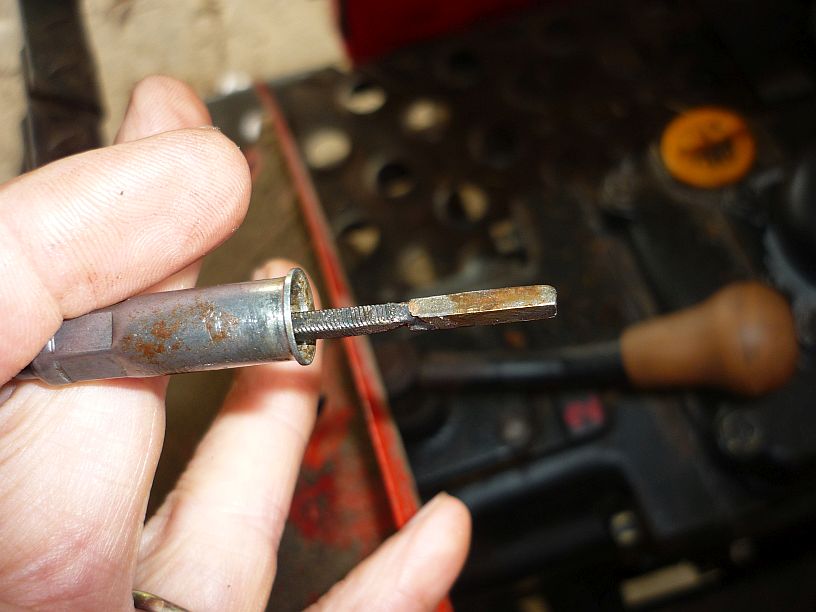
The repaired tachometer cable is now ready for installation.

The repaired tachometer cable is now ready for try out.

The tractor was started and the tachometer worked, and continued working!140718 -- TachWorking

In the process of searching for a replacement tach cable, I discovered a valuable piece of information and passed it on to Mike and Jim. The John Deere 1050 tractor is the same as the  Yanmar YM330D, except for the sheet metal (for the dash and engine cover).  John Deere actually had Yanmar, a Japanese company, make the 1050, and some other models, for them.  This might be useful to know when it comes to getting replacement parts for the Yanmar.

Yanmar YM330D tractor used for keeping the tall grass cut on the transmitter site.

Yanmar YM330D tractor used for cutting the tall grass on the TWR Guam transmitter site.

Shortly after we arrived, MIke asked me to look at a PA (power amplifier) coil that had been removed from the HC100 (100,000-watt shortwave transmitter we built in Elkhart).  The spare inductor had been installed in its place, when they found some metal particles under this inductor, which indicated excessive wear somewhere.  Because the inductor was heavy and on the floor in a very confined storage area, I asked Mike to help me get it out and set it on a table for ease of inspection.140718 -- PACoilThis inductor makes just over 5 revolutions from its extreme high frequency end to the extreme low frequency end. No obvious excessive wear could be found on either of the two rollers, nor on the coil where contact is made.  In fact, the silver plating was still in good condition in all the contact areas.

It was found that it did take extra torque to turn the coil in a couple of places.  Also noted that the contact rollers were not riding parallel to the coils of tubing in places.  I decided to document the relative information in steps of 1/4 turn to see if there is any pattern to the anomalies.
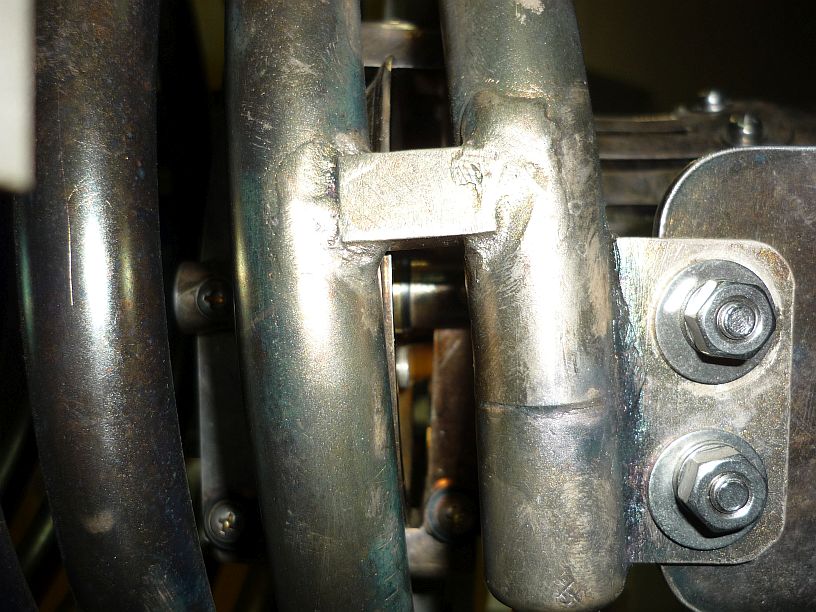
This is the worst case of the roller not running parallel to the coil.

This is the worst case of the roller not running parallel to the coil.

Near the end of the work day, it was determined that the problem of extra torque was caused when the idler rollers, that keep the contact rollers centered in the coil, contacted and began to push out on the inside diameter of the coil windings.
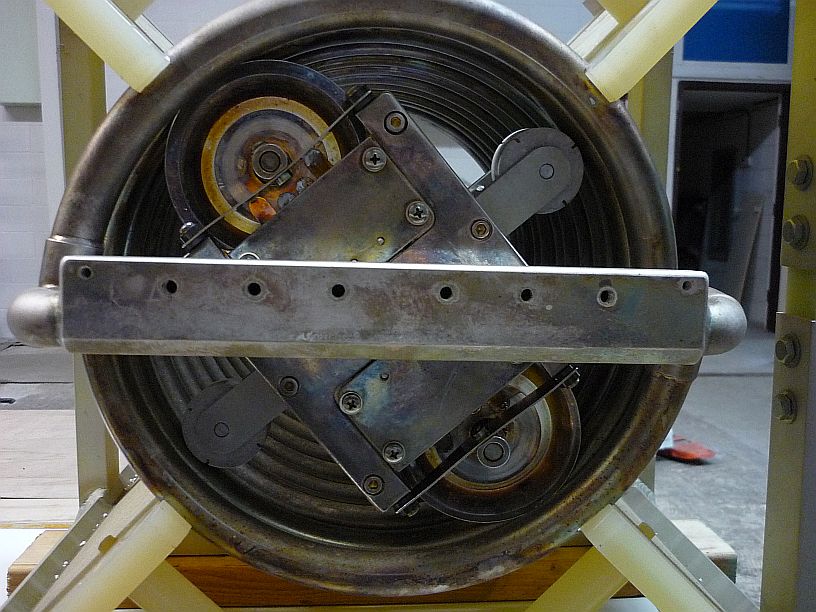
The idler rollers are the smaller white rollers seen here.

The idler rollers are the smaller white rollers seen here.


2014/07/17– Thursday — Tractor Repairs

To have something on record, I wrote up a report to attach to the dual 15 volt regulator that was worked on yesterday.  This way if someone else decides to attempt a repair, they will know what has already been done.

The tractor, a Yanmar YM330D, used for mowing the grass would not start.  After charging the battery, it was started and we found that the alternator was not working.  Mike and I wondered where the regulator for it was located and Jim told us it was inside the dashboard.  Upon opening it, a rat’s nest was found and three wires to the regulator had be chewed apart, with some of the wire missing.  After reconnecting the wires, the alternator began working again.

The wiring to the  tractor's regulator, after the repair.

The wiring to the tractor’s regulator, after the repair.

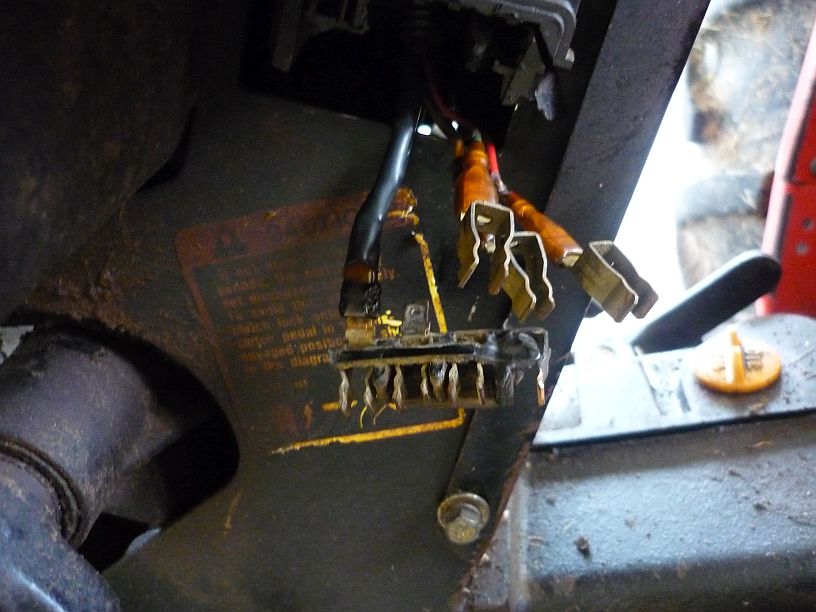
The remains of a fuse holder that had been shorting to ground.  I put heat shrink tubing on some bare wires to prevent further shorting.

The remains of a fuse holder that had been shorting to ground — I put heat shrink tubing on some bare wires to prevent further shorting. After purchasing a new fuse block, it should be easy to get all the lights working again.

Thinking that it was an electrical problem, Mike mentioned that it would be nice to have the tachometer and hour meter working again,.  After checking, it was discovered that the tach/hour meter is all mechanical, except for a light for night use.  Disconnecting the tach cable, the square end that fits into the tach was found to be rounded.  Jim repaired the tip with silver solder.  When the tractor was started, the tach worked — for a couple of seconds!  The square tip on the cable appears to need lengthening.

When something like this happens, I am one to look for solutions and found that Dorman makes a square end that can be crimped onto a cable to ‘renew’ the end.  It would take some modification to make it work, but might be worth consideration.  Dorman HELP products are available at auto parts stores and the Napa stores on Guam are on Dorman’s list of distributors.

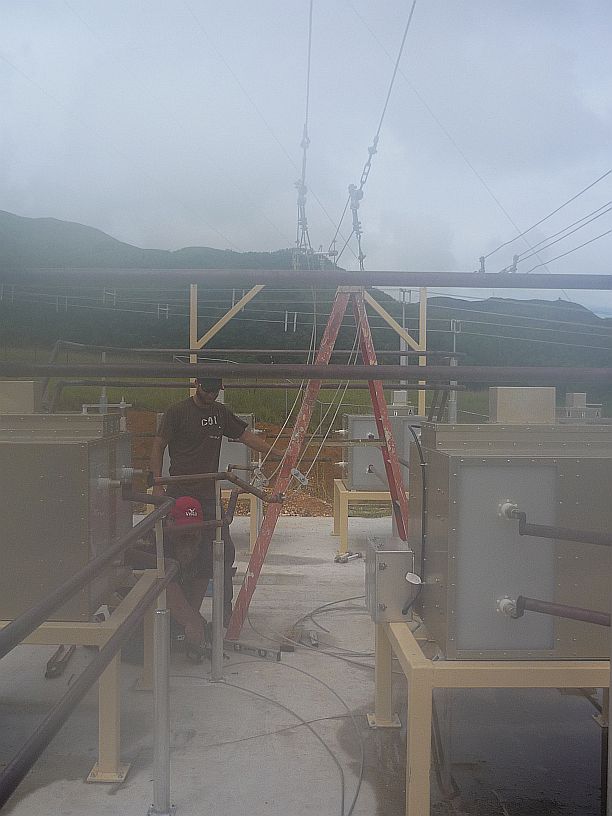
Jim and Joel completed the first connection from an antenna switch to the overhead lines, which will eventually be connected to an antenna.

First connection from an antenna switch to an overhead line.

First connection from an antenna switch to an overhead line.

I thought there was a better photo with Jim and Joel, but found that the photos were foggy!  I then realized that the lens had fogged over, due to having just brought the camera out of the air conditioned building into the high temperature, high humidity environment.

Interesting effect of a fogged camera lens.

Interesting effect of a fogged camera lens.

Late this evening, we learned that our trip to Swaziland for the 40th anniversary celebrations has been officially approved.  There are still a couple of details to be worked out before purchasing the tickets, which needs to be done while the prices are still reasonable.


2014/07/16– Wednesday

Sorry — no photos in this blog entry!

I drove our Highlander to work today and took Joel.  Virginia, Joanna and Kathy went to town in Joel and Joanna’s car to do some shopping.

Someone said there was a problem with the solar array layout from yesterday, so we verified that the layout was OK.

Mike, Jim and Joel drove to the north end of Guam to purchase materials for continuing the antenna switch matrix connections. Providentially, they were in town at the same time and location as the ladies, because their car refused to start.  After a couple of attempts, Joel got it started.  It probably had intermittent contacts in the starter solenoid, as it has worked fine since.

I had been invited to got to town with the other men, but decided to stay in case the contractor came to dig the holes.  He had laid out an extra row of holes to allow some adjustment in the location of the array.   Someone needed to stay to let him know TWR’s preferred final location of the array.

All the IT (Information Technology) men were in training today for a new play-out system to be used for sending programs to the transmitters.  These meetings are supposed to last for the rest of the week.

I continued working on the dual 15 volt power supply.  Found an anomaly between the bad and a good supply that indicates the problem is on an auxiliary board.  This auxiliary board has about a hundred tiny surface-mounted components, which makes it economically unfeasible to repair.

Since the above power supply is obsolete, I located some used ones on Ebay for $200.  I then began to look up parts for making a new substitute supply.  For less than $100, a new supply can be made to replace the obsolete one!  I compiled a list of suppliers of the parts for Mike to have on hand, if it is decided to use this option.


2014/07/15 — Tuesday — Solar Array Layout

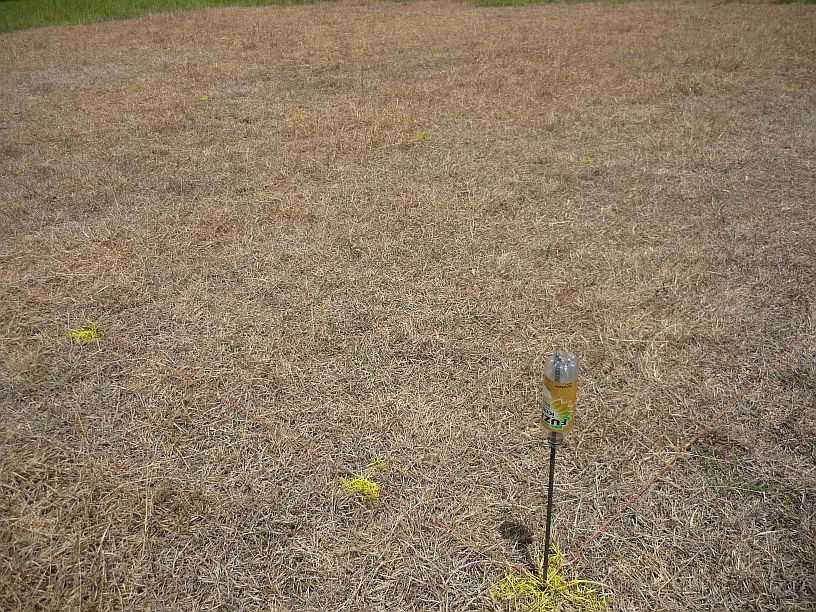
The contractor that is supposed to install the solar array came by today and marked the location of all forty holes required for installing the support poles.

The yellow dots on the dead grass indicate the location of each hole for the support poles for the solar array.

The yellow dots on the dead grass indicate the location of each hole for the support poles for the solar array.  Unfortunately, they do not show up so well in the photo.  Isn’t it amazing how much better our eyes are at seeing things than a camera?!

As a carry over from yesterday, I continued to repair the second servo amplifier, which now had two bad boards.  I found a bad semiconductor device and replaced it — that board now worked.

After not finding anything obviously wrong on the second board using a meter, we decided to apply power to see if that might lead to a clue.  When placed in the transmitter, the amplifer worked fine.  What was wrong with it before?  Maybe, we’ll never know!

After this repair, I went back to trying to troubleshoot the dual 15 volt switching power supply from last week.  Found a bad power transistor, but replacing it did not fix the problem!

Refreshing Coconut Milk Drink

Refreshing Coconut Milk Drink

Virginia and Joanna went to the farmer’s market, which is held in Agat every Tuesday.  They each got a coconut for less than half the normal price.  The farmer opened it for them and even gave them a straw.  Virginia shared some with me when I got home from work.


2014/07/14 — Monday — Servo Amp Repair

Not much happened on the antenna switch installation, because Jim worked shifts over the weekend and today was his day off.

I did troubleshooting of two servo amplifiers for the Thompson transmitters.  There are two spares and neither of them work.  Each amplifier has two different boards.  We discovered that only one board was bad on each amplifier.  Fortunately, the bad board on each amplifier was not the same type on both.  It was possible to make one good amplifier out of the two.140714 -- ServoAmpsOur evening was spent working on our August 2014 McGuiReport, which is due for proofreading on 15 July.