2014/05/28 — Wednesday — South Tour

We fell into bed just after midnight and got up this morning at about 9am.  With only a brief wake-up (from jet lag?) about 3:30am.

We had a picnic lunch with Kathy, who took us on a tour of the southern part of the island of Guam between Santa Rita, where she lives, to the TWR transmitting site at Merizo.

One of the more obvious Japanese pillboxes on Agat Beach

One of the more obvious Japanese pillboxes on Agat Beach

We saw Agat landing beach where American troops fought Japanese who were dug into caves along the coast.

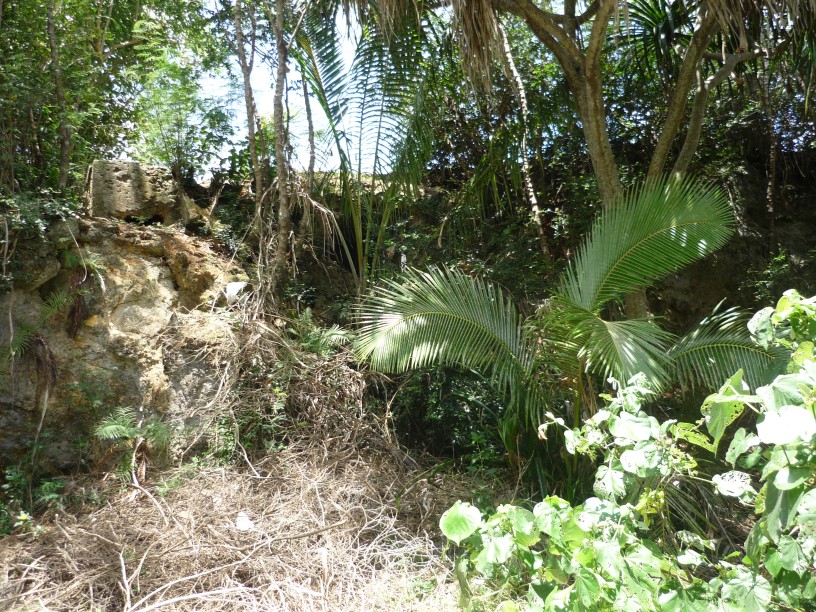
Well hidden Japanese caves on Agat Beach

Well hidden Japanese caves on Agat Beach

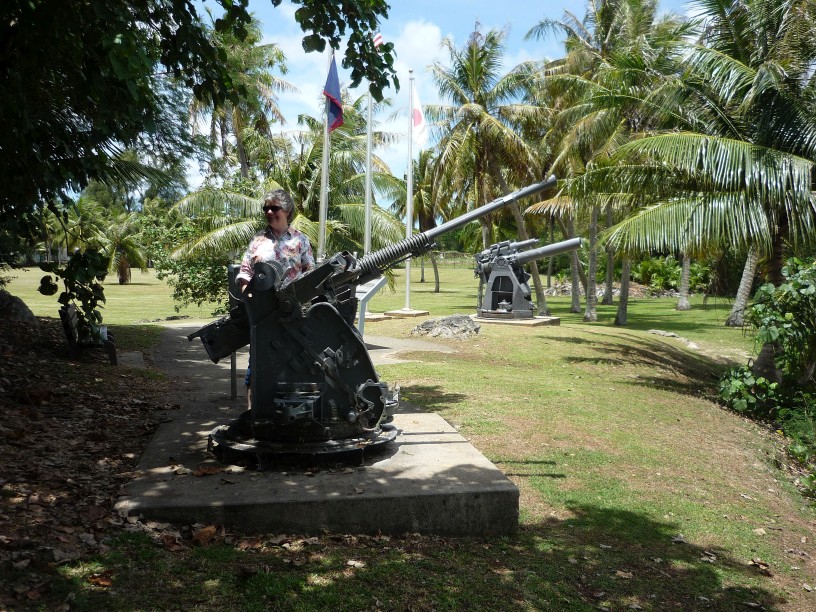
Japanese heavy weapons that the American forces faced as they landed on Agate Beach

Japanese heavy weapons that the American forces faced as they landed on Agate Beach

We passed the SDA transmitting site with its array of several shortwave towers.

Looking down from Fort Soledad at the village of Umatac and the bay in which Magellan harbored

Looking down from Fort Soledad at the village of Umatac and the bay in which Magellan harbored

We also visited a bay in which Magellan harbored at Umatac village, then the Spanish Fort Nuestra Senora de la Soledad.

120528 -- FortSoledadSign

The ruins of Fort Neustra Senora de la Soledad

The ruins of Fort Neustra Senora de la Soledad

Cannons at Fort Soledad

Cannons at Fort Soledad

Our last stop to the south was TWR’s transmitting site with its five shortwave transmitters — two Harris 100,000-watt transmitters built and installed in the 1970s, one HC100 100,000-watt transmitter that we built in Elkhart in the 1990s, and two recently installed Thomson 250,000-watt transmitters.

We got home just in time for the Gregsons to take us out to dinner at the Lemon Grass Thai restaurant in Santa Rita.

2014/05/27 — Tuesday — Arrived on Guam

Left our home in Elkhart this morning by 7am to catch a 9:21am flight to Chicago. We supposedly could of caught a later flight, but decided a 50 minute layover in Chicago was just not long enough!

Our next flight to Tokyo flew over Alaska, where we saw many beautiful snow covered mountainranges with glaciers. We arrived in Tokyo slightly ahead of schedule, so the 50 minute layover there was more than adequate to to make the Guam flight.

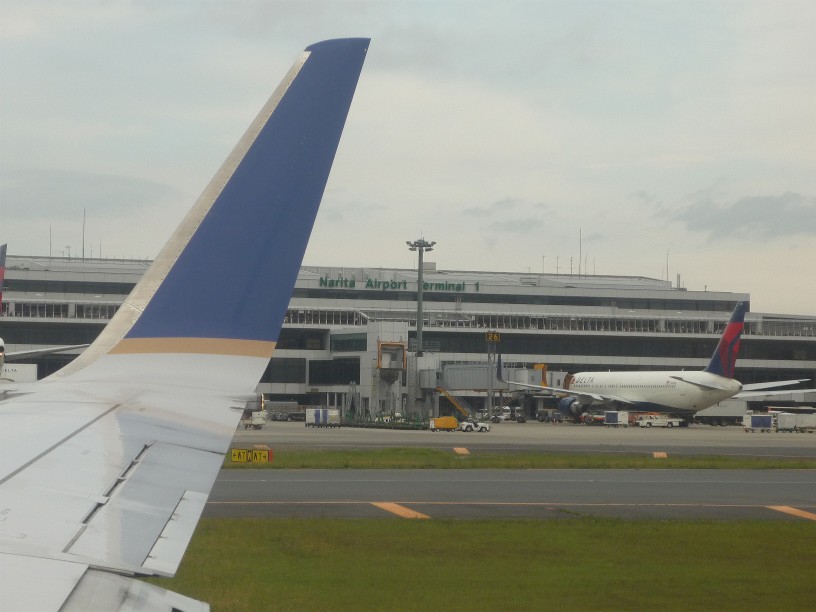
Our time in Japan was limited to a 50 minute layover at the Narita Airport

Our time in Japan was limited to a 50 minute layover at the Narita Airport


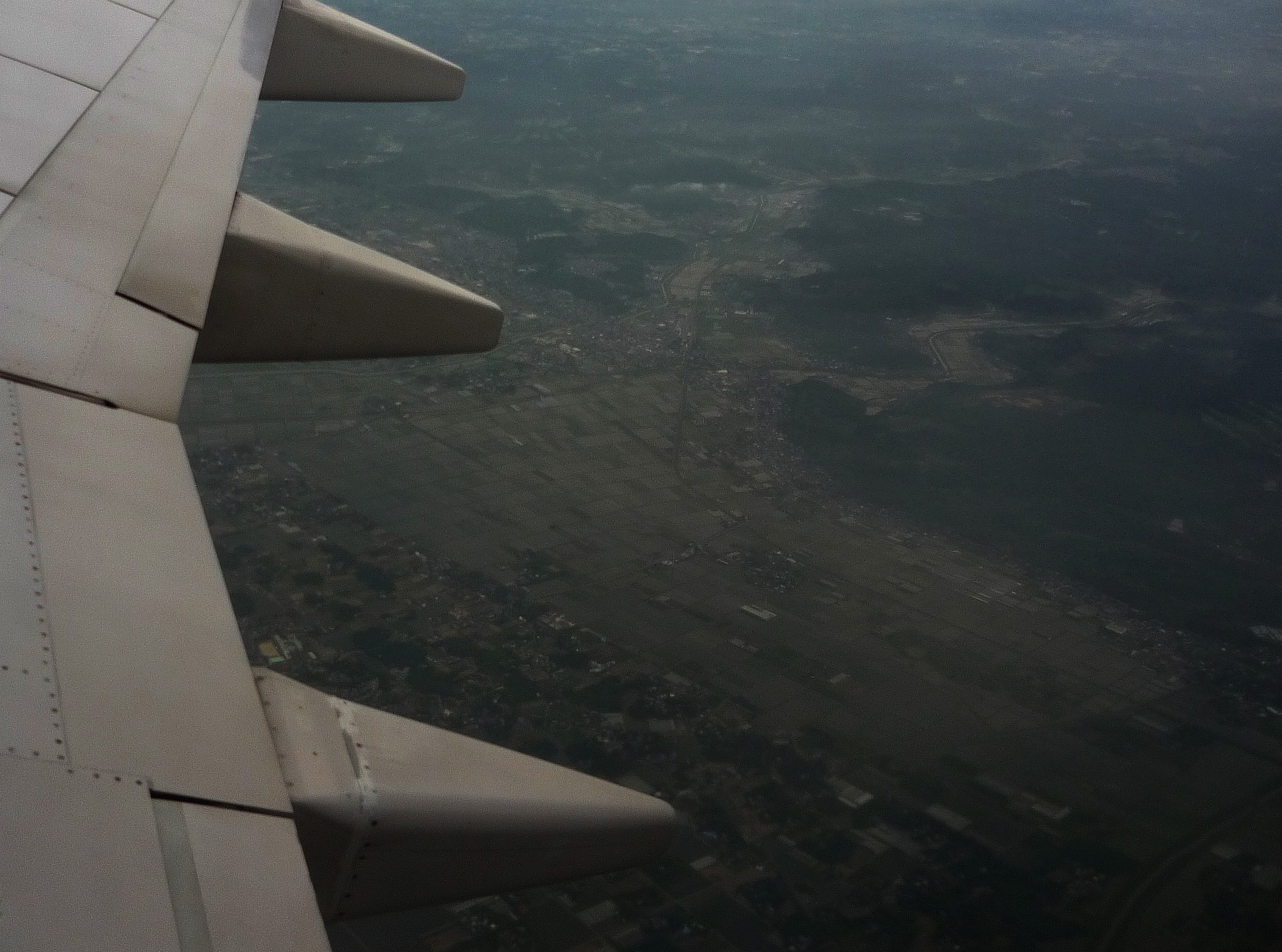
As we landed at Tokyo, we noticed hundreds of rice paddies and solar panels.  This photo was taken of rice paddies as we took off just before sunset, so is not as clear as we would have liked,

As we landed at Tokyo, we noticed hundreds of rice paddies and solar panels. This photo was taken of rice paddies as we took off just before sunset, so is not as clear as we would have liked,

Our Guam flight pulled away from the gate on schedule, then we waited in a long line of planes for about 20 minutes for take off. All of a sudden our plane turned out of line onto a parallel taxiway headed the opposite direction and stopped. My initial thoughts were, “Must be a mechanical problem”, but, after about 5 minutes, the pilot announced that we were being directed to another runway and had to wait for the right ‘paperwork’. 45 minutes after leaving the gate, we were finally airborne.

About an hour into the flight to Guam, we finally saw the sunset. The sunrise of our day had been about 24 hours earlier in Elkhart and we had flown in daylight the whole time. We arrived safely on Guam only about 20 minutes late. Many of the TWR Guam missionaries we there to met us.

We arrived very tired after almost 30 hours with little sleep. Guam is definitely warm and humid and the temperature was about 86F at 10pm.

We are staying with Paul and Kathy Gregowske for a few days until a small apartment becomes available for us. Fortunately there are small air conditioners in the bedrooms. The rest of the house has ceiling fans.

Guam time is 14 hours ahead of EDT so when it is noon in Elkhart (10am MDT), it is 2am the next day in Guam. It might be difficult to find a time to communicate via Skype at a convenient hour at both ends, but we will try to work something out!

2013/07/10 — Wednesday — Thank You Tea

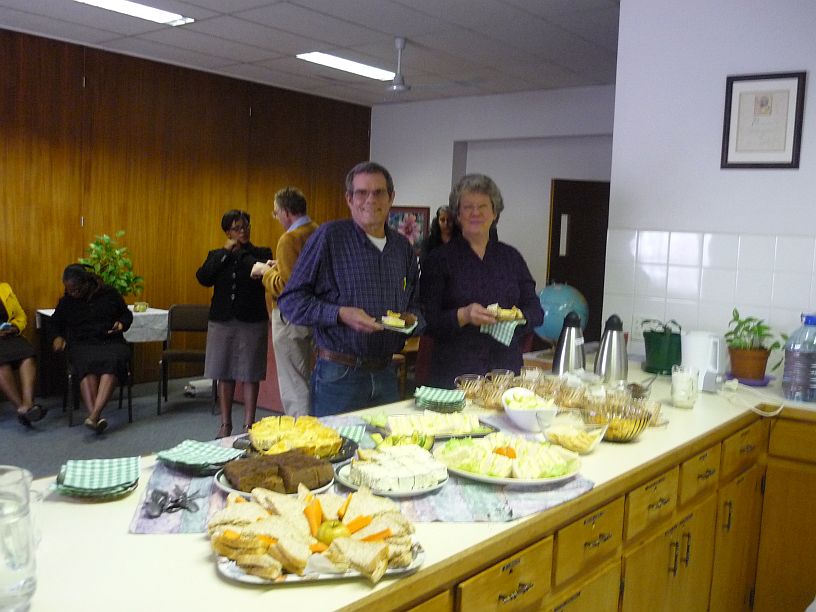
We were asked to be at the head of the queue (line).

We were asked to be at the head of the queue (line).

From right to left -- Mbusi, Salema and Bonisile

From right to left — Mbusi, Salema and Bonisile

From left to right -- Eric, Phumzile and Clementine

                                       From left to right — Eric, Phumzile, Ethel and Clementine.                                       In background — Sifiso (intern), Mbusi and Graham

Clockwise around table -- Larry

 Clockwise around table — Larry, Klaus, Eric, Sifiso (intern), Salema, Jean and Steve.                           In orange  against the wall — Bobo.

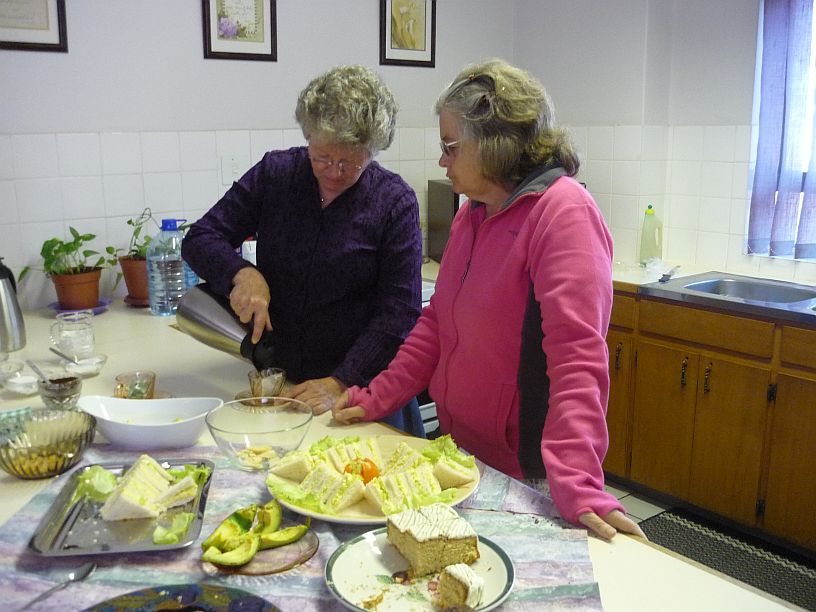
Virginia and Lorraine

Virginia and Lorraine

The post office still has long rows of call boxes (coin operated phones), but with the advent of cell phones, not many are used.

The post office still has long rows of call boxes (coin operated phones), but with the advent of cell phones, not many are used.  In the past there was a line waiting to use one of these phones.

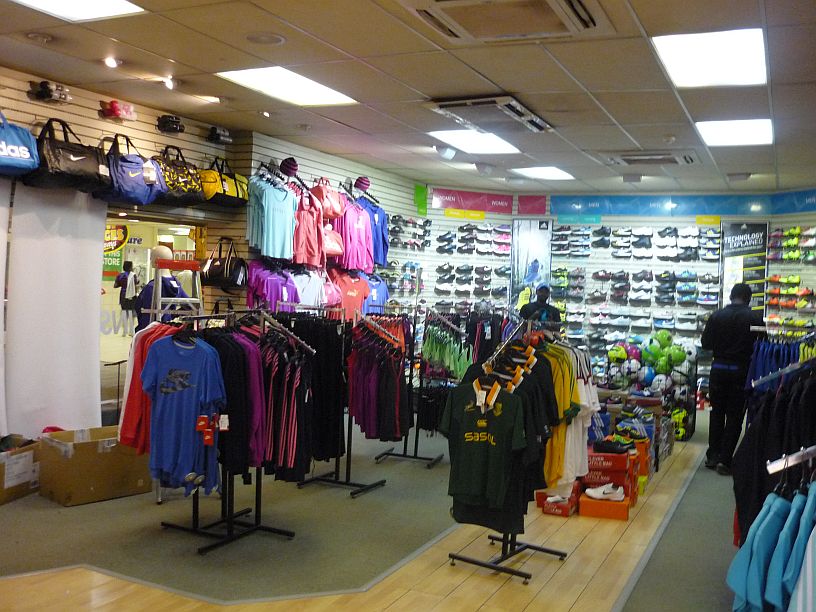
This sports store in the downtown mall looks much like those in Indiana.

This sports store in the downtown mall looks much like those in Indiana with the exception of the cardboard boxes against the wall.

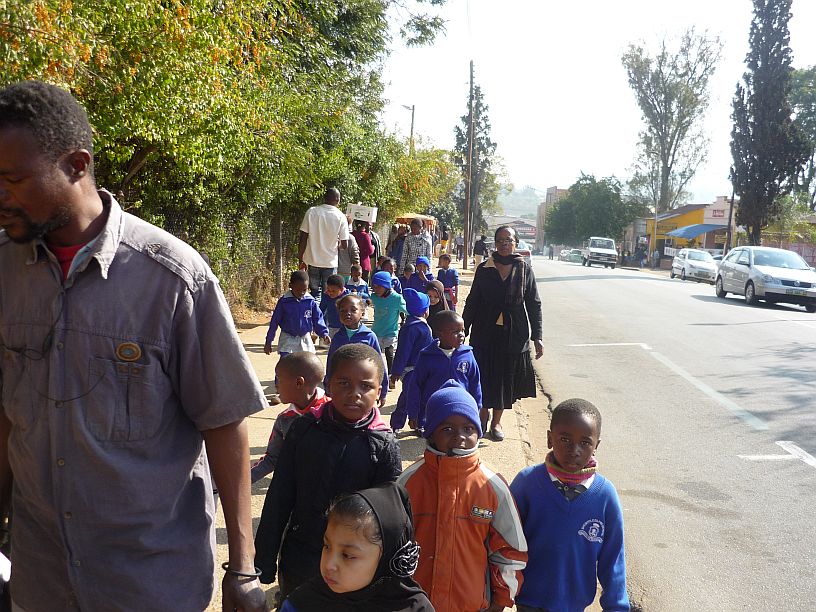
On the way to the market, we saw this group of preschoolers apparently on an 'field trip'.

On the way to the market, we saw this group of preschoolers apparently on an ‘field trip’.

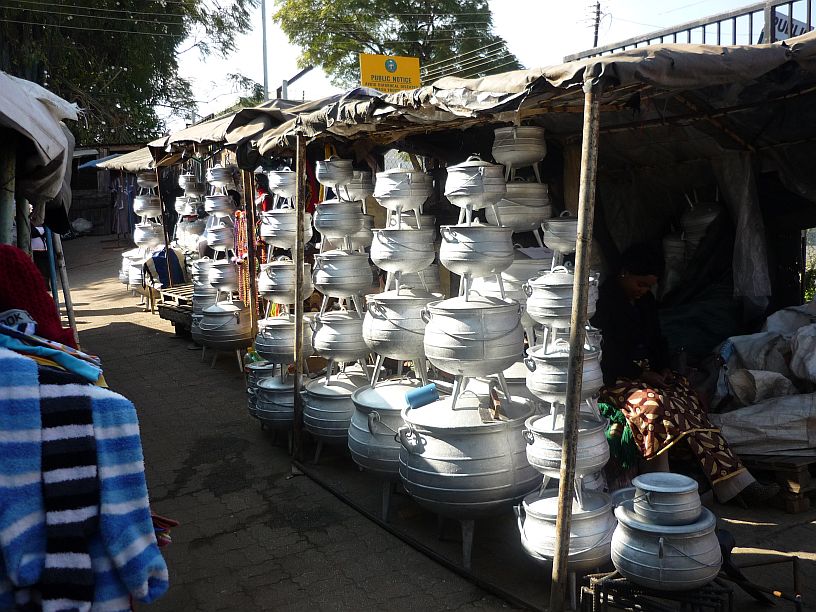
A 'few' cast aluminum (aluminium in British English) pots.  These are much lighter than the old cast iron pots, but locals say they do not work as well.

A ‘few’ cast aluminum (aluminium in British English) pots at the market — these are much lighter than the old black cast iron pots, but locals say they do not work as well.

Swazi ladies often carry heavy loads on their heads.  Just caught this photo as this lady stepped behind the back of truck.

Swazi ladies often carry heavy loads on their heads.  I just managed to take this photo as this lady stepped behind the back of truck.

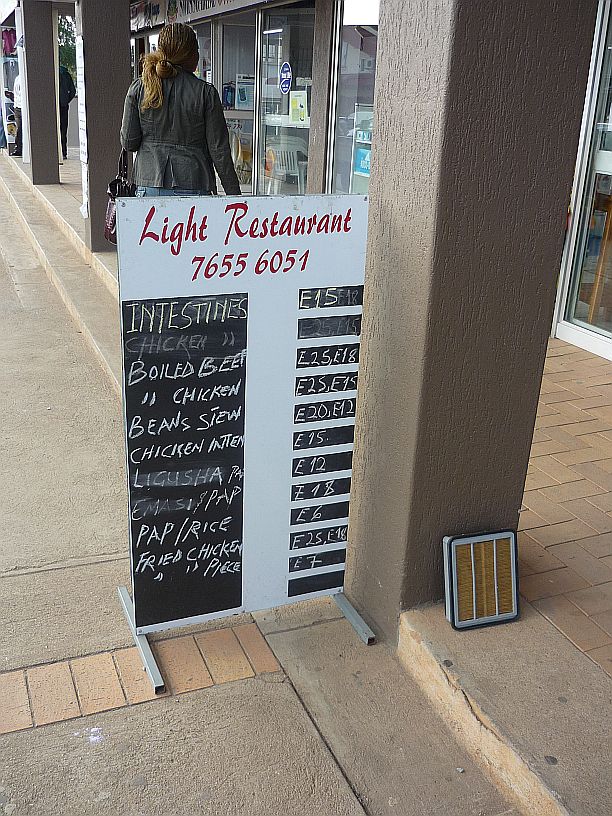
Maybe you should have item 1 on the menu or item 5 (which is the same as item1)!!

                Maybe we should have item 1 on the menu or item 5 (which is the same as item1)!!                               It only costs $1.50!!

The last stop was to fulfill a request for a small jar of Nescafe coffee.  We were amazed at the choices.  There are more choices in the next photo.

The last stop was at Pick N Pay to fulfill a request for a small jar of Nescafe coffee. We were amazed at the choices. There are even more choices in the next photo.  In the past, there would have been only one choice.  Note —  E10 is approximately equal to $1.

The request was for a jar with other languages on it.  In the past, there would have been at least Afrikaans and English.  Now it is in English only.  The ingredients are in three languages, but in small print only.

The request was for a jar with other languages on it.  In the past, there would have been at least Afrikaans and English on every product.  Now it is in English only.  We suspect that this is a backlash from the days of apartheid in South Africa.  Most processed food in Swaziland is packaged in South Africa.   On the jar we bought, the ingredients are in three languages, but in very small print only.

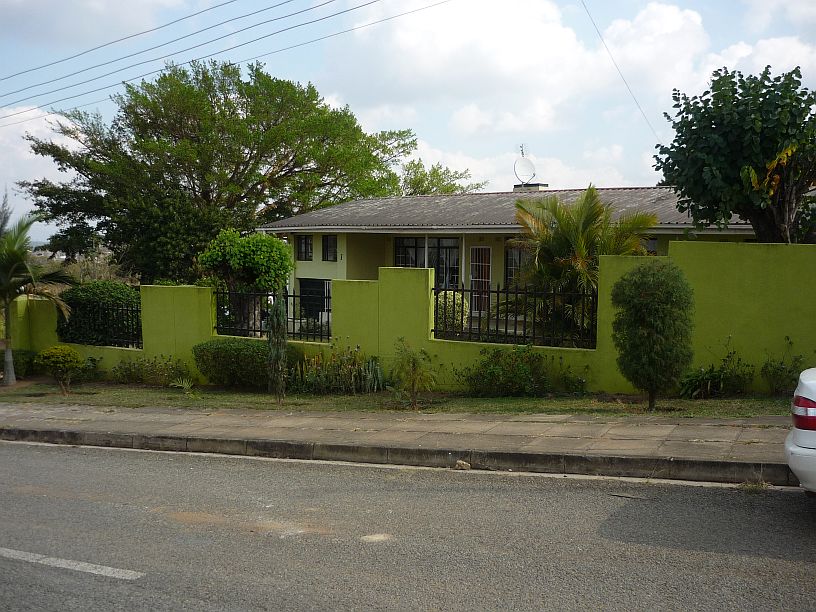
This is the house that we lived in for 13 years.  We were living here when all of our sons were born, except for Allan.

This is the house that we lived in for 13 years. We were living here when all of our sons were born, except for Allan. The color was yellow with brown trim then and the fence was chain link, instead of concrete and steel angle.

This iron ore truck is one of hundreds that are continually hauling ore between Ngwenya Mine on the west side of Swaziland to Mpaka or the port in Mozambique.  The roads are suffering from this.

This iron ore truck is one of hundreds that are continually hauling ore between Ngwenya Mine on the west side of Swaziland to Mpaka or the port in Mozambique. The roads are suffering as a result.


Today we arrived at staff meeting and noticed something was up.  Tea cups, cake, and other finger food was being set out.  After staff meeting, there was a ‘thank you tea’ for us, since we will now be leaving Swaziland next Wednesday instead of Thursday.


After the tea, Virginia and I walked downtown.  Our first stop was to buy some units of electricity.  Instead of receiving a bill for electricity every month, electricity must be prepaid.  There is a display unit near the circuit breaker box that shows how many units are left.  If it goes to zero, the electricity is shut off.  There are many other places to purchase units, but we went to the post office, since it was closest.  Payment is made, then a receipt is printed with a 16 digit number to enter into the display box.  When this number is keyed into the display unit, the amount of units purchased is added on to the remaining units.  Somehow the display unit knows whether the 16 digit number is valid and how many units to add.

We did some shopping downtown, and at the market, for items to take back to Indiana with us.


This evening we attended our last Wednesday evening serve at EBC.  Pastor Deon was back from Capetown and spoke on Psalm 91.  Someone else had been scheduled to speak, but had to cancel at the last minute.

2013/07/09 — Tuesday — Automation System Woes

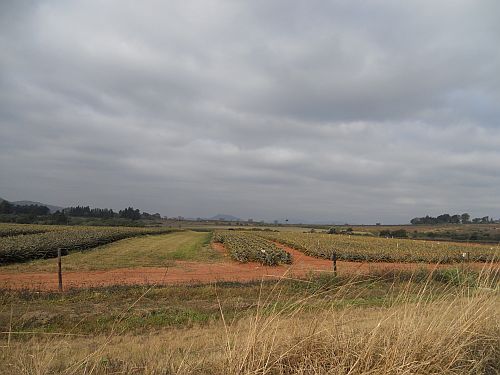
Pineapple fields at Malkerns about 12 miles west of Manzini.

Pineapple fields at Malkerns about 12 miles west of Manzini.  It has been unusually cloudy for the past few days with highs around 65F.  The nights are cooler.

Forgot to mention yesterday that Virginia went out to tea (“elevenses”) with Lorraine.  [Lunch is usually at 1pm]  They originally planned to go to Guava Gallery, but found out that it is closed on Mondays.  Instead they went to Sambane Tea Garden next to Swazi Candles, where Virginia said she had the largest scone that she had ever seen.  It had jam and whipped cream on it.  On the way home, they passed the pineapple fields at Malkerns.

There were 14 present for site devotions this morning.  I challenged the group with I Corinthians 9:24-27 to “finish strong” in our Christian ‘race’, or join in the race.

Now that some of the anomalies with the transmitter have been traced to the automation interface cards in the transmitter, all the remaining cards were modified to correct the problems.
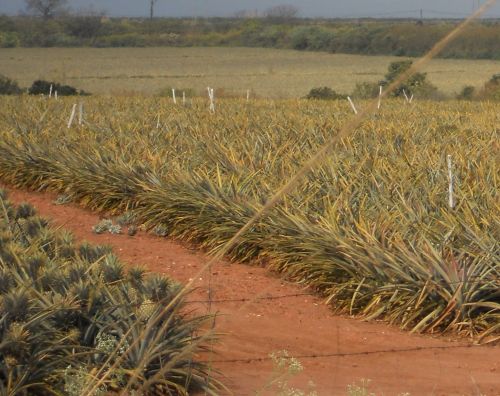
Small pineapples can be seen in the lower left field.  It takes about 2 years for a plant to grow fruit and about 6 months for the fruit to mature.

Small pineapples can be seen in the lower left field. It takes about 2 years for a plant to grow fruit and about 6 months for the fruit to mature.

Klaus and Graham began working on the automation program to clean up a few problems that were discovered.  Since this was not my area of expertise, I decided to again inspect Antenna 6.  It continues to arc (but less frequently) after our previous modifications.  I also decided to check out the other three antenna similar to Antenna 6, and the rest of the shortwave antennas.  Some observations and thoughts:

1.  The corona rings on Antenna 11 (the one built in 1985) have more ‘wrap-around’ curvature on the outside ring than the newer ones.

2.  The fourth element from the bottom on the east side of Antenna 6 looks about 4″ short.  Wonder if this could be a source of unbalance in the antenna?  Maybe it should be measured.

3.  To determine where the arcing starts from, I wonder if it might be possible to set up a movie camera during the problem 35 minute tranmission and capture an occurrence of the arc.  Replaying frame-by-frame just might give us a clue as to where additional corona treatment might be helpful, rather than using out current trial methods.

4.  Another option might be to have someone with the right computer program to more accurately model the element ends and corona rings to determine where the greatest voltage stress occurs.

This trek around the shortwave antenna field took about an hour.

At lunch I set out a carton of Virginia’s homemade chocolate chip oatmeal cookies.  Each person at the site was able to have two.  Virginia got lots of compliments!  I think they want more!!

After lunch we began testing the automation changes.  Very few of the commands to control the transmitters worked properly!  When the afternoon broadcasts began, I grabbed a list of the timetable of computer commands and manually operated the transmitters as Klaus and Graham continued to tackle the automation system problem.

The first thing they did was to replace the program that they had modified with the previous one.  It still did not work.  I was beginning to think it might be a long night manually doing everything that the computer normally does!  I’ve heard of “replacing a person with a computer”, but this would be ‘replacing a computer with a person’.

Eventually, it was found that the problem was a bad connection of one of the control wires between the automation system and the transmitters.  This was repaired.  Rather than waiting for 30 minutes (until the next set of automated commands) to verify that the problem had been solved, the system clock was adjusted to the time just before the previously observed problem, then we watched to see that it was now working properly.  It functioned properly, and we were able to head for home only one hour late.

We rejoiced in the fact that the problems had been solved with no lost airtime.  A listener would not have known there was anything abnormal happening.

2013/07/08 — Monday — Back to Work

Back to work after a fantastic weekend at Kruger Park.

I spent most of the morning catching up on all the emails that came in over the weekend.  There was no internet service at the bungalow in Kruger, so we didn’t even bother to check.

We learned this morning that the Africa Regional Office wants us to  to meet with leaders there on July 18, before we caught our evening flight back home.  Therefore we will plan on leaving Swaziland on Wednesday July 17, rather than on July 18.

Graham discovered that the interface card in TX3 for automation control was wired differently than TX1 or TX2.  This explains why it reacts differently from the other two, although receiving the same command.  Upon further review, we decided to use this revision, rather than the plan we devised on Friday.

This afternoon, when TX2 and TX3 had their filaments switched on by the computer, instead of remaining with only the filaments warming up, these two transmitters proceeded to go on the ‘air’.  This is unlike TX3, so tomorrow will be spent trying to figure out why?  There should be no problem operating tonight and in the morning under these conditions.

It has been cloudy all day, so when I got home the temperature in the house was down to 64F.  I am almost on the verge of shivering as this blog is being done.  Outside it is now about 59F, so it will likely be a cool morning tomorrow.