2013/07/02 — Tuesday — Filament Research Day

After all the work done on TX3 yesterday, it performed well last night.  After the broadcasts this morning, the driver tube removed yesterday was reinstalled.  It is believed that the only problem for all of the chaos yesterday was due to the bias supply wire with an intermittent connection.  A test transmission revealed no problem with the driver tube.

Graham and I set up a digital oscilloscope to capture the filament voltage of TX3 during various ‘turn on’ scenarios.  This information revealed the reason for a problem experienced when switching the filament from what the transmitter thinks is ‘quarter power’ to full power.  The computer does not ‘know’ the quarter power feature in TX3 has been disabled.  As a result, occasionally the filament circuit breaker trips and now we think we know why.

While we were doing this, Salema and Sifiso (a Swazi intern) discovered a water leak on TX1 and it appeared to be from the same place as the leak Graham and I ‘repaired’ last week.  I gave them instructions on how to remove the four back doors and top trim to get access to the area of the leak.  It was discovered that the leak was coming from the top seal of one of the radiator tubes located just above the fitting we ‘repaired’.  This time the leak was discovered immediately after shutdown and the water drops were still running down, instead of just a puddle of water being found.  Swaziland does not have the tool to remove this tube to replace the seal.  Since it is a slow leak, and not under pressure, silicon sealant was used in an attempt to stop the leak and a pan was placed under the radiator to collect any drips before they can cause damage to the electrical components below.  TX1 has been in service for 21 years.

We had the interns, Jonathan and Samuel over for supper this evening.  After supper, Klaus came by to show Samuel, a computer major, the ‘hub’ located at Singing Pines where the internet signals are received via a link from the transmitter site and distributed to the five houses via fiber optic cables.  Our phones also use this internet connection.  Fiber optics are being used because lightning has destroyed previous systems.  Lightning storms are very frequent and severe here in Swaziland and Singing Pines is on the top of a hill.


 

2013/07/01 — Monday — No Way to Start a Week

When listening at ‘home’ to one of the transmitters this morning, I heard it go off the air at 5:41am.  When we got to the site, Salema, the technician on call, was already there trying to get it on the air.  Earlier, some of the air piping had come apart and that was repaired, but now the Driver Bias voltage was not ‘ramping up’.

Initially, it looked like the Bias Supply circuit breaker was faulty, so that was rectified.  In the process of troubleshooting that problem, a 110 volt wire came in contact with the circuit breaker’s auxiliary switch, which created another problem that had to be traced and corrected before proceeding.  A resettable fuse for one of the 24 volt circuits had been destroyed and had to be replaced.

Back to the bias problem, we measured zero driver grid bias, but the supply had voltage going to it.  We decided removing the driver tube was the fastest way to check for a grid short.  When this was done, the bias voltage returned to normal, so a new tube was installed.  Eventually, the apparent circuit breaker problem returned and it was found that one of the wires bringing the 110 volts supply to the breaker had been inserted into a terminal block in such a way that the screw that was supposed to clamp the wire was clamping the wire insulation instead.  The connection would come and go depending on the position of the wire.  Now it should work — WRONG!

The transmitter would still not come on.  It appeared that there might not be enough RF drive, but the RF drive controller appeared to be working.  RF measurements from this transmitter were compared to one of the other transmitters.  The measurements were slightly lower.  After much searching, we found that the RF Drive controller voltage was limiting at about 3 volts.  This board was swapped out and everything returned to normal.  We found that the 15 volt regulator on the board had failed and another lower voltage supply was back feeding.  This gave the appearance of it working.  This regulator was replaced and the board was put back into service.

After all that has been done, we are not sure now whether the original driver tube was bad.  It may have been an intermittent breaker supply wire all along.  That driver tube will now be tested with a high voltage tester.  If it checks out OK, it may end up going back into the transmitter for testing.  If it passes that test, then it might be used for broadcasting again.

I spent the time after lunch locating the quarter power filament drawing and schematics.  There are a couple dozen files that I need to study before proceeding with troubleshooting the filament anomalies, which had been our original objective for today.  Maybe tomorrow!

2013/06/30 — Sunday — Pastor Healy

Pastor Deon is gone to Capetown for a training conference with the former pastor Neil and the intern.  This morning, Pastor Healy had a really good message on the last part of John 3 with an emphasis on John the Baptist’s proclamation, ” He must increase, but I must decrease.  Pastor Healy recently celebrated his 71st birthday.

During the first part of the service and before children’s church, we had two little girls creep over to sit with us.  One is the little girl that Virginia is tutoring and the other is her older sister.  They are feeling comfortable enough to come climb on ‘grandma’s’ lap.  Makes us feel good, too!

This Sunday, we brought Ruth to our house for dinner.  We had arranged for her to talk to her daughter, Sharon, and grandchildren using Skype, but they had to unexpectedly leave earlier to their church.  Maybe something can be arranged for Wednesday.

2013/06/29 — Saturday — Hlane Game Park

Today we went to Hlane Game Park with Steve and Lorraine.  The new intern, Samuel, also came along.  The clouds from yesterday were gone and the sun quickly turned a cool morning into a rather warm day.  Below are some photos from today:

Impala are found in abundance at all the game parks.

Impala are found in abundance at all the game parks.

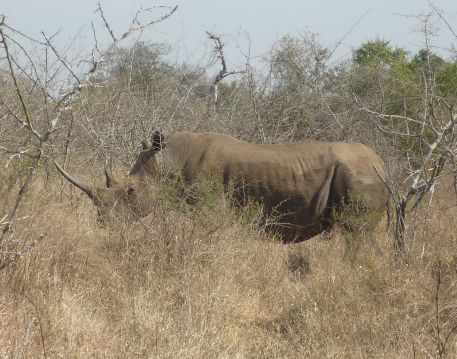
We marveled at the narrow 'wheelbase' of the rhino.  Want to try some rhino tipping?!

We marveled at the narrow ‘wheelbase’ of the rhino. Want to try some rhino tipping?!

It looks like it is possible to see the ribs of this rhino

It looks like it is possible to see the ribs of this rhino

Several female nyala, the most abundant antelope at Hlane after the impala.

Several female nyala, the most abundant antelope at Hlane after the impala.

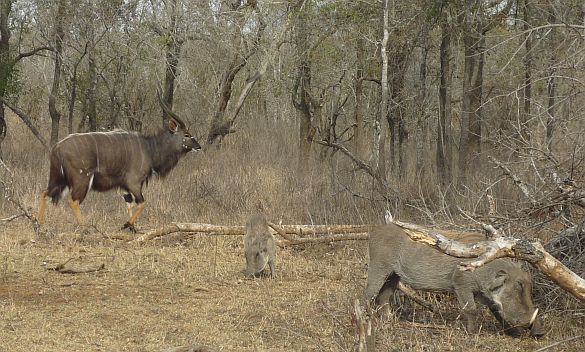
Warthogs and male nyala

Warthogs and male nyala


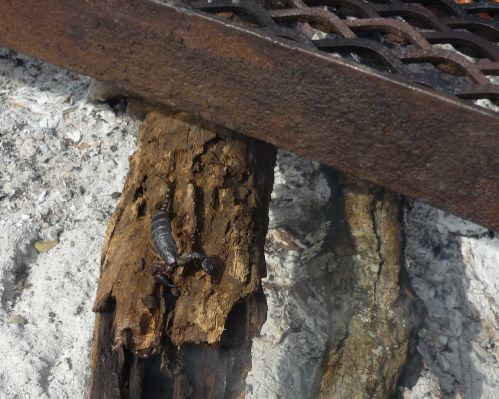
A scorpion emerged from the firewood used for the grill

A scorpion emerged from the firewood used for the grill

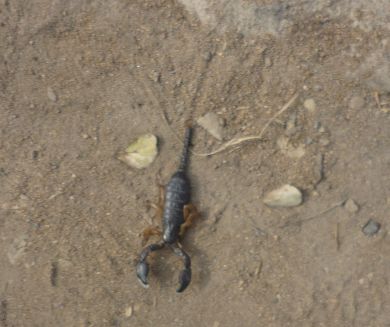
The scorpion 'high tailing' it from the fire.

The scorpion ‘high tailing’ it from the fire.

The male nyala is much darker than the female.

The male nyala is much darker than the female.

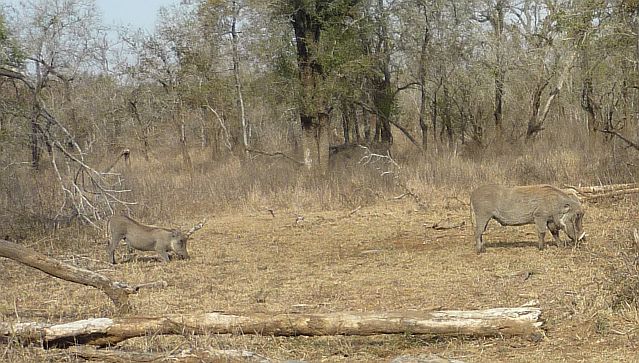
The juvenile warthog kneels to graze while the adult does not.

The juvenile warthog kneels to graze while the adult does not.

Just as the sun was setting, five elephants drank from the waterhole at Ndlovu (elepant in Siswati) Camp

Just as the sun was setting, five elephants arrived to drink from the waterhole at Ndlovu (elepant in Siswati) Camp


2013/06/28 — Friday — What’s up with those filaments?

There were clouds all last night, so the temperature was 55F this morning instead of in the 40s.  If the clouds remain, it will not warm up.  At 11am the temperature at the site was 53F.  I’m glad I took my jacket today, because the buildings are cooling down without the sun shining to warm them up.

While the transmitters were on the air this morning, I reviewed the HCJB drawings for the grounding switch and found that the TX3 grounding switch had been made according to that drawing.  Based on our successful modification yesterday, suggestions will be made for changing the drawings to the more reliable configuration.

TWR Swaziland does not have an easy way to read AutoCad files, so Jonathan volunteered to convert all the HC100 drawings to PDF files.  Unfortunately, he found out that, before the conversion can be done, about 20% of the drawings need to be modified.  This would be a long, tedious process, since there are about 2,000 drawings.  I will check to see if it can be more easily done at HCJB Elkhart, if they have not already done it.

Graham has been testing some spare metering boards to determine if they were functioning properly.  If so, then he would place them into the stock room.  While doing the testing, he discovered that the driver ambient air temperature on TX1 was reading 204.7C and someone has raised the metering limit to 500C to prevent it from tripping off the transmitter.  This reading was an indication of an open circuit.  It was found that the sensor’s plug had come apart.  After putting the plug back together, the temperature read 27C and the limit was returned to its normal 50C.

When the transmitters started to tune up for last evening’s transmissions, something happened on TX3 to cause the filament circuit breaker to trip.  It was assumed that the controller was allowing the voltage to ramp up too quickly, thus causing excessive current.  Today we checked the controller and it was functioning properly, then we heard a relay pull in, which bypassed the controller.  I recalled that this transmitter has a 1/4 power filament feature and suspect the relay is part of that circuit.

We decided to see if it was possible to repeat the sequence of events that tripped the breaker, but this time watching the PA filament voltage.  When the filaments went to 1/4 power, the filament remained at 9.8 volts (full power).  The driver was switched on and the PA tube filament voltage remained at 9.8 volts until the ‘driver on’ delay ended.  At this point the voltage dropped to about 4 volts and climbed slowly back to normal.  This time, the breaker did not trip, but was probably very close to the tripping point.  I am guessing the relay that bypasses the controller dropped out at this point.  Since the controller senses current, I suspect it instantly goes from sensing no, or little, current (due to the relay bypass) to full current.  There is likely a delay in the controller’s ability to handle this rapid of a change.  Since it was almost time to begin broadcasting, the transmitter was put on the air for the evening.

TX2 had a 40 minute break in broadcasting just before we left for the weekend.  It has often failed to come up when the automation called for it to come on after this break.  I decided to switch it on manually, since it was due to come on within a few minutes anyway.  The filament on light was flashing, indicating 1/4 power filaments.  When I pressed driver on, an ‘undetermined fault’ message came up and the filaments were turned off by the computer.  By manually turning the filaments back on, the transmitter came on properly.

I am beginning to suspect the problems of both TX3 and TX2 filaments unexpectedly turning off may be associated with this 1/4 power filament power feature, which is supposed to reduce the filament power when the transmitter is off to save power costs.  All three transmitters have this updated software installed.  TX1 and TX2 do not have the circuitry to implement it and I now suspect TX3, which is newer, has this circuitry bypassed.  It looks like further investigating will be done on Monday.

Tomorrow, Virginia and I have been invited to go to Hlane Game Park with Steve and Lorraine.