2013/06/13 — Tower Work — Day One

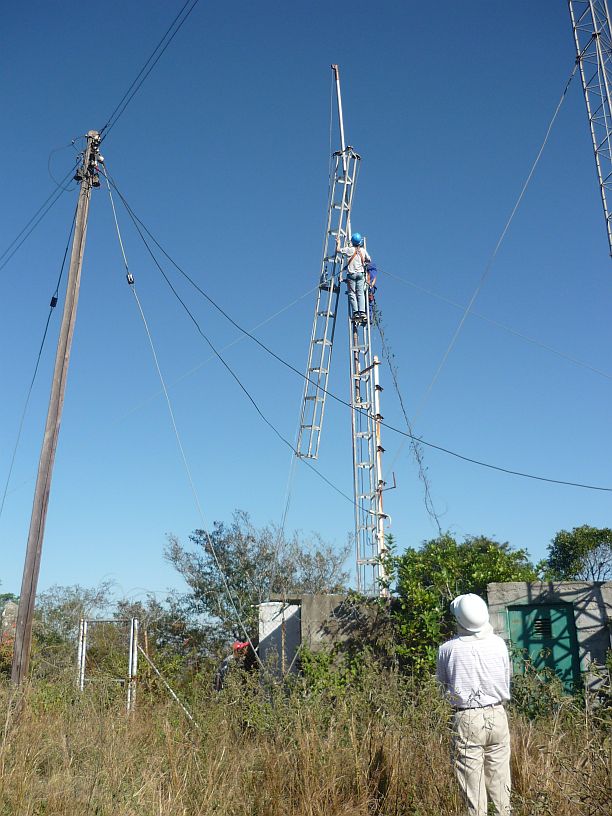
Taking down the tower at Kaphunga.  Note the power line, two transmitter huts and fenced enclosures that had to worked around.  Also not the vine climbing one of the guy wires all the way up to the tower!

Taking down the tower at Kaphunga. Note the power line, two transmitter huts and fenced enclosures that had to worked around. Also note the vine climbing one of the guy wires all the way up to the tower!

Today we dismantled a tower located at the top of a 3,000 foot peak near Kaphunga.  By 11am it was loaded onto the truck for the two hour trip to a 4,550 foot  mountain peak about 8 miles west of Mankayane.  There we were able to get all but a 10 foot section of the tower up at the new site.  We had to stop because the sun was setting.  The drive down the rocky mountain road to Mankayane and on to Manzini in the dark took a little over an hour.

Tomorrow morning we plan to complete the job.  Thanks for your prayers and please continue praying for us as the tower gets topped off tomorrow.
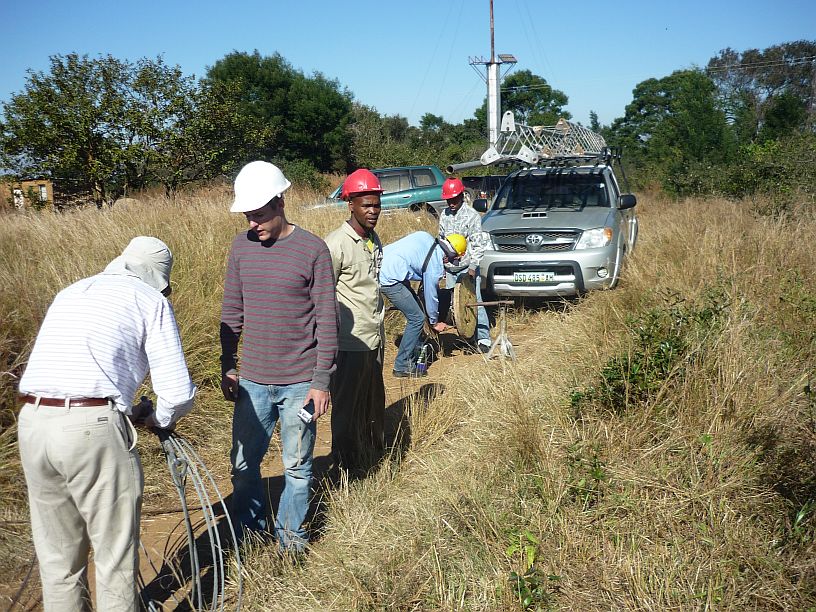
The tower sections and gin pole are already loaded on the truck and the cables are being prepared to leave Kaphunga for the two hour trip to Mankayane.

The tower sections and gin pole are being loaded on the truck and the cables are being prepared to leave Kaphunga for the two hour trip to Mankayane.

The first section is in place and the gin pole has been secured to lift the second section into place at the mountain peak site west of Mankayane.
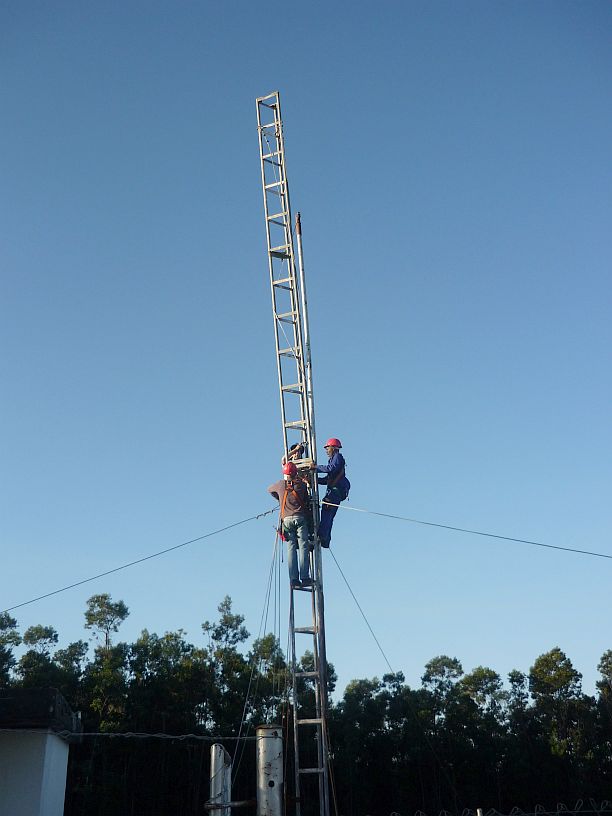
The first section is in place and the gin pole has been secured to lift the second section into place at the mountain peak site west of Mankayane.

The second section being bolted onto the bottom section.

The second section being bolted onto the bottom section.

Tower Work Tomorrow

Tomorrow, 12 June 2013, we plan to take down a FM tower at Kaphunga and put it back up near Mankayane, here in Swaziland.  We will have to complete the work on Friday, if there is not enough time.  Unlike those of you experiencing the 15 hours of daylight in the U.S. as the solistice approaches, it is winter here and we have about 10 hours of daylight.

We would appreciate your prayers for safety and for the success of this project.

For those who are wondering why there have been few updates to our blog recently, the internet connection has been so bad that it is impossible at times to post even text to the blog.  Hopefully this one will work.  Monday night I tried for over an hour, without success, to upload one small photo.  Ended up giving up.  Tuesday night I could not even connect.


2013/06/12 — Wednesday

It was not quite as cold this morning — 53F outside and 61F inside.  The inside temperature is the same as yesterday, but with the outside temperature higher, there is promise that the inside temperature will improve, too.

Today was a short staff meeting.  It was also supposed to be a day off, but it was decided to postpone the Wednesday off until next week.  This is to allow us to prepare for Thursday and Friday’s work.

When we got to the site this morning, we learned that Antenna 6 had arced once during last night’s transmission.  This may be an improvement over the average of two or three times, but not what we wanted.  We will be review this again next week,

Since the transmitters are on the air in the morning until 10am, I try to write up reports during this time.

Thursday and Friday the plans call for dismantling a tower and erecting it in another location.  Most of the day today was spent gathering equipment and reviewing the techniques to accomplish the task.  It has been about 25 years since my last involvement with such a project, but I am pleasantly surprised at how much can be remembered when the need arises.

Many memories came flooding back as we sorted through the rigging equipment.  There were gin poles for four different sizes of towers and I could recall enough about each to convey information about which gin pole was used for which size of tower.   Reviewing the equipment that had been assembled for the coming days’ work, I noticed that the head (top pulley assembly) did not match the gin pole that had been selected and would not have worked.  It took some further searching, but the correct gin pole head was finally found.

This evening we attended the Wednesday service at the church where the Bible study on Revelation continued in chapter 10.


2013/06/11 — Tuesday

It was cold again this morning — 47F outside and 61F inside.  Selema picked Graham, Jonathan and I up to take us to work.  Selema had the heater going in the Toyota RAV4 and it was hot inside.  Comfortable for him, but almost stifling to me!

Steve, Klaus and I met this morning to discuss possible solutions for the arcing seen on Antenna 6 last week.  From our experiences with a similar antenna in the 1970s, I am convinced that this antenna is not rated to handle 100kw, despite what the manufacturer claims.  This antenna, and three more like it, were obtained from a station in South Africa that was being shut down.  TWR Swaziland has already modified it with larger corona rings and radiating elements with larger effective diameters and it still arcs some.  It was decided to add an additional corona ring in a strategic location to see if the problem can be resolved.

The rest of the morning was spent in fabricating two corona rings from some scrap copper tubing.  Just before lunch, the rigging equipment was collected in preparation for lowering the antenna,

After lunch, Graham, Selma, Jeremiah and I lowered one side of the antenna.  To our pleasant surprise, we discovered it was possible to install the new corona rings on both ends of the elements without having to lower the other side.  The process took about 30 minutes from the time the antenna was lowered until it was raised again.  It was done in record time — a record that will be hard to beat!  The antenna was tested on the problem frequency with no arcs for about an hour before the transmitter was needed for the evening broadcasts.

Virginia tutored Berniece again this afternoon.  When reviewing the alphabet, Virginia commented that Americans say ‘zee’ for the last letter of the alphabet, but most other English speaking countries say ‘zed’, which is what she should be learning.  Somewhat later in the lesson, Berniece was going through the alphabet and when she got to the last letter she got a twinkle in her eye and said “ZEE”!

Tonight we turned on an electric heater in our bedroom for a few minutes with the sheets opened on the bed.  That helped a lot to overcome the shock of crawling into cold sheets.


2013/06/10 — Monday

It was cold this morning — 47F outside and 64F inside.  Today was the first time that have worn my jacket since we have been here.  The Swazis were all bundled up and thought they were ‘freezing’!

I wrote up an initial report about attempts to tune up TX3 on higher frequencies.  After the morning broadcasts ended, this tuning was continued.  At some point while tuning on 15475 kHz, it was discovered that the auto tuning was not tuning the PA plate current into the dip, but off to one side.  This caused a decrease in PA plate efficiency of about 10%, which is enough to cause the cooling water to boil excessively when operating at 100kw.

When we set this transmitter up in Elkhart, we adjusted the lengths of coax cables that provide signals to the phase error detector so that tuning into the dip takes place automatically.  I am puzzled as to what has changed to cause these different results.  There had been a 4″ length of coax added to the PA plate signal, so I removed this and saw a slight improvement in tuning.  It appears the PA plate signal coax needs to be shorter, but it looks like it will not reach, if it is shortened any more.  Alternatively, it should be possible to lengthen the other two signal inputs instead, but we need to find a method of doing this without trial-and-error use of expensive connectors and cutting up expensive cable.  Also, there may be something else in this circuit that may have changed, which we should be looking at first.

We added two 18″ cables to the other two inputs, since this is all we had on hand, but the transmitter decided it would not come up at all.   High voltage did not even come on!  We were within minutes of needing this transmitter on the air, so aborted the test, took out the two 18″ cables, and retuned to the needed evening frequency.  Thankfully the transmitter came up on this lower frequency, leaving us to sort out the other problem on another day.

Virginia has been asked to help tutor Graham’s daughter Berniece to get her make an easier transition from the Swaziland to British school system.  This afternoon was her first session.

Was it ever cold getting into bed this evening!  An electric blanket would sure come in handy.