2012/05/01 Wednesday

It’s been one week since we left home.  Today is a holiday here and I have the day off after Wednesday morning staff meeting.  We did some shopping at the Pick N Pay supermarket while we were in town, but nearly all other stores are closed.

We are finding communication fairly time consuming.  The internet connection to TWR is very slow.  Just to check our email, it takes a couple minutes for the login page to load.  After putting in our login information, it takes several minutes (this morning it took 10 minutes) to connect to the email site, then another two minutes to show the email that had come in.  Our co-workers in the U.S. think the DSL that we use at home is slow — it works like lightning compared to this!

Connecting to Facebook usually takes a long time, so we use it a lot less than back home.  It looks like email will be our primary method of communication.

We can use Skype and it seems to connect more quickly than doing email.   If you want to contact us using your Skype connection, send us an email with your Skype address and we can provide our Skype information.  The ‘call’ is free if you have a Skype account.  We are typically on Skype from noon to 3pm Indiana time (CDT).

If you do not have a Skype account and would like for us to call you, send an email  with the phone number and  we can call your phone directly for less than 2 cents per minute.   If you have a time that you would prefer a call, let us know.  Just remember that we try to sleep from about 3pm t0 midnight Indiana time (CDT).

My time here is mostly spent at the transmitter site — two days so far.  Initially I have been catching up on changes that have taken place since we were here a little over four years ago and trying to determine the current status of the transmitters.  So far, I found out that the drive control on one of the three transmitters was performing quite differently than the other two.  Yesterday, we determined that it had an old version of EPROMS on the CPU card.  These were changed out for the newer version.  Both spare CPU cards now have the old version.
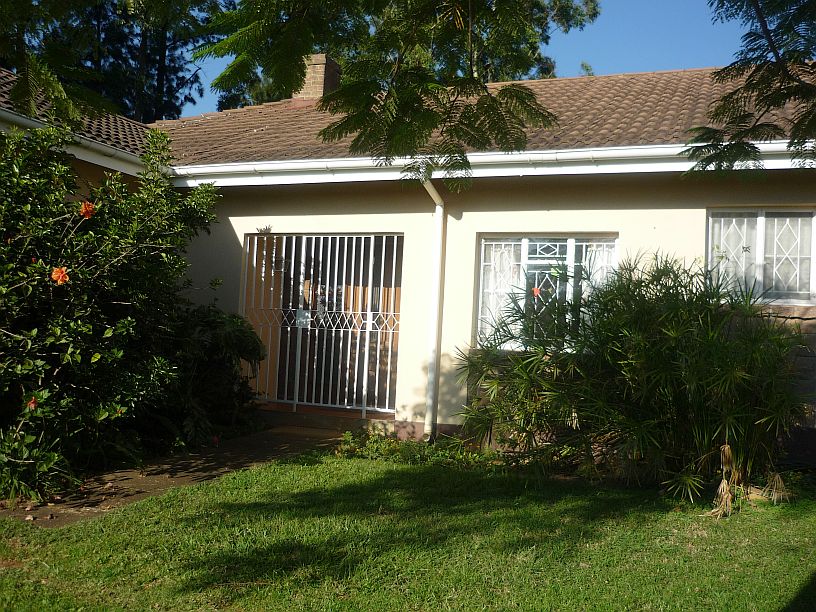
The front door with its security gate

The front door with its security gate

We are beginning to get into the routine of things here.  Before going to bed, there is a ‘ritual’ of locking security gates  (there are four — two to the outside, one to the attached garage and one in the hallway between the main house and bedrooms) and certain doors.  Then after we are securely in our bedroom, we activate the alarm, if it has not already activated itself at 10pm.  We can move between the bedrooms and bathrooms without setting off the alarms.  First thing in the morning, we deactivate the alarm and switch on the hot water heater for about 30 minutes so we can have warm showers.

When a co-worker and his family visited two nights ago we discovered that the alarm also activates some outside motion sensors.  Our visitors had to explain to us what the intermittent squawking sound was.  We assume that it automatically activates around dusk.
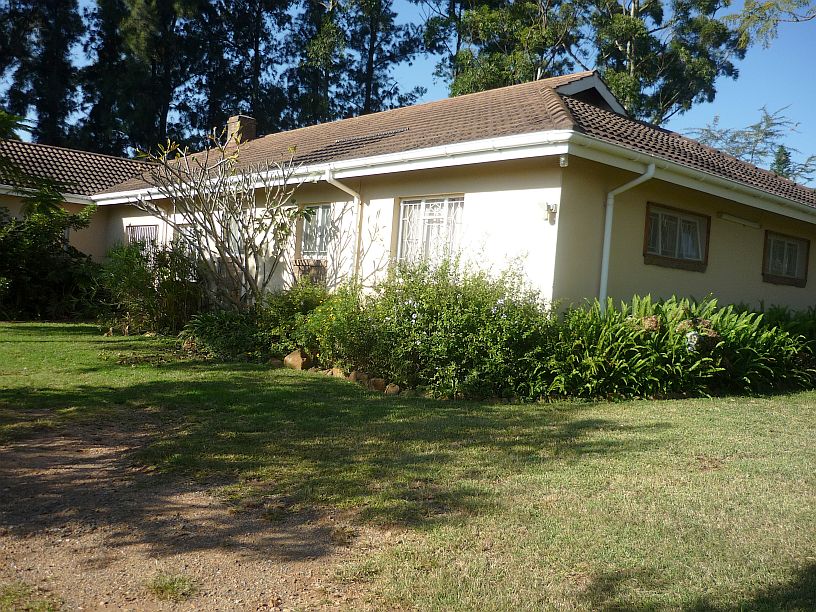
The front of our home away in Swaziland.  If you look closely you can see the security bars on the windows.  The dark rectangular shape on the roof is an experimental solar heater for the geyser (hot water heater).

The front of our ‘home away from home’ in Swaziland. If you look closely you can see the security bars on the windows. The dark rectangular shape on the roof is an experimental solar heater for the geyser (hot water heater) made from black plastic pipe.

When we leave the house there is a similar routine of locking doors and gates.  We have a remote device that we take with us, which has four buttons on it.  One button is to open and close the garage door, the second button sets the alarm (there are bright LED lights in two of the house windows to indicate the alarm status), the third button opens the fence gate to drive out (it closes automatically once the car passes through) and one is a ‘panic’ button — pushing that one results in alerting TWR staff and a rapid response team from the security company.  Of course the car has its own start-up sequence using its own remote button, plus hidden switch inside, which Virginia mentioned in her previous post.  There is a similar reverse routine to return to the house.

Should the alarm sound while we are gone, it will call our cell phone as well as the cell phones of two other staff members.  I think the security company is also alerted.

Many of the gates for vehicles are automatic and controlled with remote buttons carried in the vehicles.  In addition, many of the gates can be opened by a call to a cell phone incorporated within that gate’s controls.  The gate’s cell phone determines whether a valid number is calling before opening the gate.  Since the gate phone never actually ‘answers’, there is no fee charged to either phone.  If someone arrives at the gate off the main road which is about five miles from the site, that person can call the site, or other person with a valid phone, who can then open the gate by calling that gate’s cell phone number.  If I should forget my remote gate opener, I can pull out my cell phone and call the gate’s cell phone number myself and not incur a fee to do so.  If I forget both the remote and cell phone, it would be a long walk to the site or a long drive back home!

Arrived!

Just a quick note to say that we arrived on time in Johannesburg last night and stayed with the Burnetts.  Will be meeting at the Africa Regional Office this morning, then driving ourselves to Swaziland this afternoon, if we don’t crash from jetlag first!  Please pray as we are being thrown in at the start with driving on the left side of the road.

18 Nov 2010 Thursday

This morning the two cruise ships, Sea Princess and Noordam, both arrived just before 8 am.

After devotions, I reprogrammed the thermostat that will be used for the 6 ton unit at the site, then documented these new settings. Also sent an email to Joe Barker with attachments of both the installation and operation guides for this thermostat.

I then headed to the transmitter site via town, this being the shortest and fastest way. Tourists were all over the place. Guess that’s what happens when almost 5,000 people stop in a town about 5 blocks long!

Flood waters around Tower 3

At the site, I noticed the water on the property was a couple of inches higher from the rains over the past few days. It is the highest that it has been since we got here. For additional photos visit TWR Bonaire on Facebook or, if much later than when this was written, try clicking here.

With the programmable thermostat all prepared for installation, this project was quickly completed. Had to remove the old thermostat, drill and tap new holes in the box cover to which it is attached, and reconnect the wires. The air conditioner was then switched on. Not sure that it is functioning up to par. Cool air is coming out of the vents, but it seems to take an hour for the temperature to drop a couple of degrees.

When I headed out the door to pick up Virginia for lunch, the rain was pouring down with a blustery south wind. Driving through town, there were lots of drenched tourists making their way back to the ships. Only noticed one that seemed to be enjoying the situation and that person was wearing a swimsuit and flip-flops.

While picking Virginia up for lunch, I also gathered a few small parts that were needed for the site. [I suspect, most of these items are also at the site, but I already knew their location in the studio’s tech lab.] Originally, Virgina was planning to pick up lunch from the vendor who prepares Bonairean food for the ships, but, because of the heavy rain, we ordered sweet-and-sour chicken from China Nobo instead.

Brrr — it was cold as we headed to the site. Only 80 degrees and still raining hard. I turned the defroster on to clear the condensation off the inside of the windows. Since there is no heater on the car, only an air conditioner, Virginia had a towel wrapped over her to keep warm. One doesn’t think they would feel cold at 80 degrees. The posted weather says partly cloudy, but the clouds are staying put for awhile.

The water at the site was about an inch deeper than this morning. Shortly after getting there, Gaby Felix (Amado’s younger brother) came from Cargil, the salt company, to inform us that he was going to start the pump to lower the water in the perimeter ditch around their salt pan bordering our property. Hopefully, this should help lower the water level on TWR property.

My first afternoon project was to connect the front door switch and remove the motion sensor for that area. Because of the preparation yesterday, this only took a few minutes.

I then moved the motion sensor into a more strategic location. This required running two pairs of wires — one pair for power and one pair for the sensor switch. When asked for a masonry drill for mounting the sensor, Benny said to use a regular drill. I was amazed that it was still pretty sharp after drilling two holes through plaster into block. After connecting power to the sensor and wiring the sensor switch in series with the other sensors, it was ready to test. It functioned amazingly well, even triggering with motion outside a couple of door openings into that area. I don’t think it could have been installed in any better place.

Next, I began to search out a way to control the tower lights remotely. The tower lights are feed from a circuit breaker panel, which goes to an control box with a contactor inside. The contactor is closed using a photo cell mounted outside the building, or by a manual switch on the side of the control box to override the photo cell. From the contactor, the power goes to a second circuit breaker box that has four separate breakers — one for each tower.

I noticed that there were two small control cables coming into this area. One was traced to extra contacts on the contactor. This provides a switched signal to the Gentner for indicating that the lights are on. The second control cable goes to a circuit, with three current transformers attached, that provides an metering signal to the Gentner of the amperes currently used by the lights. This measurement can be used to determine if there a light bulbs that are no longer functioning.

I need to ask if the switched contact is really necessary, since the metering signal will be zero, if the lights are not on. If not needed, this pair of wires can be used to provide for the remote override of the photocell. If needed, I could run another cable, but this would take extra time.

I mounted a relay socket in the second breaker panel, next to the current sensing circuit, instead of in the control box, which lacks room for it. Tomorrow, I will try to wire it up.

With the transmitter successfully starting up for the evening, we decided to head for home. It was still raining some and the wind was now out of the north. The water was another inch or so higher, as we drove through it on the road out. Hopefully the Cargill pump will begin to make a difference soon.

Nearing town, we noticed that the Noordam ship was just leaving for Curacao. We also noticed the big engines were puffing smoke on the Sea Princes. Virginia decided soup would be good for supper on such a ‘cold’ evening, so we stopped at Warehouse Bonaire Supermarket. In the few minutes that it took to purchase the soup and head for home, the Sea Princess was a half mile or so from shore, also headed for Curacao.

Tomorrow will be a part day for working. The staff is planning a farewell breakfast first thing, then the Pelikaan School is having an open house in the afternoon. All TWR staff has been invited to that. Pelikaan School purchased TWR’s former activity building across the street from the studio/office. It has continued to grow, and they also used part of the office wing for school while expanding their building. The building is now completed, so they are having an open house.

Click here on Pelikaan School and see if you can find Rich West in the first photo.

48 hours from now, we should be flying between Atlanta and Chicago on our way home. Right now it is supposedly 79F here, but it feels cooler than that.

17 Nov 2010 Wednesday

Noticed today that all the piers are nearly empty of ships. Freewinds had left after being here for 3 days. Dona Luisa and Don Andreas, the ships that transport most of the goods between Bonaire and Curacao, are also gone. This is probably in preparation for the two cruise ships, Noordam and Sea Princess, that are due in tomorrow.

Before devotions this morning, I had a few minutes and looked into why Joe had stated that the power plugs on the large UPSs we not interchangeable. Discovered that the 60 amp receptacle of UPS(A) and it mating plug are mounted upside down compared to the other three places. The ‘hot’ wire was connected to the right blade in all cases, but, if the plug is upside down, it will find a ‘cold’ slot when plugged into the other receptacles and vice versa. When I emailed Joe to have my observation on record, he replied, “Sounds like a task we can put on your list for your next trip to Bonaire :).”

After devotions, with the encouragement of Rich West, I checked into the possibility of using a programmable thermostat control, from an unused room at the office complex, to ‘turn-off’ the site 6 ton air/co when no one is there. I wanted to make sure it was compatible before ‘borrowing’ it. After reviewing its installation manual on the internet, it looked like it would work.

After rounding up some tools, connectors and the thermostat, I headed to the site.

My first site project was to test the pager feature of the security system. After ‘erasing’ the ‘primary’ phone numbers, the ‘pager’ number was entered to ‘call’ my cell phone. After disconnecting the ‘sirens’, an alarm was purposely triggered and my cell phone was called — almost 4 minutes later! Another test was done and the time was about 8 minutes. It doesn’t look like this will work for use as the ‘first’ alert. I suspect the system is ‘attempting’ to contact the ‘primary’ phone numbers (even though they are erased) 16 times before beginning to contact the ‘pager’.

While installing a backup battery for the security system, I took a little too long, because the terminals of the old battery were different size spade connectors than the ‘new’ one. The system ‘beeped’ and displayed an error message of ‘battery voltage low’. In this case, the ‘pager’ number was called immediately!

I checked the ‘sensitivity’ settings of all the motion detectors and discovered that the two in the big rooms were set to least sensitivity. I changed them all to highest sensitivity and they seemed to work much better. I assume that when the manual states to set for least sensitivity for harsh environments, it is not referring to temperature range. If there are any false alarms, as a result of these changes, my assumptions will have been proven wrong!

Next, my focus was on the thermostat for the 6 ton site office air/co. I quickly discovered that there are only three wires with 24 volt AC control voltage. The thermostat must handle 0.74 amp to energize the air/co. The programmable thermostat will work, but, since only one side of the 24 volt supply comes to the thermostat, the batteries will need to be replaced yearly. [As an after thought — since this air/co will be off much more than it is on, would it be possible to provide power to the thermostat from the fan or compressor control line through a resistor to the C (common) terminal? The batteries would only need to supply power when the unit is actually running. Will have to think about this some more, but won’t implement it this week. Of course and easy to say, the best solution is to run a common (C) wire from the air/co to the thermostat.]

To complete the thermostat installation, new batteries are needed, holes drilled and tapped for mounting it, and a revised program entered. Decided to do some of this tomorrow at the office/studio where the user manual is stored on a computer. Hopefully there are also some new batteries there. Joe would like the thermostat to automatically set itself to 85F at 9:00 am (after getting tools to work outside), 2:00 pm (after lunch), 4:30 pm (after work) and 6:30 pm (after working late). The temperature can be manually lowered any time, but will automatically revert to 85F should the building become unoccupied. [This sounds kind of strange when most Americans think of setting the thermostat lower to save heating costs.]

I now began to install the wiring to install a door switch, instead of a motion sensor for monitoring the entry door. The motion detector will be moved to another location that should be protected. I drilled and tapped the metal door frame and door to mount the magnetic switch and magnet. The wiring was run above the ceiling in preparation for connecting it to the line currently going to the motion sensor. It was getting too close to quitting time to make the final changeover. Planning to do this tomorrow.

Before leaving the site, the primary phone numbers were reprogrammed into the security system. The ‘sirens’ were reconnected, then the system was ‘armed’.

This evening we went for a swim to ‘cool off’. The current temperature is 80F and ‘feels’ amazingly good!

Since we had our dinner at noon (chicken and rice), we cleaned up the peanut butter and jam jars to make sandwiches this evening. It was nice that they emptied at the same time. I will have to go without my PBJ sandwiches until we get home :-(! We also had bacobas (small sweet bananas).

No pictures in this entry, but should get to bed earlier tonight as a result.

16 Nov 2010 Tuesday

As Virginia and I headed to the office this morning, we noticed that the Dona Luisa was back at the dock after delivering containers to Curacao yesterday.

Today I again spent all day at the office/studio. I was studying up on a way to use the pager output on the security system to contact a cell phone and leave a text message. It appears the differences between the two protocols are too great to allow that to even happen. I also found out, from various user’s experiences documented on the internet, that the pager output may not even work to call about an alarm. We will make an attempt to test this out tomorrow. We had hoped to use this to avoid the ‘comm failure’ error that always occurs with the other method of ‘phoning’ an alarm.

On the way home for lunch, we went by Warehouse Bonaire Supermarket to get some milk, cereal and a couple more things to just tide us through til Saturday. They did not have milk (except for a big can of powdered milk) and had only the more expensive cereals. After lunch, we then went by Cultimara Supermarket, which tends to have slightly higher prices, to get what we needed.

A shipment of muffin fans had arrived this morning and Joe Barker asked me to install one in the amplifier assembly for the Intelsat satellite dish. This fan had a problem getting water into it and failing because of the high dish angle required closer to the equator. At higher latitudes in the U.S. the dish is tilted down more and the water runs off, but here it runs into the fan shroud.

When it failed they did not have the right size fan, so two smaller ones were installed instead. An extra shroud was built to help keep out water.

I had to remove both shrouds, remove the two fans, and install and connect power to the new fan. Fortunately the fan voltage is only 12 volts, so all this could be done with power on. When putting the shrouds back on, I added additional weather stripping on the original shroud and some silicon seal on the extra shroud to help keep out most rain water.

Joe asked me to look into the cost of an internet module for the security system and whether it would be useful. After quite a bit of research, I discovered this module is mainly a way to use the internet to contact the alarm monitoring center if phone lines are not available. It would also allow the user to program the system over the internet, but not allow the internet to directly report an alarm to the user. The cost for the additional equipment would approach $1,000, which is 4 or 5 times the cost of the basic system itself! Why am I getting the impression that this system is designed to give job security to the installers and monitoring services of these systems?!

We got home a little after 6pm and the sun was almost setting, so we decided to forego our evening swim. We did have a special treat later this evening — homemade Coca-Cola floats.