10 Nov 2010 Wednesday

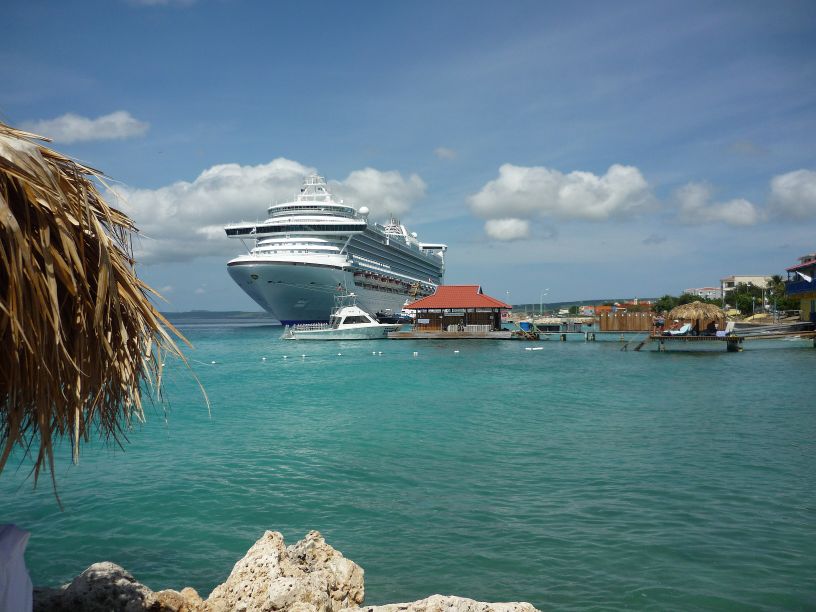
Caribbean Princess as seen from 'our' swimming beach at Divi Flamingo Resort pier

The Caribbean Princess was at the pier by 7am this morning. [The photo at left was taken from the Divi Flamingo Resort pier where we try to swim each evening.] There are supposed to be two cruise ships here on Friday and two more on Thursday of next week.

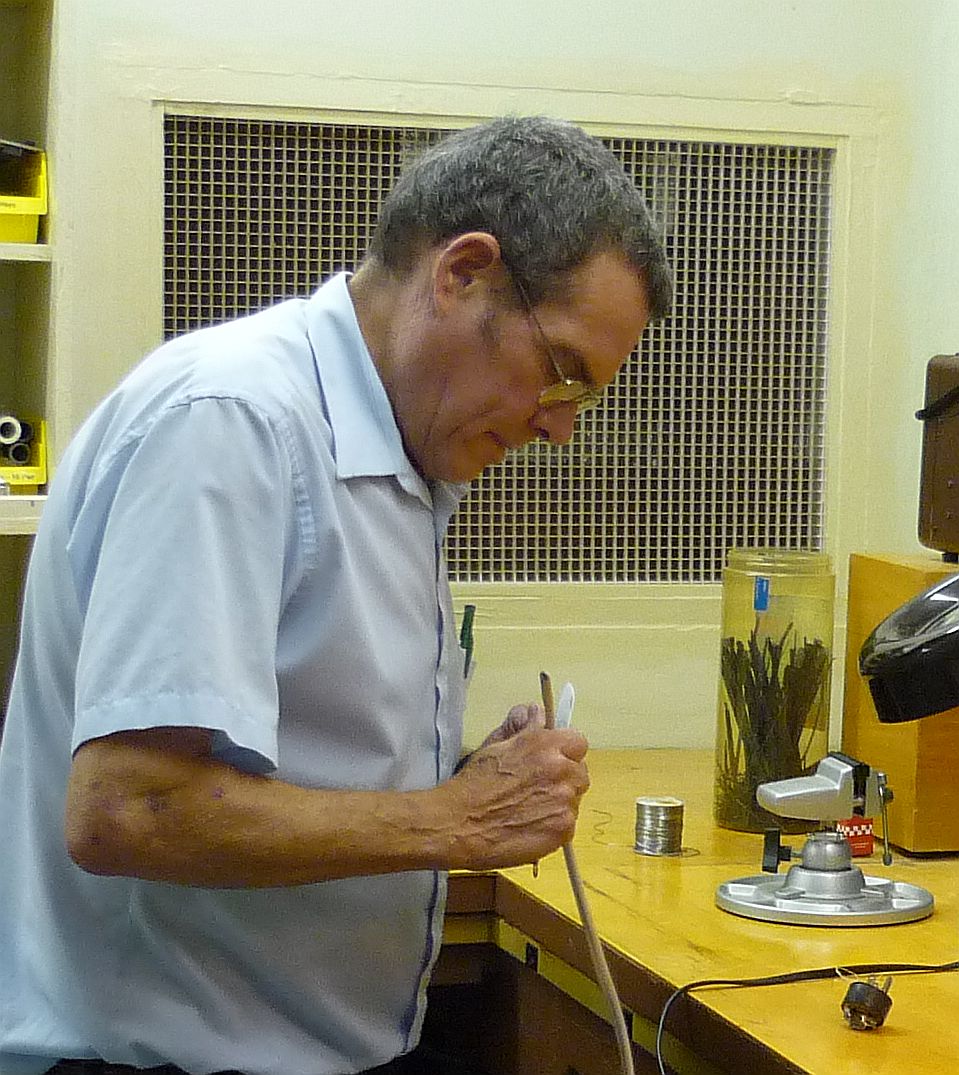
This morning, we had a 30 amp twist lock connector that had a broken screw on one terminal. I like a challenge and decided to see if it could be repaired. It was a ‘challenge’, but the repair was accomplished and I was able to assemble an adapter cable to connect the UPS at the transmitter site. This way it would not be necessary to remove a 30 amp connector from the UPS and have an extended time of outage.

After our noon meal of Japanese chicken and rice, Virginia and I headed to the site. We noticed at least three things while on the way.
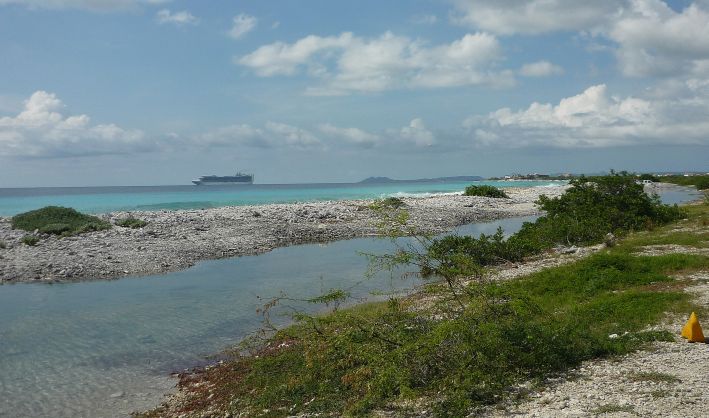
Caribbean Princess leaving shortly after noon.

First, the Caribbean Princes was already leaving. The cruise ships, we have seen, have always left at sunset.

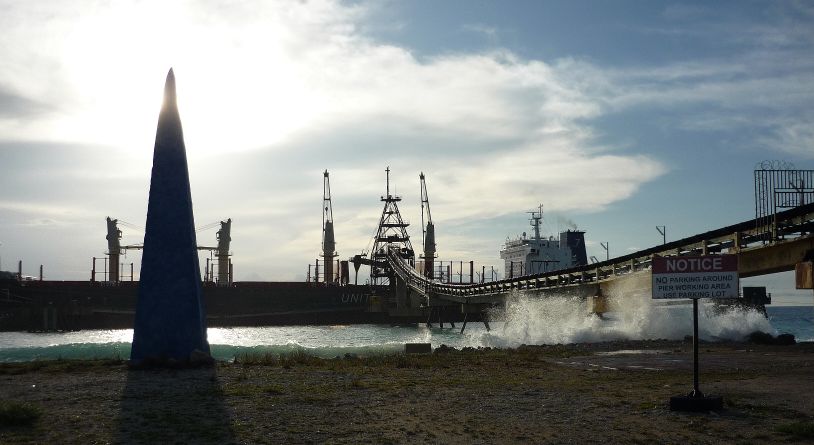
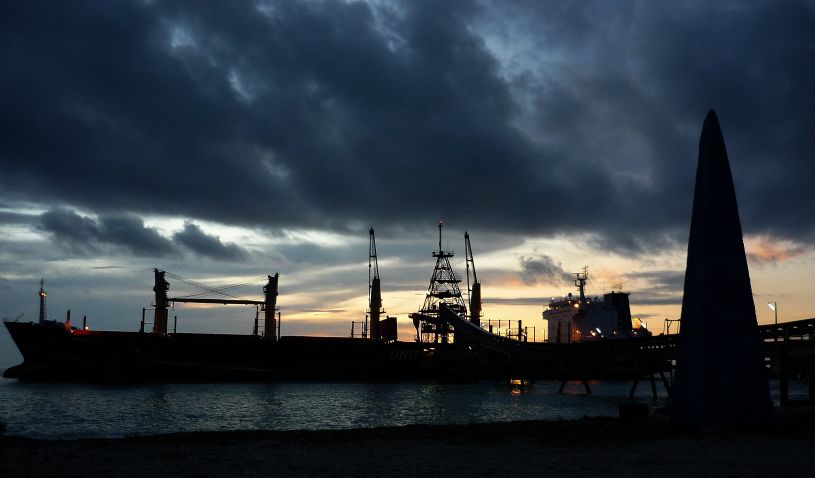
Second, we noticed there was a ship at Salt Pier. It was the United Tenorio that was here last week! We asked the pier guard where it took the salt. He replied ‘America’. My response that it made a quick trip made him chuckle and say that
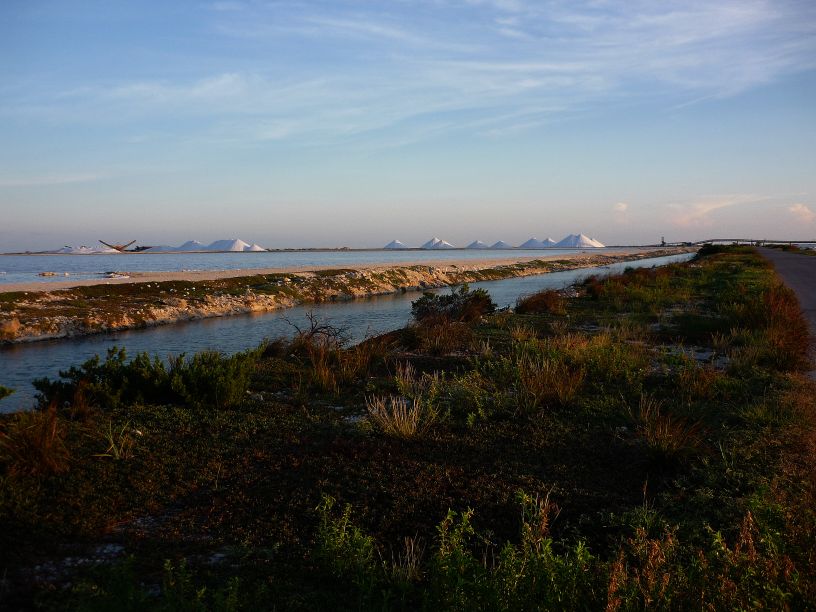
After loading almost two ships, there are noticeably fewer 'mountains'of salt

the ship had gone out to sea before fully loading due to the rough waves of the past week. It had just now come back to complete loading. I thought I had seen a similar ship (to the United Tenorio) a long distance from shore over the past several days and opined whether it might be another salt ship arriving.

Third, we observed a truck and trailer capable of loading a 20 foot container onto itself at the transmitter site. He was moving the dozen or so containers that WEB, the electric company, has there, by loading them one-at-time, then taking them out to the main road and transferring them onto a truck with a container trailer. As fast as he could load the containers another truck would be there to take it. All the containers were moved in a period of about four hours.
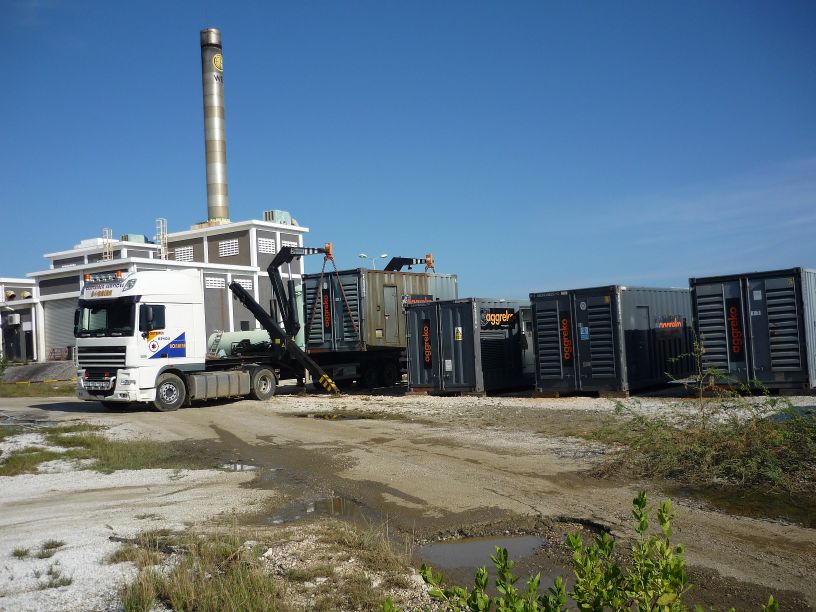
The site property looks almost bare with these gone.

Most of these containers were Aggreko generator sets that WEB had rented to meet the increased power demand for Bonaire before they built their new power plant just south of BOPEC.

At the site, I swapped out the old UPS and installed the new UPS. Everything went smoothly until I started to push the UPS under the lab workbench. The stiff electric cable caused the standard 110 volt plug to ‘pop’ out of its receptacle! [There is a reason a lot of UPS’s use twist lock plugs for the output.] Since the power was already down, I took the extra time needed to ‘safety wired’ the plug into its socket before turning the power back on.

Now it was necessary to check all the transmitter’s automation equipment to see that everything was working. This also included the dial-in remote control feature which, though not working at first, seemed to recover after a few minutes.

It was nearing time for ‘sign on’, so we delayed our departure to make sure the transmitter came on with no ‘glitches’. While waiting, I investigated what was needed to do a couple other projects on my ‘to-do’ list. One is the capability of overriding the photo cell to remotely turn on the tower lights. The other is to shut off the transmitter’s office area air conditioner by a time command and/or remotely. I was able to glean some useful information for both. Hope to have time to implement both.
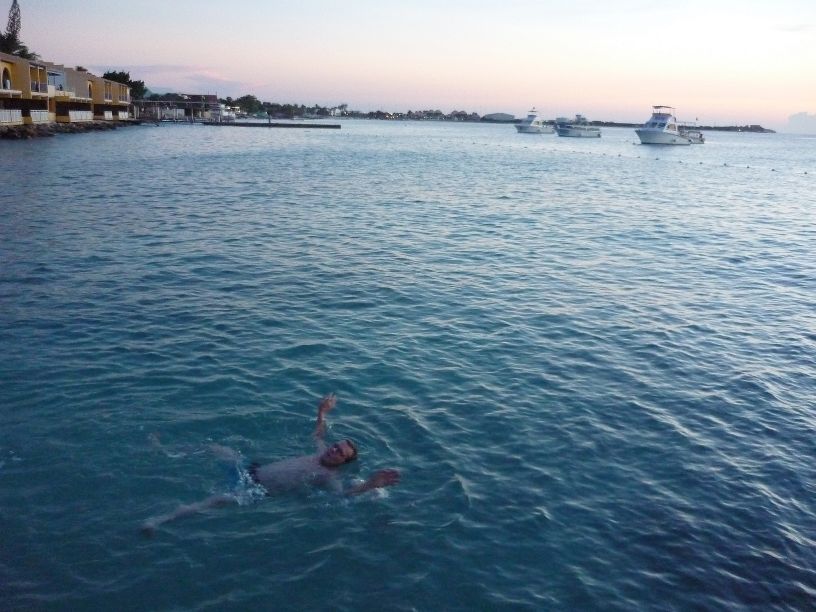
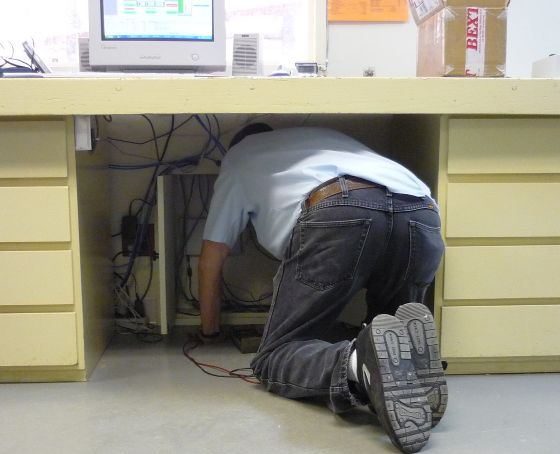
No, I'm not about to drown! -- just perfecting my elementary backstroke, which is best for use while wearing my glasses to observe what is going on around me.

The transmitter came on fine, so we headed home for a swim. The waves were still a little high, but not dangerously so. It is amazing how refreshing the swim was after not being able for several days.
9 Nov 2010 Tuesday

After about a week of no problem with the transmitter, the Gentner called this morning at 7:45am. I quickly fired up the laptop and checked to see what was wrong. The Gentner showed that there was no power at the site. This was verified when I checked the camera aimed at the transmitter control panel and saw NO lights. I then looked at the audio rack camera and the only lights on were those supplied by the uninterruptible power supply (UPS). Since there is no standby engine, not much can be done except wait for the power came back. Sign-off is normally at 8:30am.

After devotions this morning, my priorities have been changed. Joe informed me that the three new APC SMT-3000 UPSs had arrived and were ready to install. One was for the transmitter site. When it is installed, the large one temporarily moved there will be returned to the office/studio. The second UPS would go into the Intelsat room and the third would be a ‘standby’ and located in the automation room. It will be running with a very light load to keep the battery charged and ready for use in case of a failure of one of the other UPSs.

These new UPSs have a power supply input cord with a 3 prong 110VAC 30 amp twist lock plug. For the ‘standby UPS’, I had to make up a cord with a standard 110VAC ground plug on one end with a socket to mate to the twist lock plug on the other end. This was not a difficult project, but finding the parts took a bit of the time. Benny was called to bring a standard plug from the site. Fortunately he was already out there unloading the new site UPS.

When Benny delivered the plug, I was able to install the ‘standby UPS’. It was connected to one of the servers in the automation. This server has two power supplies, and either one can provide power should the other fail. This standby UPS was connected to one of these two power supplies.

These UPSs have a lot of features that can be monitored and configured using a computer. The manual is on a CD provided with the UPS, so we downloaded it onto a computer for easier review.

For noon meal, Virginia and I decided to order Nasi Goreng carry-out from China Nobo Restaurant. It was delicious and there was enough for two meals for both of us. After lunch, we went to the site for the afternoon.

Preparing cable to attach to standard power plug to connect to the output of the new UPS.

I removed the UPS from its packing box and began to assess what was needed to connect it. Initially I was thinking of using the cord from the large UPS (that actually belongs in town), but the diameter of its cord was much too large to allow attaching a standard 3 prong plug for connecting it to the output of the new UPS. I began searching around the site for a suitable cord — large enough to carry the required current, but small enough to fit the standard plug. I finally located some ‘Romex’ type cable and connected the standard plug.

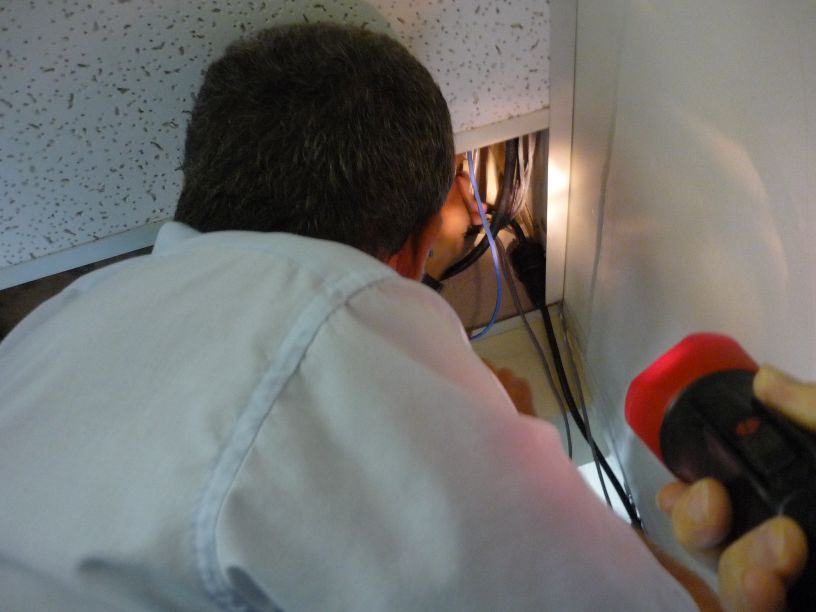
Inside that small opening there is a punch block with 66+ wires attached, just a few inches higher than the camera can 'see'. Virginia took the photo and held the flashlight.

I was then going to shut off the large UPS to retrieve the ‘receptacle’ socket from its output cable to attach to the cable I had just made. Here is where the next challenge came. How do you shut off a UPS? If you pull the power plug, the output is now powered by the battery backup! The large UPS requires a key to shut it off and there was no key. After calling Joe a couple of times, I finally located a key in a well hidden place. The time was now after 4 pm, so the decision was made to wait until tomorrow to make the transfer, rather than risk ‘on-air’ time.

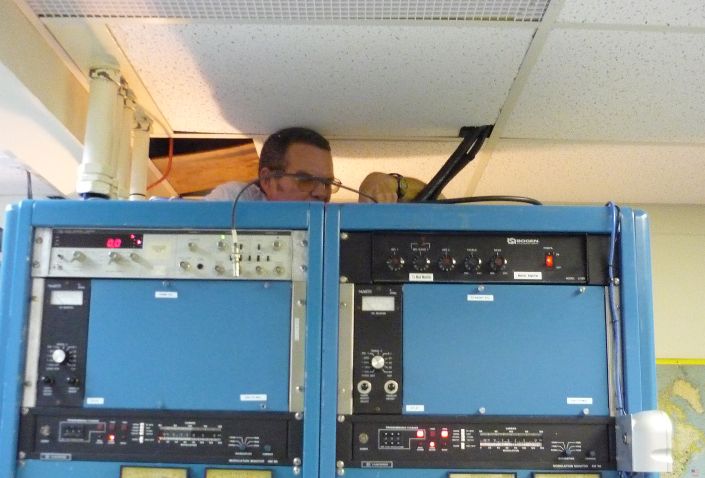
There's not much room between the top of the rack and the ceiling and there is only about 18 inches between the back of the rack and the wall.

Now back to where I left off yesterday — tracing the fire alarm wires. On the punch block located in the ceiling behind the audio rack, I found two wires of a 2 pair cable attached to the fire alarm terminals. The wires were traced to a terminal block on top of the audio rack with feed through terminals going inside the rack. Two wires went inside a plastic duct and by removing the cover the wires were easy to trace. They went down, then looped back up to — THEY ARE NOT CONNECTED!! Joe and I will need to discuss what to do from here. At least wires are already there, if we want to connect them for extra monitoring by the Gentner.

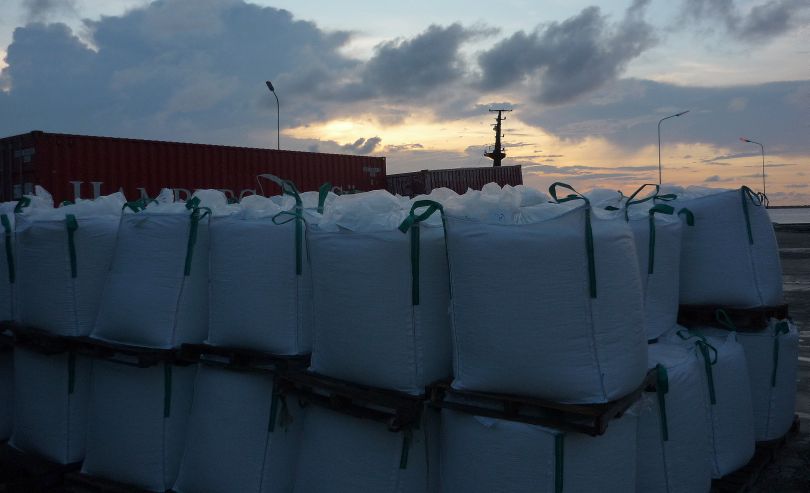
Bags of salt on the pier -- here is another way to ship it, instead of in bulk in the hold of a ship. 'Bulk' is a reality term in this case -- purchasing 5 pounds of salt would be buying it in 'bulk' to me.

Now my curiosity motivated me to see where the other ‘fire alarm’ wire went. I found that it was attached to the bottom two terminals of all eight punch blocks in the phone panel and to the bottom two terminals of all three punch blocks in the transmitter hall. There was a two wire cable attached to the punch block located in the ceiling above the audio rack, but this cable did not go to the audio rack. By lifting numerous ceiling panels, I discovered it was attached to a transformer on a speaker (with grille) mounted in the ceiling. It dawned on me that this was the paging system for the whole building, and one of the punch block covers had written on it something about ’70 volt audio line’. I’m not sure that there is even a functional paging system any more. All the phones I have found are directly connected to an outside line and I don’t recall seeing a PA system anywhere.

A friend land crab crossed our path.

Or is he friendly?!

This evening, we went for a walk along the shore into town. It seems the waves are lessening, so hopefully we can swim tomorrow evening.

For supper we had the left over nasi goreng from lunch.

8 Nov 2010 Monday

Today, I again updated the ‘Security System Notes’. This draft is nearing completion, but I know of a couple more things that need to be added. One of these I researched this morning for checking out this afternoon at the site.

There was a ‘Comm Failure’ error on the security system keypad left from Friday when the men wanted to hear what ‘siren’ sounded like. Because the alarm was set off, it attempted to contact my cell phone eight times and a secondary phone eight times. These repetitive calls confirm to us that there is an alarm. Because the system is looking for a security company computer and did not get the response it expected, it recorded the above error. How to clear that error was my initial quest of the afternoon. I already knew the user code or the master code would not, therefore it was speculated that the installer code might do the trick. NOT so!! The only way found to clear it was by powering down the system, which requires resetting the clock. If necessary, we can live with this, but will investigate the possibility of also using the pager alert function of the system.

With the intent of providing additional monitoring by the Gentner controller, I began tracing wires from the old fire alarm system. I found two outputs. One goes to WEB, the electric company sharing the south end of our property, and turns on a fire alarm on their supervisory panel. The other goes somewhere in the building.

I found a label on a cable going out of the phone line distribution box that said fire alarm to Gentner, so decided to trace from there. After lifting ceiling panels, and following ducts through four rooms, I found that it ‘dead ended’ in the room that once housed the BBC 500kw transmitter. At one time, the Gentner must have been located there, but was later moved to its current location near the Nautel 100 kw transmitter.

I now began to more intently trace the second output from the old fire alarm system. Fortunately, among the hundreds of phone line wires, the wire colors for this pair remained the same. After passing through a couple of telephone punch blocks, the wires were traced to a punch block labeled ‘TX Hall’. To this was terminated a 33 pair cable with beige PVC jacket.

FOUND! The cable comes here

Now the challenge was to find the route the cable took to the transmitter hall, and where it ended. Again, lifting ceiling panels and tracing ducting (again in four rooms), I discovered it went into a conduit down the south wall of the transmitter room. Under a built-in desk were some doors concealing two more punch blocks. The PVC jacketed cable being traced terminated on one of the punch blocks. The fire alarm pair was jumper to the second punch block to which another cable was terminated, but this one had a braided shield over the outside.

I was fairly confident that this shielded cable terminated at a punch block in the ceiling just behind the audio rack for the transmitter. By now it was 5:30pm and time to head home. This search will continue tomorrow.

This evening we walked again, instead of swimming. The wind is out of the west, a very rare occurrence. It is almost always out of the east. This west wind results in large waves at our usual swimming beach and all along the west coast.

7 Nov 2010 Sunday

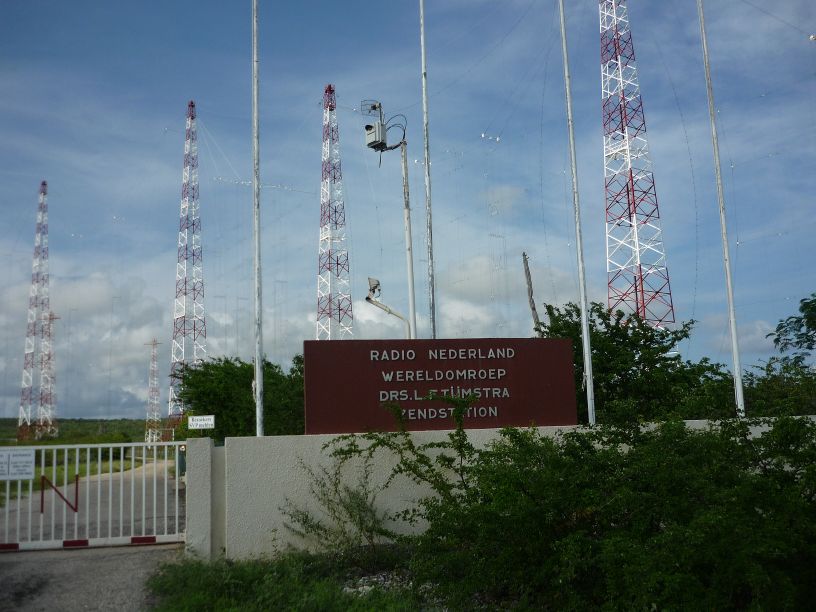
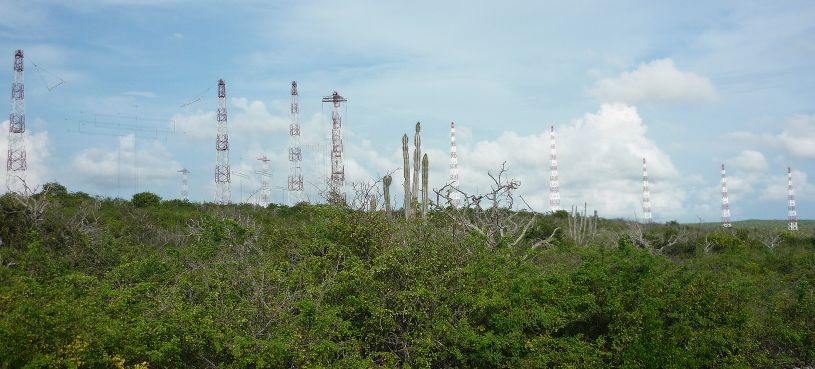
The entrance to the shortwave relay station of Radio Netherland, also known as Dutch World Radio.

This morning’s message by Pastor Baran at International Bible Church was from Revelation 2 on the church at Thyatira. In Sunday school we viewed and discussed a video bible study by Dick Woodward on the book of Romans.

For dinner we had left-over Nasi chicken, again with mango chutney because we liked it so much.

Radio Netherland's extensive shortwave antenna field

This afternoon we decided to take a drive up the west coast of Bonaire. Our drive took us past the Dutch World Radio (Radio Nederland) shortwave broadcasting station. TWR relayed some of Radio Netherlands programs from 1964 until they built this facility about 1974.

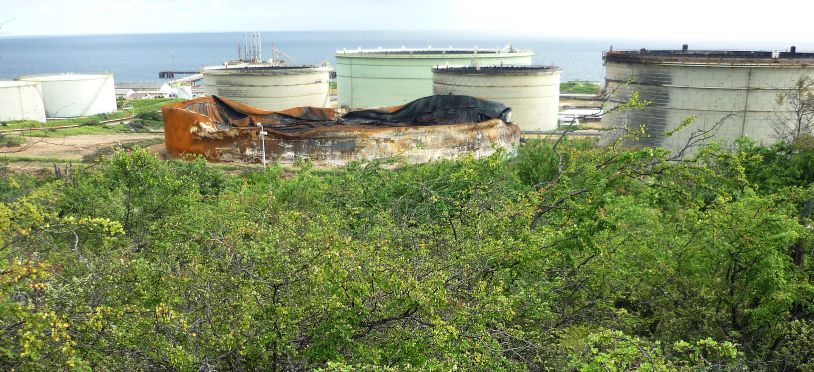
This photo was taken by holding the camera way above my head to 'see' over the vegetation. I was amazed at what was captured on the camera!

Since BOPEC is a high security facility with a pier for loading and unloading oil tankers, we had to skirt around their perimeter fence to get back to the west coast road to the north. It is hard to get a good photo

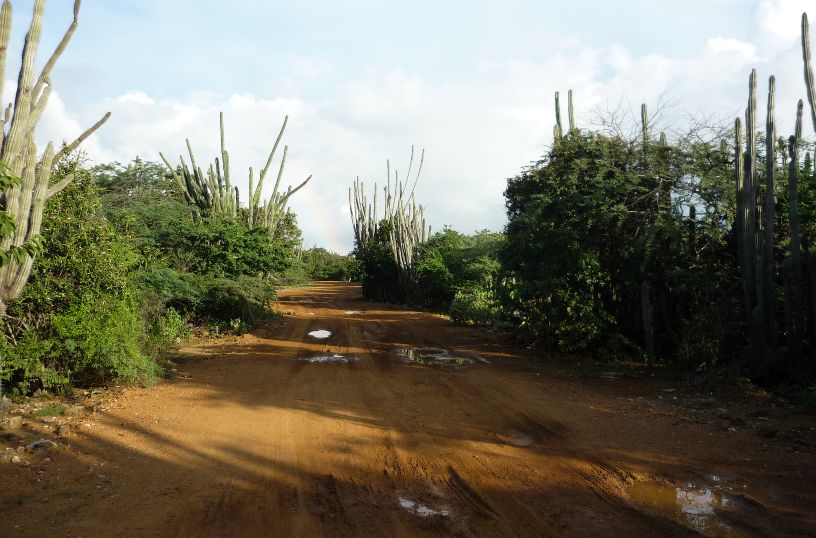
The road was a little muddy in places!

of BOPEC, but I saw a small break in the cacti. By chance, and by holding my camera way over my head, I happened to get a photo of the tank that burned after a lightening strike in September. This road ended only a few kilometers north of BOPEC at Playa Frans,

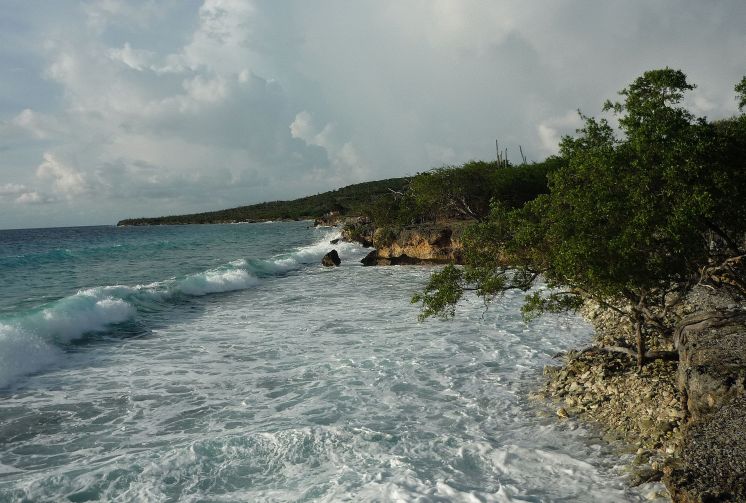
Waves at Nukove Beach, between BOPEC and Playa Frans

where there a couple of houses belonging to fishermen. It is a rather unique place to travel with some fairly rugged coast line.

I am always on call, especially after the transmitter goes on the air at 5:30pm. By retracing the route taken, we figured we would be back home

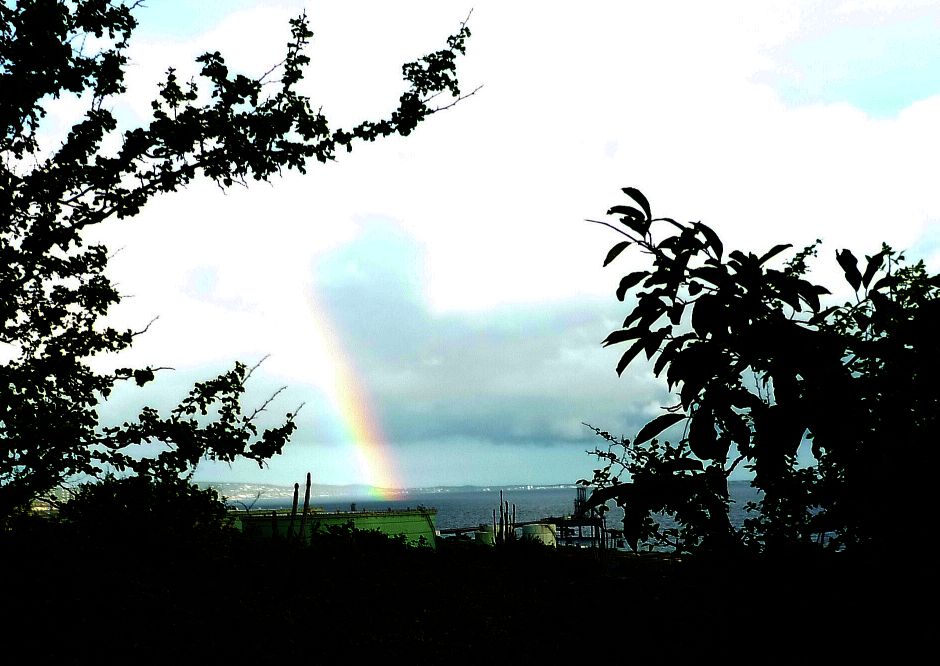
On our return, we saw this rainbow that looked like it was rising out of a BOPEC oil tank. Actually it was raining in Kralendijk where we were headed.

about 5:30, but, about half way home (time-wise), we encountered a ‘detour’. Only upon seeing the ‘do not enter’ symbol on the sign post on our anticipated return route, did we realize that part of the road that we had previously traveled is now ONE WAY going north. This was not the case 40 years ago, and, both times we have taken part of this route in the past four weeks, we returned another way. The only way we knew to get back was through Rincon, then to the east coast and back to Kralendijk. We got back about 6pm and the transmitter was OK.

It was raining when we got back, so we decided not to walk or swim [we might get wet!]. Actually a breeze is still blowing from the west and the surf is very rough.

We checked at the salt pier this evening and noted that the third of five holds was being filled. We also stopped by the office and called my mother.

NOTE #1 — Click on the highlighted ‘Playa Frans‘ above, or here, to see an amazing panaroma. Also click on this one –> Nukove and see how calm the waves usually are on the west coast of Bonaire.

NOTE #2 — To see a bigger (and in some cases, expanded) version of any of the images, just click on the one you want to enlarge.

6 Nov 2010 Saturday

Dryer seems to work fine in spite of the rust and modification on the front bottom left. The gas burner is inside this hole, so who knows what problem it had in the past?

Saturday morning is the one day of the week that we can sleep in an extra hour or so, which we did. I was just getting up when someone called from outside to say I needed to move the car out of our driveway. They were going to pour a new gate post and were letting us know that it would be trapped inside the yard for the weekend.

This morning, Virginia wanted me to repair the gas dryer in the outside utility room. With high humidity the past few days, it has been difficult to get things dry. The dryer drum belt was missing (apparently broken) but there was a replacement belt on a shelf beside the dryer. I popped the top up, took two screws out near the

The dark line around the middle of the drum is the belt

top of the front panel and lifted the front up about a 1/4″ to gain full access. That part was amazingly easy, then I saw the idler pulley assembly laying in the bottom with no screws and wondered where it was supposed to go! Fortunately a drawing on the package for the belt showed a typical installation. From this, I figured out that one end of the assembly fits into a slot in the bottom panel of the dryer and the tension of the belt holds it in place.

No wonder the dryer was a little slow drying -- the vent was almost stopped up with lint that got past the lint filter!

I put all the panels back on and started it, only to hear a ‘thump’ on every revolution. This was resolved when it was discovered that the plastic bearing surface attached to the front edge of the drum had slipped out of place. Some of the plastic clips that hold it in place were broken, but when put back in the correct position the remaining clips held it OK. Now, after again replacing the panels, the dryer was up and running great.

Dryer vent after cleaning -- it would not be clogging if a proper vent were used, but lizards might get in!

We planned to do some sightseeing after a lunch of peanut butter and jelly sandwiches and ice tea, but rain began to pour down during lunch. Now Virginia was really glad that the dryer was working! As the rain kept up for quite a long time, with water running

A sign like this appeared at many empty shelves around the store.

everywhere we decided to take the opportunity to work on updating our blogs. We heard later today that Curacao, around 40 miles west of Bonaire, received the equivalent of its annual rainfall in one day! Glad it was not that bad here.

After the rain let up, we went shopping. Some of the things we were wanting were missing and in their place were empty shelves with a sign apologizing because Hurricane Tomas had delayed their shipments. Some of the things we noticed missing were spaghetti, cheese and butter.

Tranquil Bachelor Beach (we used to call it Lime Beach) was far from tranquil today!

Weather was looking pretty good after shopping, so we decided to see what the ‘new’ road from Belnem going across the island to Sorobon was like. Before doing so, we elected to make a detour via Salt Pier to see how loading of the United Tenorio was progressing.

United Tenorio at the Salt Pier -- the waves were pretty wild here, too.

On the way, we noticed that waves were really crashing against the east shore which is usually very calm. This precipitated a stop at Bachelor Beach, where we used to frequently swim, to take a photo. This was much worse than the effects of Hurricane Tomas — must be from the storm that passed through earlier.

Moving on down to Salt Pier, we noted that the second of five holds was now being filled. At this rate, the United Tenorio will spend at least two, maybe three, days at Salt Pier.

Virginia took this photo from the parking lot of the transmitter building while I was checking out the security system.

Since we were near the transmitter site, I decided to run a test of the security system by switching it off, then later coming back after the auto-arming programmed time to verify that it had indeed armed itself. On our way into the site, we noticed that the water had risen even higher and was over the paved road. Fortunately, it was not more than a couple of inches deep. I entered the building, disarmed the system, then locked the door upon leaving,

Another neat photo at the Salt Pier

We now began our trip from Belnem to Sorobon. This must be the straightest road any where on Bonaire. With all the black marks seen on the pavement, it looks like it is also being used for a drag strip! It definitely seems to be the fastest way straight across the island east/west. When we got to Sorobon, there was a big group having a party on the beach. We also noticed that there were a lot of cars, most of them rented, at the Naturist Resort.

We came back the same way to Belnem then went to the site to check the security system. It had auto-armed as it was supposed to.

Due to the high waves, Virginia and I took a short walk tonight along the shore, then came home for a supper of nasi chicken. ‘Nasi’ is the Indonesian work for rice. We used some mango chutney on it, which really gave it an excellent flavor.