Day 12 — Automation Challenges

The only thing done on HC100-9 yesterday was wiring the Programmable Logic Controller (PLC) to automate its operation.
Today, Steve followed up on the pulleys ordered last week to increase the speed of the blowers.  He was informed that the truck had overturned in Johanesburg and that it had not arrived.  Unfortunately, with former experiences I have had it sounds like an excuse for not meeting a commitment.

Today the wiring was completed, a few PLC wiring errors were corrected and preliminary tests commenced.  The first problem encountered was from HC100-9 when the left driver blower quit.  No voltage was measured at the blower which was finally traced to a loose terminal screw on 2A4TB8-23.  Easy to solve but it took time.  The filament breaker tripped at one point, but that has not reoccurred.

The next challenge happened when the filaments dropped to quarter power as the automation switched the driver off.  This is because the automation ‘pushes’ enable for both ‘on’ an ‘off’ controls.  Enable does not need to be pushed for ‘off’ commands and has not been a problem until the most recent version of EPROMS which allows switching to 1/4 power filaments by pressing enable and driver off simultaneously.  The two older HC100s do not have the 1/4 power revision, so they ignore this command.  This is one problem that needs to be sorted out by either disabling the quarter power fils in HC100-9 or reprogramming the PLC for driver ‘off’ functions.

The automation control now seems to be functioning and plans were well underway to use HC100-9 for broadcasing this evening.  At the last minute, it was discovered that there is a problem with one of the automated antenna configurations required for broadcast.  With not enough time to verify the configurations for all antennas before broadcasts began, it was decided to give the old 100kw Continental  a reprive to remain in service for another night.
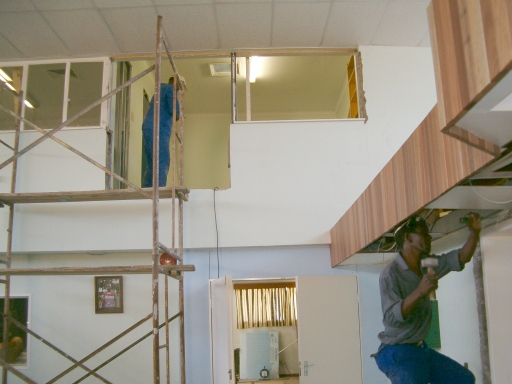
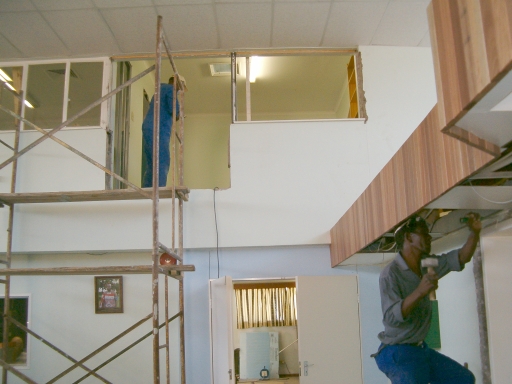
Mbusi makes opening and Aaron removes door frame

Mbusi makes opening and Aaron removes door frame

Several other projects are taking place in the transmitter hall, with a wall being knocked out and a door frame moved in preparation for installation of a ice chiller system to be installed.  This system will allow for formation of ice and cold water during offpeak hours to use for cooling the transmitter hall air during broadcasting hours.  Part of the system will incorporate the large heat exchanger used on the 100kw Continental. 

Leveling the tamped sand and ready for concrete

Leveling the tamped sand and ready for concrete

Another project is filling in the 12 foot X 15 foot X 24″ deep ‘pit’ that used to be under the old control room in the middle of the transmitter hall floor.  It had been used as a means to bring ‘cool’ air from the shady side of the building into the control room and for easy access for wiring to the transmitters, to the bank of 12 large reel tape machines and to the manual audio board.  As a result over one hundred wheelbarrows of sand were wheeled into the building and tamped firmly in preparation for pouring a slab for a new floor in that area.

No animal stories for today except for the usual cattle on the site road.  On the way out, one adolescent calf decided to run down the road in front of us and crossed the road three times before finally deciding to stay off to one side and let us pass.  It is usually the calves that drivers have to observe most closely.   Its too bad their mothers don’t train them to look both ways before crossing the road!
Day 11 — Automation Wiring Cont’d + More Animals

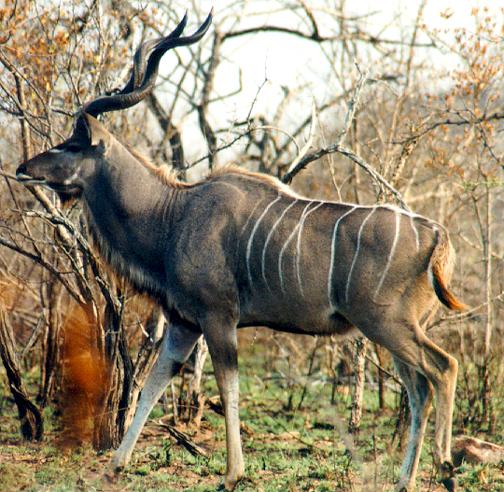
Greater Kudu

Greater Kudu

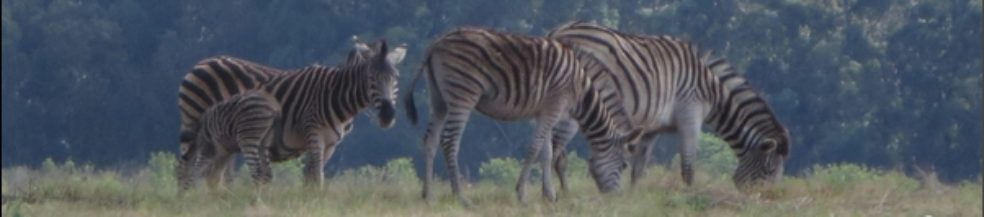
On the way to the site this morning, I spotted something huge standing in the road some distance ahead.  As we got nearer we recognized that it was a male greater kudu, one of the largest African  antelope.  I estimate it was about 13 feet high to the tip of its corkscrew horns.  We then began to notice there were other males around and counted four before we passed the area.  In sixteen years of traveling to the site, I had only seen one.  Steve had not seen any for three years and never four at once.

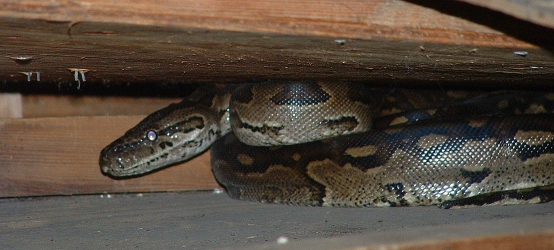
After we arrived at the site, everyone was buzzing about the python being visible in the loft of the big

7 foot python in big shed

7 foot python in big shed

shed laying on top of one of the crates.  We hurried over with our cameras only to find it was slowly on the move and eventually hid between two pieces of plywood.  Steve and Klaus bravely climbed onto the loft and carefully pried its hiding place open to get the photo shown.

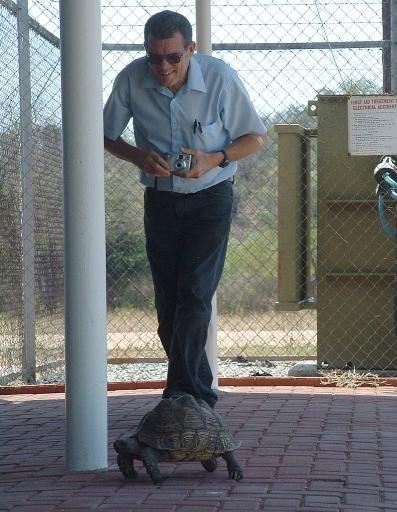
Tortoise

Tortoise

Our animal adventures for the morning were not over yet.  When Mbusi, TWR’s builder, arrived from town, he had the next creature in the back of his bakkie (pickup).  He had found a large tortoise along the road that we ended up photographing and releasing.  It was about 18 inches in length and about 9 inches high when it was walking.

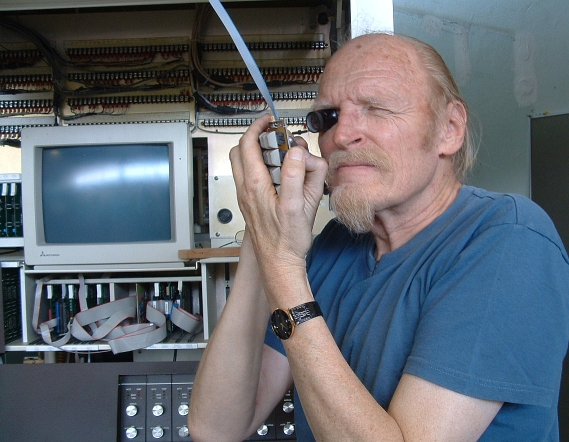
Automation Wiring by Hans Van Kampen

Automation Wiring by Hans Van Kampen

With animal adventures over for the morning, automation wiring began in earnest.  Since this was Hans’ design and installation, I spent much of the day trying to catch up with email correspondence and doing some of this blog.  By mid afternoon it was obvious that the wiring would not be done to allow the new transmitter to go into service today.  I looks like it will be ready tomorrow barring any unanticipated problems.

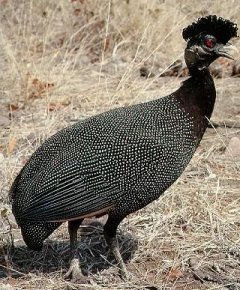
Crested Guinea Fowl

Crested Guinea Fowl

There was one more animal adventure for the day.  This one again on the site road.  On the way home we saw a group of several guinea fowl.  Initially we thought they were the helmuted variety that we had seen as mentioned in an earlier blog.  As we got closer, we noticed that they were of a different variety, possibly crested guinea fowl.

Saturday 18 October 2008

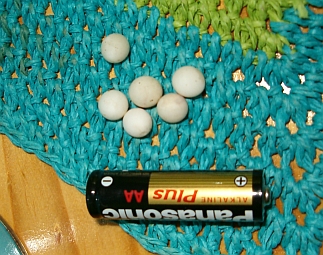
Lizard Eggs beside a AA Battery

Lizard Eggs beside a AA Battery

After our late night last night, we slept in til almost 8 am this morning.  For the past several days the hot water for our shower has been gradually getting colder each day, and Virginia got a chuckle from Lorraine when she told her that our shower no longer had therapeutic value.  After borrowing a ladder and meter, and donning my trusty LED headlamp, I climbed into the attic to get to the water heater.  Upon opening the cover for the heating element and thermostat, seven lizard eggs fell out.  This is Africa!  Quickly assessing that the eggs were not the problem, attention began to focus on some slightly overheated wires on the thermostat which proved intermittent.  Being Saturday with most shops closing at 1 pm, a quick 4 mile drive was made into Manzini with Lorraine’s car. My first time to drive on the left side of the road since 1999 went without incident!  After the initial shock of paying E105for a new thermostat, I determined with the latest exchange rate the actual cost was only about $11.  The water heater was quickly repaired and therapeutic value restored!

While I worked on the water heater, Virginia did our laundry and hung it on the line to dry.  Drying did not take long in this warm, dry climate with a little breeze.

One of the church ladies from further down our dirt road picked Virginia up for the ladies meeting this afternoon where she met many more women that she had not seen for 9 or maybe 19 years.  While she was away, I walked around the TWR property known as “Signing Pines” because of sound made the very tall pine trees in the wind.  I took lots of photos of flowers and plants that are not common in Indiana.

We had been invited out to the transmitter site for supper with the work group and the Stavropouloses.  I had moved Lorraine’s car out of the garage, closed up the house and set the alarm system.  When I went to the bungalow to wait for Virginia, I began to feel very light headed and lay down on the bed.  By the time Virginia arrived, it was obvious that we would not be going to the site as I was too dizzy to even stand up.  After a couple of quick trips to the bathroom, I began to feel a little better but was still unsteady.  Climbed into bed about 6pm and fell asleep.  Upon getting up briefly about 11 pm, I was still a bit wobbly, but by morning I felt almost normal.

What caused this?  We are speculating that it was not some exotic African bug, but granola that I had eaten for breakfast.  Granola had been one of my favorite breakfast foods but many years in the past it began to cause heartburn.  Figuring that a Tums tablet would take care of any discomfort, it was not realized that my reaction to it seems to have risen to a whole new level after years of not eating any!

Day 10 – Transmitter Ready and Many Other Adventures!

On the 5 mile gravel ‘driveway’ into the site this morning we saw a python stretched out perpendicular to the road with its head about 6 inches into the road and his tail under the barbed wire fence on the side.  We were about 100 feet past it before we could stop and reverse for a photo.  It continued laying in the same position until we got about halfway back to it, then disappeared.  I paced off 4 paces between the edge of the road and the fence, estimating that it was at least 13 feet long!  It looked about 5 inches in diameter in the middle.  When we got to the site, the Swazis said there was also a python on the loft in the big shed by the river.  We went to look but did not see it among the stacks of crates and lumber stored there.  The Swazis claimed it was at least 3.5 meters (11.5 feet) long.

When the morning broadcast schedule ended and the need antennas became available, we began testing HC100-9 with audio and all the frequencies on which it will be operating starting next week.  It autotuned perfectly each time and only minor adjustments were required for optimum performance on each new frequency and antenna.

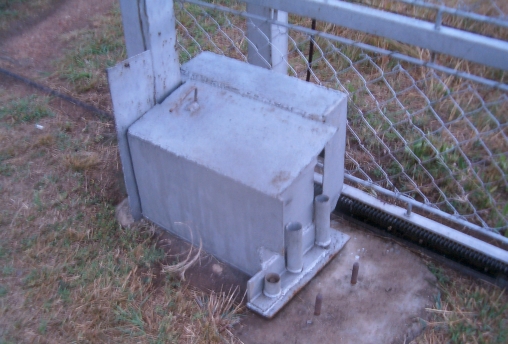
Remote controlled gate for the site road

Remote controlled gate for the site road

We planned to leave the site right after the evening broadcasts began to meet a work group coming from South Africa to work on some site projects on Saturday.  Before leaving a call came that the remote control gate off the paved road was not closing.  [Remote controlled gates are common here, because gates are an ideal place for carjacking, if the driver has to get out of the car to open the gate, especially at night]  A charged battery (from a cannibalized UPS) and special tools were quickly loaded and taken to the

Gate opener box for motor, battery and electronics

Gate opener box for motor, battery and electronics

gate.  The special tools  are used to remove the plate steel box covering the battery and electonics — this is to prevent theft (most theives do not carry special kinds of tools)!  When the gate was initially installed there was a solar panel on a steel pole about 20 feet in the air, but that was stolen within the first week!  Now recharged batteries are installed about every 6 months.  After installing the battery, the gate was cycled and worked correctly.

That done we headed off to Manzini to meet the work team coming from South Africa.  We had hoped to get them settled at the site accomodations before dark, but they were delayed some by a Friday night border crossing.  So just after dark we (including Virginia and Lorraine) headed a convoy of five vehicles (two with trailers) on the 20 mile trek back to the site.   We got to the remote controlled gate and it did not open!  Fortunately Steve had a key to the lock on the side manual gate. [Interesting note — since this gate is used by several farmers and TWR, there are locks strung in series so each can unlock the gate as necessary.  Be sure not to bypass any of the locks when locking back up or you might hear from an irritated farmer!]  Finally all the vehicles made it across the low level crossing and to the accommodations across the river from the transmitter building.

This was one well organized work group of about 20 people!  In short order they had a fire going in the braai (BBQ) pit and boerewors (sausages) on the grill.  Meanwhile others were unloading specialized hand and power tools and supplies for the work they would be doing, plus food for two days, and bedding for all and tents for overflow sleeping.  While we were eating the sausages in what looked like large hotdog buns, dessert was on the grill.  Bananas were split down one side with the peel left on, a marshmallow was put in the middle of the slit and a piece of chocolate on each side of the marshmallow.  This was wrapped in foil and put on the grill then eaten with a spoon when ready.  It was amazingly good — a South African version of smores!

After a short time of devotions by the pastor of the group and a time of prayer we headed back to Manzini.  Once again we encoutered the remote controlled gate and decided to try it again.  It opened this time and we drove through, but again it stuck open.  We could not leave it that way since there were cattle in that field.  Fortunately we still had the special tools, plus an LED headlamp that I ‘happened’ to bring, in our
vehicle to once again remove the heavy metal box to gain access for releasing the clutch to the gate’s gear drive so we could close it, re-engage the clutch and reinstall the box.  Something else to repair next
week, but the transmitter will come first!

We finally made it home about midnight — a long day!  Steve and Lorraine would have to leave just after 7am to provide guidance to the work groups.  Since Virginia was to attend a women’s Bible study tomorrow, we would be staying at our bungalow to do other things.


Day 9 — First Tests with Audio

Today we adjusted the blower motors for the highest speeds possible with the current pulleys since the input power is 50 instead of 60 Hz.  We should have changed the blower pulleys to 5″ or 6″ diameter instead of 8″ before the transmitter left Elkhart, but forgot to do so.  Today we ordered two 5″ pulleys from a company here at Matsapha,  which should arrive by the middle of next week.  Meanwhile the water temperatures will need to be monitored closely.

After the morning broadcasts ended, we were able to access one of the antennas required when this transmitter starts actual broadcasting.  We fine tuned it for 9525 kHz and the corresponding antenna.  In addition it was tested with audio and performed well.  We had hoped to test on the second antenna that will be used on several frequencies, but the afternoon broadcasts were starting up, which blocked access to that antenna.  Tomorrow, right after the morning broadcasts we plan to complete testing on all the remaining frequecies to be used.

One of the disadvantages of an automated transmitter site is the inflexibiltiy for testing a new transmitter on the broadcast schedule on a random basis.  The way the automation is set up the old transmitter will have to be taken out of the automation program and the new one put in.  There seems to be no easy way to quickly switch between the two transmitters should faults need corrected.

Today and tomorrow there is a seminar in the Manzini office and all the staff not needed for essential broadcast function are there.  As a result, the final wiring for audio and computer control of the new transmitter will not be completed until Monday.  We will continue ‘manual’ testing until then.

Virginia and Lorraine Stavropoulos are organizing food for about 70 people for the “Farming God’s Way” seminar mentioned above for both today and tomorrow.  This has kept them very busy for much of the time we have been here.  Please pray for this seminar, as it is designed to teach more than just methods of farming.