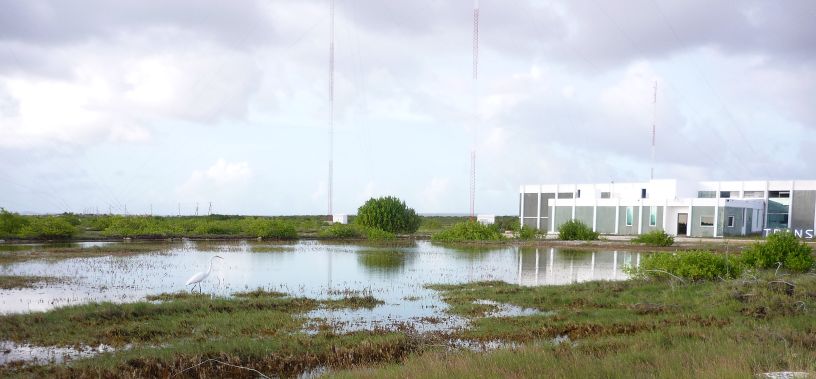
This morning there were no cutbacks on the overnight transmitter log, so it looks like our adjustments to arc gaps are proceeding in the right direction. Will increase the audio input by 0.1dBu to 8.0dBu for tonight’s transmissions and see what happens.
Today I provided information to Joe Barker for ordering red sidelight glasses to replenish stock after Lionel used the last one to replace the one on top of Tower 3 that was destroyed by lightning. I also provided a list of other spare parts (and prices) that might be needed.
Wrote an email to TWR Swaziland about the possibility of using thermal imaging, infrared scanners or infrared thermometers in transmitters to detect ‘hot spots’ that might indicate an imminent failure. This might also be a way to avoid unnecessary disassembling for routine inspection, especially when disassembling has risks of causing other unrelated problems!
After a lunch of tuna sandwich and papaya fruit, Virginia accompanied me to the transmitter site for the afternoon. My primary task for the afternoon was to move the repaired PA Module into its ‘proper’ slot and return the original spare to stock. What should have been an easy task uncovered several unanticipated tasks.
Actually my first priority was to reset all the control/monitoring equipment. Last night we lost remote access to the transmitter. Fortunately there were no transmitter problems. Resetting or repowering of four units restored remote control. [I do this at home when my wireless modem gives me problems! The principle must be the same 🙂 ]
The first unanticipated task was repairing the cover over the wiring that carries control signals to the eight left-side PA modules. There are two guide pins on the bottom edge of this cover that slip into holes to keep the bottom in position, while the top is attached with lever type fasteners. One of the guide pins fell off into one of the bottom holes. The bottom channel, with the holes, had to be removed to find the guide pin. After retrieving the guide pin, I tightened the hardware that holds both guide pins. The identical cover over the eight right-side PA modules’ control wiring also had both guide pins near to falling off, so tightened those, too.
While swapping around PA Modules, I found that the face plate on one of the PA Modules was very loose. Of course to fix it, this module had to be removed from the transmitter and the side panels of the module had to be removed to get to the loose hardware to tighten it.
After the face plate was tightened and upon putting the module back into the transmitter, I noticed that the bottom retaining screw did not want to thread in. (I had noticed something was not exactly right when removing this module earlier.) Upon closer inspection, I noticed that the front flange under the module was bent, and not at the correct angle to line up the screw and threaded insert. Using a Crescent wrench, and several layers of paper to protect the finish, I was able to remove the bend. I again installed this module into its slot only to find the retaining screw still did not line up properly. Further inspection showed the side rails were also bent causing the PA module to be shifted slightly to one side. The Crescent wrench ‘fix’ was applied again and everything lined up nicely.
Now that all the PA modules were situated in their correct places, the transmitter was powered up to 100kw and all modules performed properly. I prefer to do a test like this rather than finding out at the last minute that something is wrong and losing valuable air time!
With this out of the way, Joe Barker, who was in town, wanted to test another method of carrier control for the transmitter. This method is called Amplitude Modulation Companding (AMC), which actually reduces the carrier level with modulation. It saves a lot of power and research has revealed that listeners could not detect the difference when compared to normal broadcasting. At O% modulation, the carrier level is 100% and, at 100% modulation, the carrier power level is 50%. At 50% modulation, the carrier power level is 75% and, at 125% modulation, the carrier power level is ~41%. There are other advantages to AMC besides power savings. The peak voltages on the RF system from the transmitter to the antenna are reduced. Also, if engines are used for power, whether continuously or for standby, the power requirement does not vary dramatically with modulation. This is a tremendous advantage over Dynamic Carrier Control which most engines can not tolerate. There is also less variation in power input required from 0% to 100% modulation with AMC when compared to standard modulation.
Joe controlled setting up the test from town and I was able to watch what he was doing on the computer monitor at the site. It’s kind of eerie watching the cursor moving around on the computer monitor and making selections without my touching anything! The test seemed to work well. When Joe switched off AMC, he inhibited the RF to make the switch. For some reason, this switch needs to be done only when the transmitter in ‘off’ mode. Not doing so, caused a lot of unexplainable faults of the transmitter that could not be cleared from the control panel or computer using normal procedures. The only remedy was to turn off all power to the transmitter to reset everything back to normal. [I have often done this to my computer as a last resort to get it working!] Joe showed me how this could be done remotely by a feature that has been added to the remote controls. A relay purposely causes the 3 phase detector protection device to temporarily send a ‘missing phase’ fault to the transmitter thus ‘shutting down’ power. This same relay can also be used to ‘restore’ the power.
Everything was set back to normal AM modulation for tonight’s broadcasts. Tomorrow Joe plans to walk me through the setup procedure to implement AMC for regular broadcasting. From what I have learned, the audio input level has to be set up for proper AMC, then fixed to remain at that level, otherwise gross over-modulation might occur. This will be a new learning experience for me.
We got ready for our swim this evening only to find that there was a big party going on at Flamingo beach, so we missed our swim for tonight. We could have gone to another beach, but by the time we would gotten there, it would have been too dark.
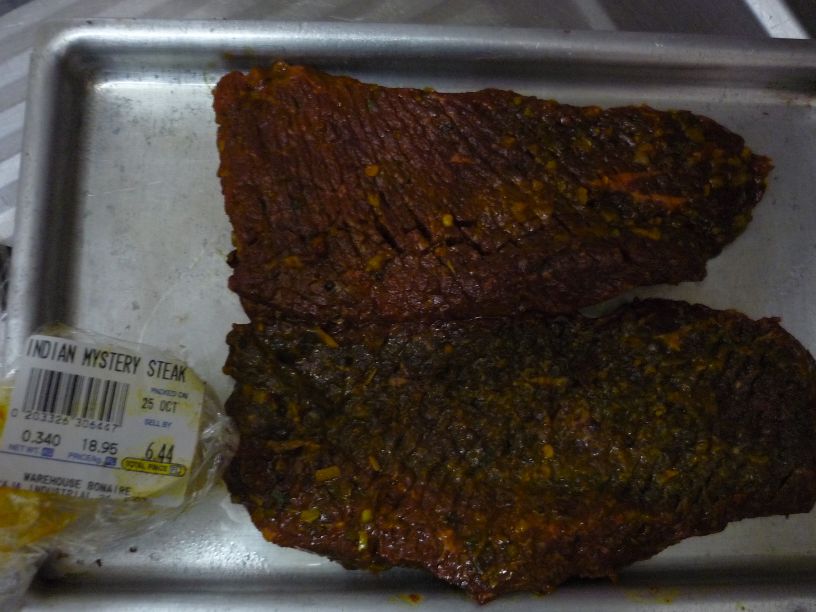
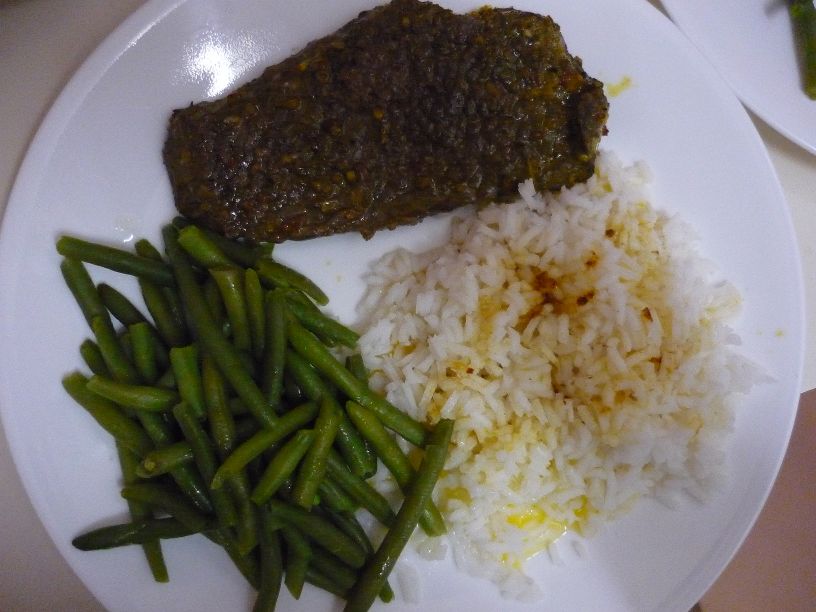
For supper, Virginia surprised me with one of the Indian Mystery Steaks that was mentioned in her 22 Oct 2010 Friday blog entry. We had green beans and rice with it. It was all very good and the ‘mystery’ is solved!

 Today was laundry day again. I was afraid it was going to rain, so didn’t get it out as early as usual. It didn’t rain here, but it did a couple of miles up the road. I managed to get a picture of a cute green lizard, probably iguana, hanging on the screened-in porch. He just hung there watching me.
 fabric and will do some sewing there. I also visited some other shops that I had not been in before.
 sake. It is now air conditioned and very comfortable.