2014/06/17 — Tuesday — Solar Field Layout

TWR Guam plans to install a large solar panel array to help reduce electricity costs for their station.  Electricity costs on Guam are well over double those typical on the U.S. mainland.  This makes solar panels even more cost effective than in the U.S.

This morning after devotions, I helped Mike lay out the location for the solar panel array that will be arriving later this month.  A smart phone with a compass app was used to obtain the south facing orientation.

Later someone else, as a double check, used their smart phone, which seemed to indicate that the orientation was not correct.  This resulted in considerable discussion of which phone was correct.

I decided to use the website, Google Maps, to determine the north-south axis and discovered that there was a telecommunications tower almost due north.  By comparing the  coordinates (latitude and longitude) of the tower to the coordinates of one side of the solar panel array, it was determined that the communication tower was only 2.5 degrees east of true north.
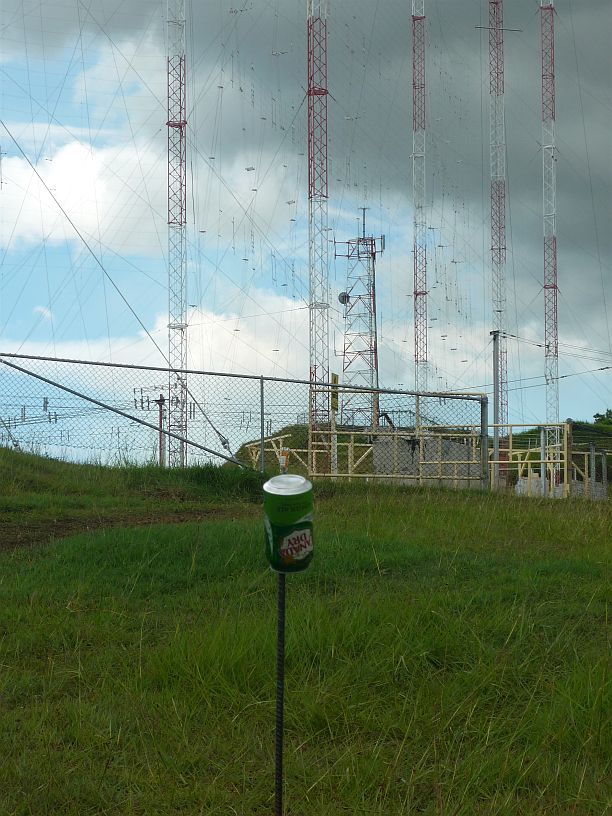
The north reference is the shorter telecommunications tower in the far background.

The north reference is the ‘shorter’ telecommunications tower in the far background.

I then found another reference point that was only 2 degrees west of true south.
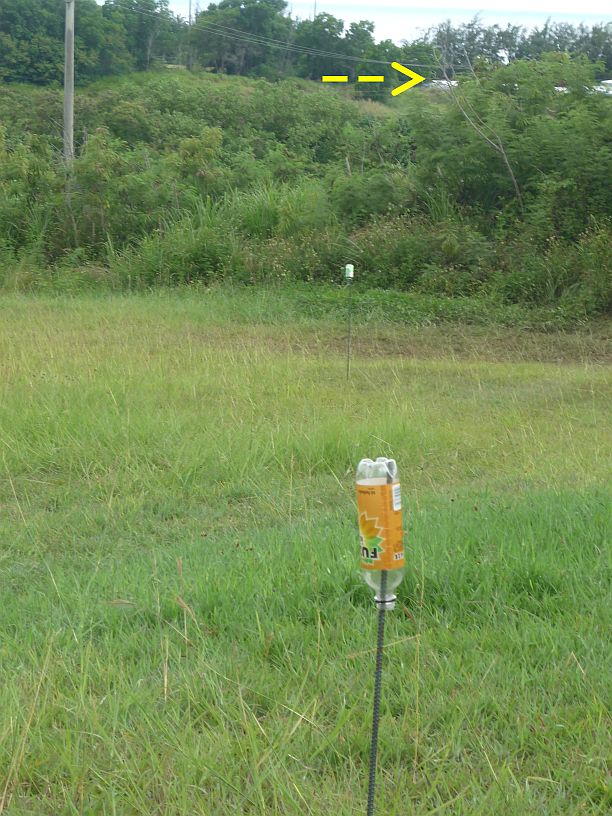
The south reference point is the end of the building which is about 1/2 mile away.

The south reference point is the end of this building which is about 1/2 mile away.

With this information, we made adjustments to the layout after lunch with confidence that the layout is now within 1/2 degree of the desired orientation.
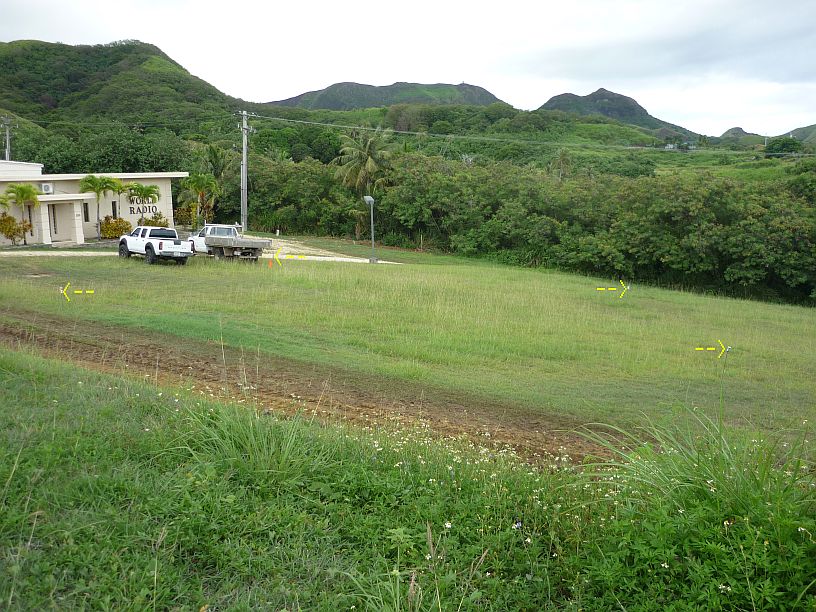
The proposed placement of a 30-kilowatt solar panel array is layed out in front of the transmitter building.

The proposed placement of a 30-kilowatt solar panel array is laid out in front of the transmitter building.  Future expansion of the solar array can be made to the south and east..

After doing this layout, my pant legs were covered with grass seeds, so I decided to tour the antenna field now.  If I would have waited for another day, I would have to remove these pesky ‘stick tight’ seeds a second time. [Actually, Virginia removed them before I got a chance — she said it took about an hour!]  I was amazed at what I saw both from a technical and aesthetic viewpoint.  The following photos show some of the amazing views (I will save the more technical ones for the engineers in Elkhart!):
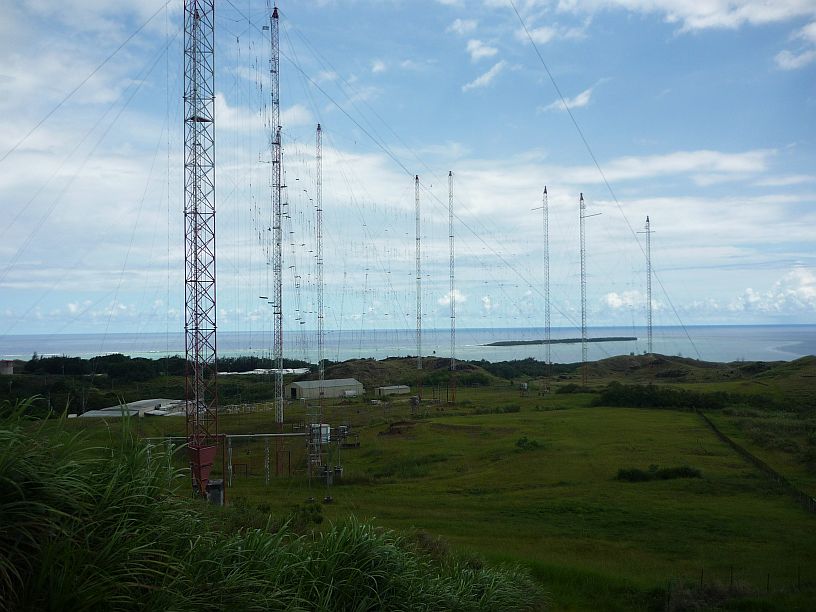
Looking south from the north edge of the property.  The transmitter building is to the left.  To the right of the transmitter building is the heavy equipment storage building which also houses the standby generators.  The Cocos Resort Island can be seen offshore.

Looking south from the north edge of the property. The transmitter building is to the left. To the right of the transmitter building is the heavy equipment storage building which also houses the standby generators. The Cocos Resort Island can be seen offshore.
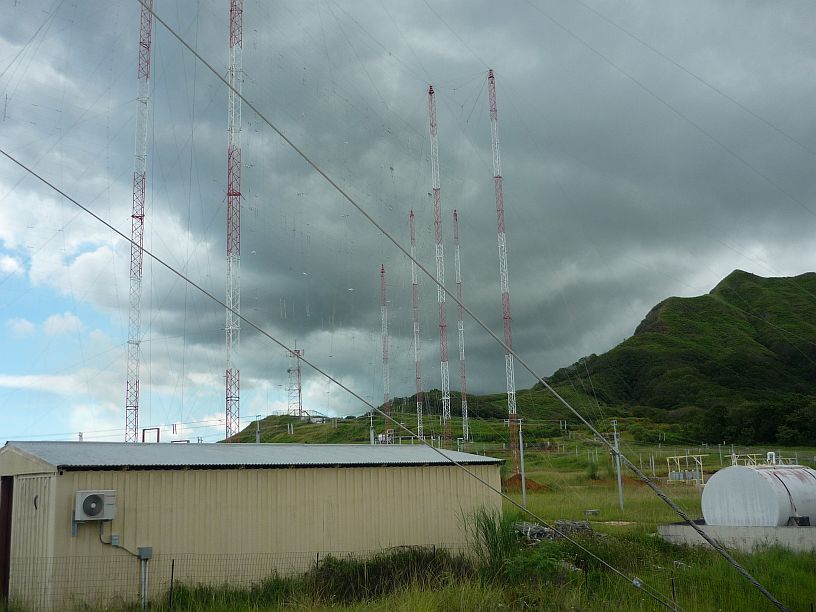
Looking north from south of the storage building.

Looking north from the storage building.  The building in the foreground is used for storing antenna parts and rigging.  It was made out of the two 40-foot containers that were used to ship the two Thompson transmitters.  The fuel tank for the standby generators is to the right.
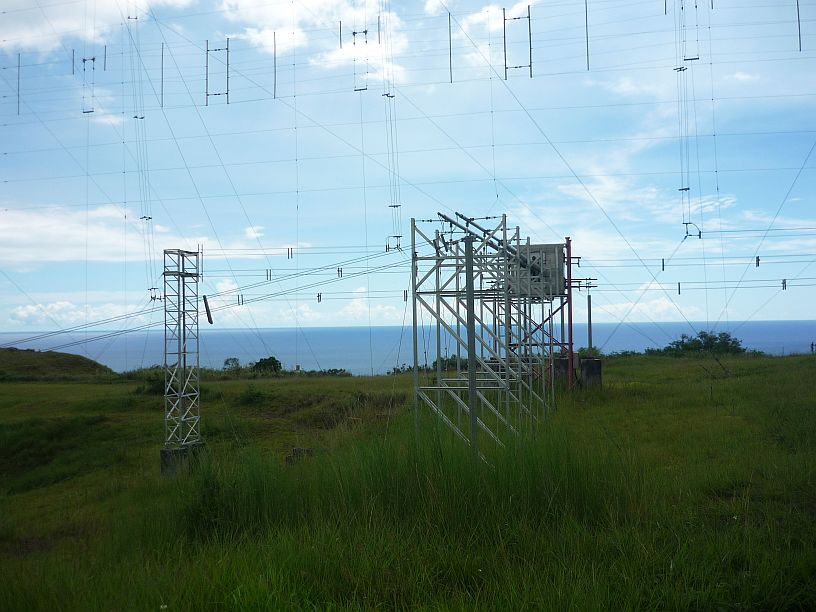
This photo gives the best view of the transmission path to China, India, Indonesia and all of South Asia.  Nothing hinders the signal as it takes off over the Philippine Sea!

This photo gives the best view of the transmission path to China, India, Indonesia and all of South Asia. Nothing hinders the signal as it takes off over the Philippine Sea, especially when you consider that the radiating part of the antenna is over 100 feet above where this photo was taken!
2014/06/16 — Monday — Cleanup

Today was spent cleaning up after removing the two transmitters, that are now in their containers and ready to be transported to the ship.

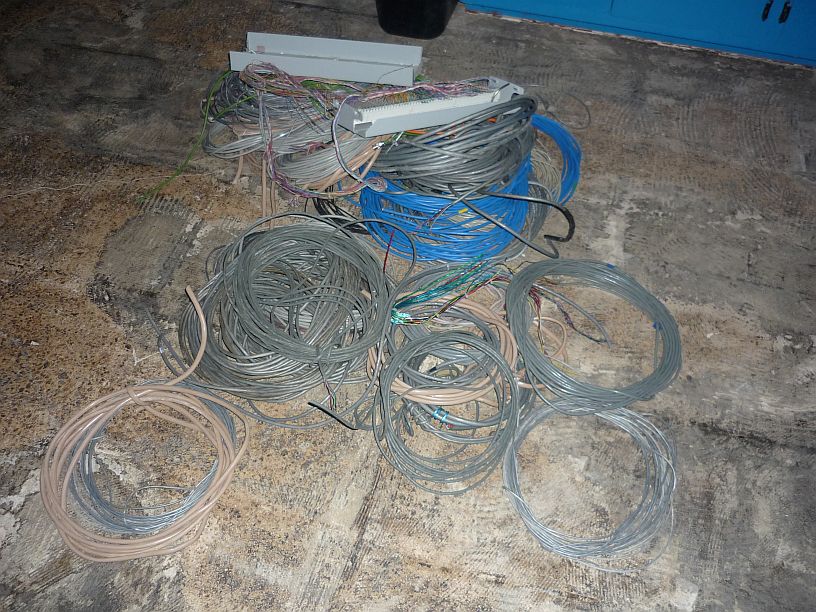
Some of the smaller sized cables that were removed for 'clean up'.

Some of the smaller sized, now unused, cables that were removed for ‘clean up’.

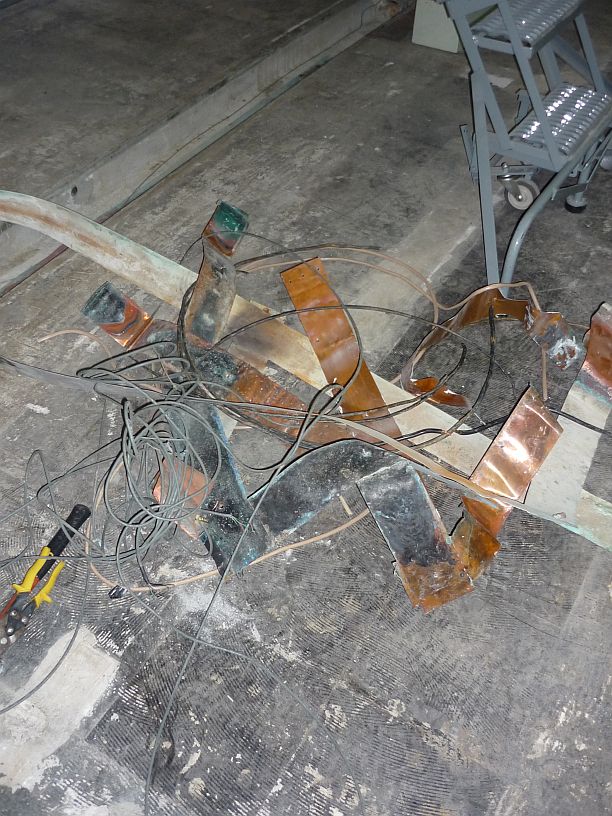
Copper Ground Straps that were removed and will be saved for future needs.

Copper ground straps that were removed and will be saved for future needs.

The ends of now empty conduits that were sticking up out of the floor were cut off flush with the floor to eliminate tripping hazards.

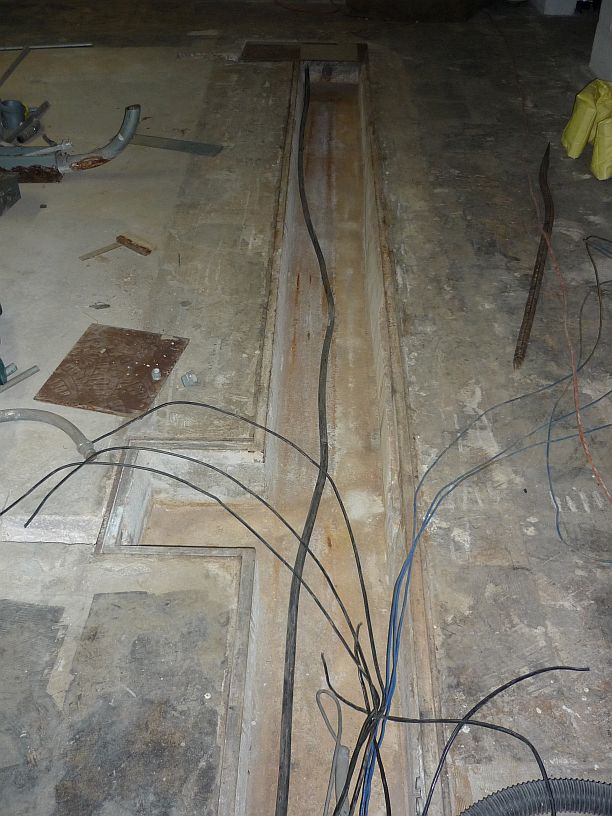
Trenches that had been filled with conduits and wires were now able to be cleaned of almost 40 years of dirt and rubbish that had collected in the bottom.

Trenches that had been filled with conduits and wires were now able to be cleaned of almost 40 years of dirt and rubbish that had accumulated  in the bottom.


2014/06/15 — Sunday — Invited to Dinner

This morning before church (Saturday afternoon in the U.S.), we were able to use Skype to call directly to Larry’s mother’s phone.  Afterwards, we used used Skype to make a video connection to Allan and Joyce, and their three children who were home.  Virginia bought a computer camera before our trip to allow our grandchildren to see us this time, instead of just us seeing them.

When we arrived at Harvest Baptist Church this morning, our friend, for whom we had been looking the past two weeks, was waiting for us.  It was good to see him again after many years.  We invited him out to have lunch with us, but he had a previous commitment.

Jack and Kathy Marlowe, with whom we had chatted the previous two Sundays, invited us to their home for dinner.   Their youngest daughter Grace is still at home and attends Harvest Christian Acadamy. They showed us their small raised garden, where they are raising several vegetables.  We had fresh cucumber and tomatoes from the garden.  The key for a garden in Guam seems to be using good soil, lots of shade and plenty of water.

Jack works for Stanley Consultants, the company that is replacing some of the bridges on Guam.  Two of those bridges are on the way to the transmitting site and work on them is scheduled to start next month.  They were declared unsafe in 2005 and replacement one-lane structures were constructed which have been in use since then.

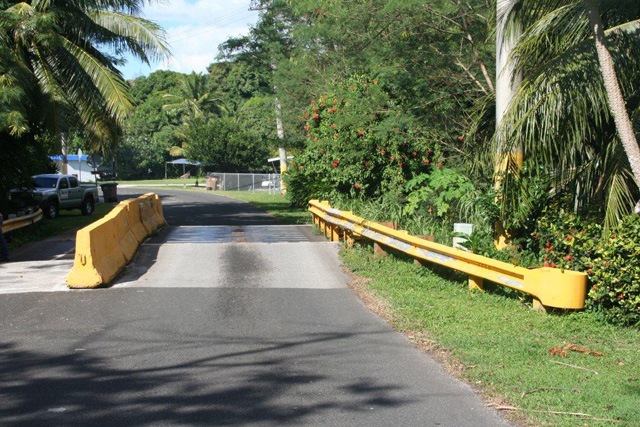
The Piqua temporary one-lane bridge that has been in use for almost ten years.

The Piqua temporary one-lane bridge that has been in use for almost ten years.

Since we were already on the north side of Guam, we decided to stop by K-mart to pick up a couple of items.  Some claim Guam’s K-mart is the world’s largest, which is technically not true, but is probably the world’s busiest!  I wonder if any other K-mart has parking on the roof like this one!  Tourists from China, Japan and other parts of Asia shop there.  There is even scheduled bus service to bring tourists from the hotels for shopping and often two or more buses are waiting near the entrance.  It is interesting to read the comments at — http://www.yelp.com/biz/kmart-store-upper-tumon  The success of Guam’s K-mart is probably due to the fact that there are no Walmarts on the island!

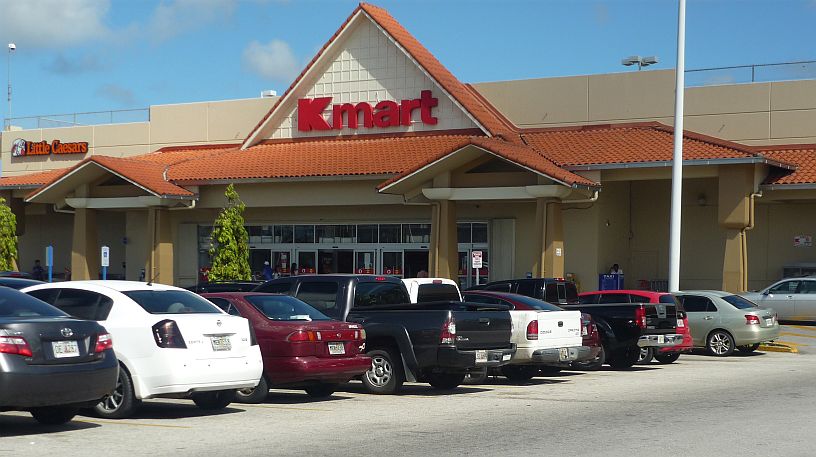
Guam's K-mart -- notice the railing and lights on the roof for the rooftop parking lot.

Guam’s K-mart — notice the railing and lights on the roof for the rooftop parking lot.

When we got home this evening, we had to make a quick trip to the Water Store.  If we were staying here longer, it would be good to get a second 5-gallon jug. [After writing this, Virginia discovered a second jug in a bottom cupboard!]

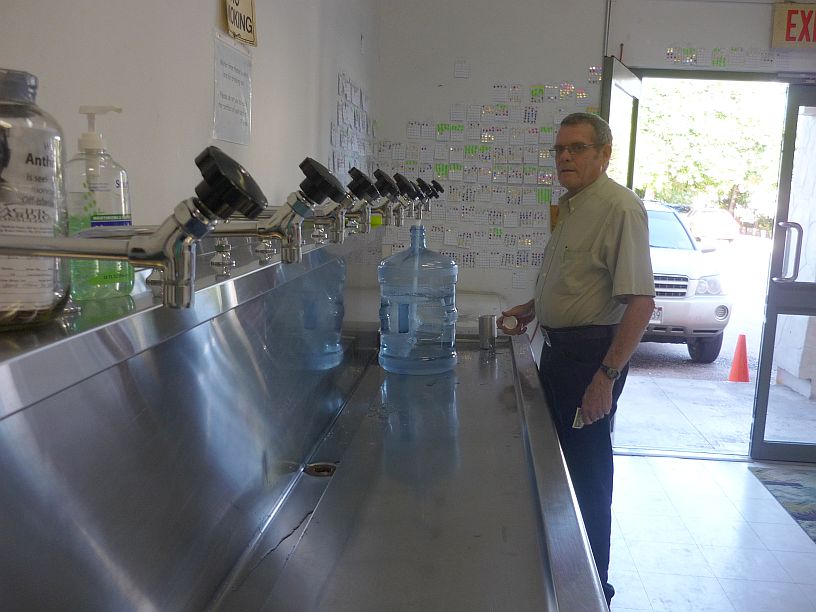
Inside the Water Store -- filling our own jug.

Inside the Water Store — filling our own jug.

Tonight, we managed to complete about 4 days worth of blog entries.

2014/06/14 — Saturday — Containers Packed!

Although today was Saturday, it was a workday to finish packing the transmitter into the containers.  The two men from the U.S.– George and Jason — are scheduled to leave today.

The container that was offloaded into the tight spot was on uneven ground.  When the 3-ton transformer was loaded all the way in yesterday, one of the front corners lifted off the ground almost a foot.  This morning I jacked up the corner with the transformer and blocked that corner up.  This should keep the container from twisting when the transmitter is loaded into the other end.  The truck driver had warned us that, if not blocked properly to keep it from twisting, that the doors would not be able to close.

I strapped down the 3-ton high voltage transformers in this container.  A condenser and other smaller items were loaded to fill in empty space, then the top frame was loaded in followed by the transmitter itself.  We then strapped down the transmitters in both containers with wide tie-down straps.

The last things to be loaded were the two 25-foot long feedline ducts.  These were loaded beside the transmitter in the last container and strapped to the side opposite the transmitter to keep them from rubbing against the front of the transmitter cabinets..

The containers were both closed right at noon.

Jason asked that everyone get together for a prayer of dedication as these transmitters begin their journey to a new location for ministry, after serving at TWR Guam for nearly 40 years.

Virginia did some grocery shopping this morning and made some bread — good bread here costs around $6 per loaf.

I got home in time to eat my lunch with Virginia.

Allan sent me instructions via email for correcting my laptop problems.  It took me about an hour to sort through everything, but it is now working.  If there is a next time with the same problem, I think I could correct it much quicker.


2014/06/13 — Friday — Loading the Containers

Virginia went to Underwater World — http://uwwguam.com/ — this morning with several of the ladies. Denise had some complimentary tickets and had invited them earlier this week. They went out for ice cream afterwards.
With Virginia away, April stepped in to help George and Jason with the spare parts packing and lists.  By the time they were finished, the list totaled over 110 boxes of spare parts.
The truck driver arrived right at 11am and came with the second container on the special trailer that could lower the container onto the ground.  This container was unloaded under the transmission lines going to the antennas.  It was necessary to lift these lines slightly with a pole to give enough clearance for the side-loading trailer to accomplish this task.  Fortunately, the transmitters were not on the air to allow this to happen.
It was at this point that this driver’s expertise began to shine!  He convinced us that he could lower the second container onto the ground on the other side of the building in a very tight space and still have its doors open onto the concrete slab.  The process went like this:
1.  He unhitched the side-loading trailer.
2.  He hitched onto the other trailer with the first container and moved it to the other side of the building.
3.  He unhitched from this trailer
4.  He hitched back onto the side-loading trailer, moved alongside the other trailer and transferred the first container onto this trailer.
5.  With a few attempts he managed to back into a very tight space with a ditch and power pole on one side and another container being used for storage on the other, leaving just enough space for the first container.
6. With less than 6 inches to spare on each side he lowered the first container between his side-loading trailer and the storage container!
All this was done in less than an hour!
Now the loading of the containers began in earnest.  First the 3-ton high voltage transformers were loaded using the forklift then the ‘skates’ to move them all the way in — two into one container and one in the other.  After the two transformers were secured in place with heavy strap tie-downs, the steam condensers (radiators) and spare parts boxes were used to fill in spaces around the big transformers.

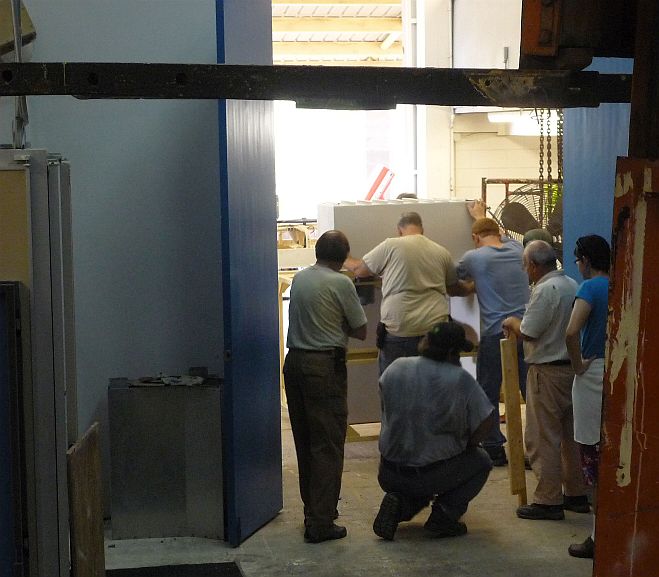
The top frame is being moved out of the building.  Looks like we have plenty of help for this one!

The top frame is being moved out of the building. Looks like we have plenty of help for this one!

The top frame was loaded into the container and its empty spaces filled with spare parts boxes and smaller transformers, motors, etc.
Now TX 1 was moved to the container with three ‘skates’ — two at the back (the heavy end) and one at the front to do the steering.  At first we tried four ‘skates’ — one on each corner, but found that with any unevenness in the floor that one or more of the ‘skates’ would come out.  With three, this problem was eliminated and steering was quite easy.
For those who are interested in what these ‘skates’ (also called machinery skates or roller skids) look like check out this (which is very similar to those we used) — http://www.rollerskids.com/mark-5.html
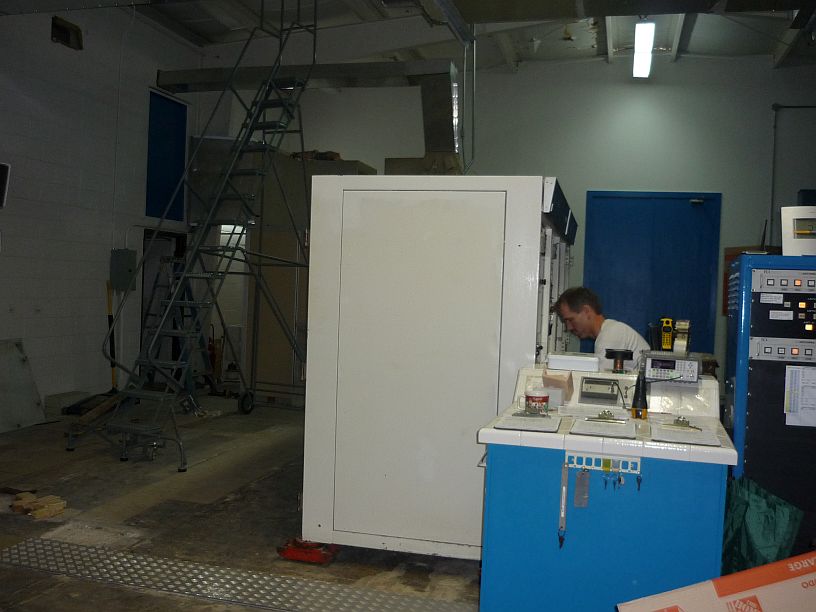
Transmitter is on 'skates' (rollers) and ready to be moved out of the building.  One of the 'skates' can be seen under the corner of this transmitter.  The top plate on the 'skate' can swivel to allow the rollers to move in any direction.

Transmitter is on ‘skates’ (rollers) and ready to be moved out of the building. One of the ‘skates’ can be seen under the corner of this transmitter. The top plate on the ‘skate’ can swivel to allow the rollers to move in any direction.

To get TX1 into the container we jacked up the frame and put 2X4 blocks on top of two ‘skates’ just behind the front, then pushed the transmitter so the front extended into the container.  It was now possible to us the forklift to lift the back of the transmitter and slide it the rest of the way into the container.
While the other men were loading more parts into the remaining open spaces of this container, I prepared TX 2 to be moved, only to find some conduit still connected to it from underneath.  I was able to disconnect one of the conduits, but the larger one had to be cut off with a saw.
By 4:30 (normal quitting time) we had TX 2 moved where TX 1 had been.  Now it was in a position that it would be possible to remove the top frame with the forklift. By 5pm, the frame was off, we picked up the tools outside and closed the containers.
Because George and Jason are scheduled to leave tomorrow, we decided to work tomorrow (Saturday) and try to finish packing the containers before they leave.
When I got home this evening, Virginia gave me the news that my laptop not working — it refused to log on– so was unable to anything on our blog or download photos.  I sent a quick email to Allan for help using Virginia’s laptop.
For some reason, after supper tonight I was so tired I could not hold my eyes open!  Decided to stop fighting sleep and was in bed by 8pm.