2013/06/04 — Tuesday

First thing this morning, I noticed that Transmitter 2 (TX2) efficiency was back to normal, but no reason could be found!  One of the ways of comparing the efficiency of like transmitters is to check their cooling water temperatures.  They should be the same.  Using a hand-held digital thermometer, I compared all three 100,000 watt transmitters.  TX1 & TX2 readings were comparable and similar to their computer readouts, but TX3 read was about 15 degrees higher than its computer reading, which was comparable to the other two transmitters!  When TX3 was shut off, the hand-held thermometer instantly returned to a ‘normal’ reading!!  TX3 had been on 9500kHz.  After it was retuned to 7315kHz, the reading was normal.  This confirmed that the hand-held electronic thermometer is sensitive to certain RF frequencies, which can cause erroneous readings.

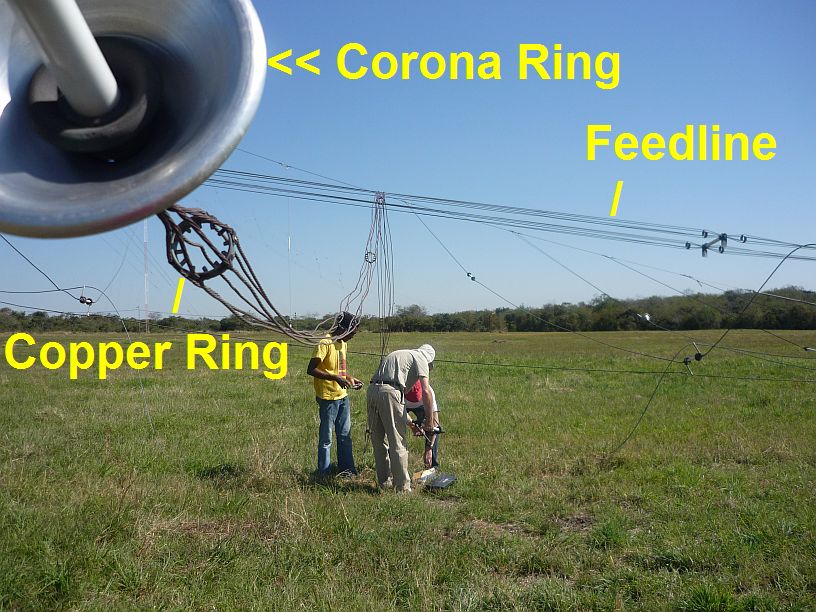
The copper ring shown here is the same as the ones used on the feedline

The copper ring shown here is the same as the ones used on the feedline

We made some adjustments to the feedline to Antenna 6 to see if the RF unbalance, when it is used on TX3, can be improved.  The 300 ohm feedline consists of two conductors.  Each conductor is made up of six wires spaced equally by 2 inch diameter rings (like the antenna element in the photo).  On one of the feedline spans, the two top wires of the six were sagging, so we fabricated and added another ring, with clamps, to correct the sagging.  When this was tested, there was no obvious improvement in the RF unbalance.  We noticed that another span had two bottom wires of the six that were sagging.  We cut two pieces of PVC pipe to temporarily pull these two lower wires into position  Again, there was no noticeable improvement in VSWR or RF unbalance.

In the afternoon, it was decided to test TX3 on Antenna 6 on 7300kHz at full power with modulation and have observers under the antenna to pinpoint any arcing problems.  After about 30 minutes we heard minor arcing and Graham spotted its exact location.  This arcing was not enough to trip the transmitter off, but if left to continue, it could possibly flare up to a much bigger arc due to heating and ionization of the air at this high voltage point.  This may be what has been happening in the evening to cause the transmitter to occasionally trip off due to RF unbalance.  At about 2:45pm it was decided to quickly let the antenna down and investigate.  We found that the arcing was between the corona ring and where it was attached to the element.  The bolt was not making a very tight connection.  The connection was taken apart and a file was used to clean up the surfaces.  The corona ring was then bolted more tightly onto its radiating element.  Everything was put back together and the antenna raised in record time — before 3:30pm.  We just had time to bring up the transmitter and test the antenna before evening broadcasts began.  I listened to the broadcast in the evening and heard no dropouts at all.  Will have to verify this by reviewing the logs when we get back to the site on Thursday.

It was a really full day!!

2013/06/01 — Week 5 Review

On Sunday, Pastor Deon’s sermon was on seals 4 to 6 from Revelation 6.  This was the first Sunday that we  ate at home, so I was able to spend the afternoon working on the blog entry for last week.
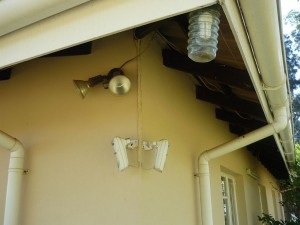
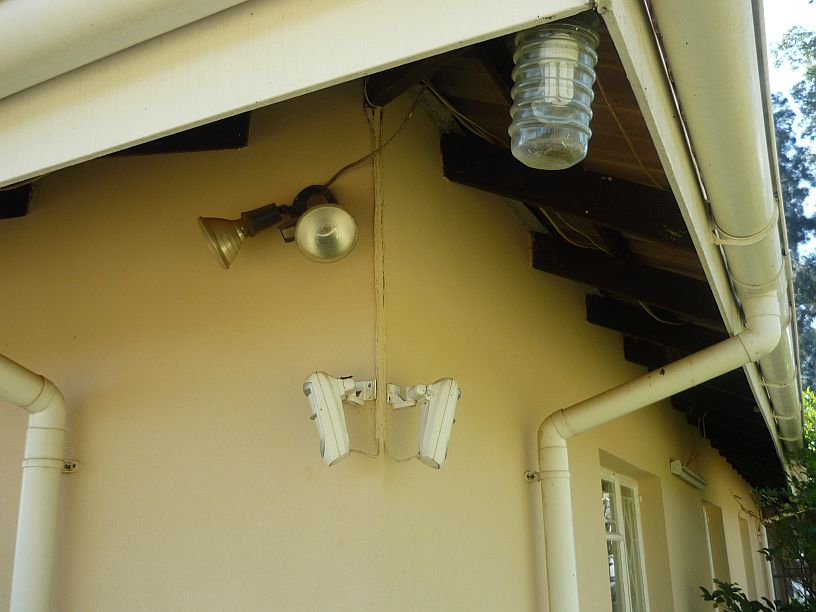
Two motion sensor on one corner of the house.  There are a total of 7 such sensors that cover the perimeter of the house.

Two motion sensor on one corner of the house. There are a total of 7 such sensors that cover the perimeter of the house and are switched on shortly after sunset, then switched off just before sunup.

Since Joshua and Angie had made a quick trip back to Indiana and would need to drive back on Monday, Allan and Joyce invited everyone to their house for an early Memorial Day family get-together on Sunday.  We wanted to talk to everyone on Skype, so Virginia and I played some Rummikub to stay awake.  We got to see and talk to everyone after everyone got there about 5pm (11pm our time).  As a result, we got to bed late.  Unfortunately, it was windy during the night and the outside motion detectors sensed some moving branches and kept ‘squawking’ about every 30 minutes all through the night.  I had a good idea which branches were causing the problem, but decided not to go outside to trim them in the dark!
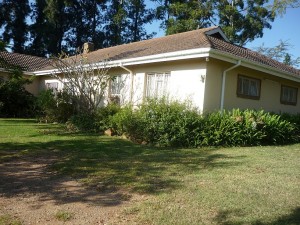
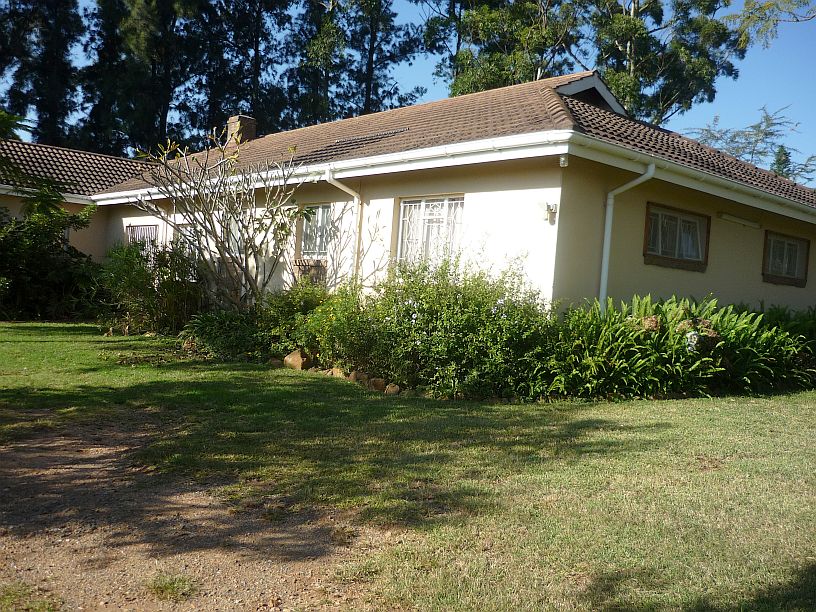
Notice the motion sensor on this corner of the house and the bushes starting to grow up in front of it.

BEFORE — Notice the motion sensor on this corner of the house and the bushes starting to grow up in front of it. Taken about five weeks ago.

Monday, I covered the Maintenance section of the HC100 manual during the morning training.  After lunch, I took an exploratory walk down to the river crossing to get a little exercise.  In the afternoon and following up on the morning’s discussion, we confirmed that all the transmitters were using newer PA inductors with both copper and silver plating, which results in cooler operation than earlier versions with silver plating alone.
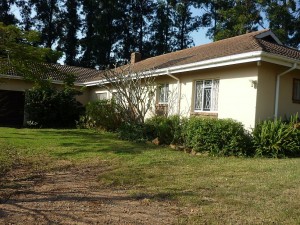
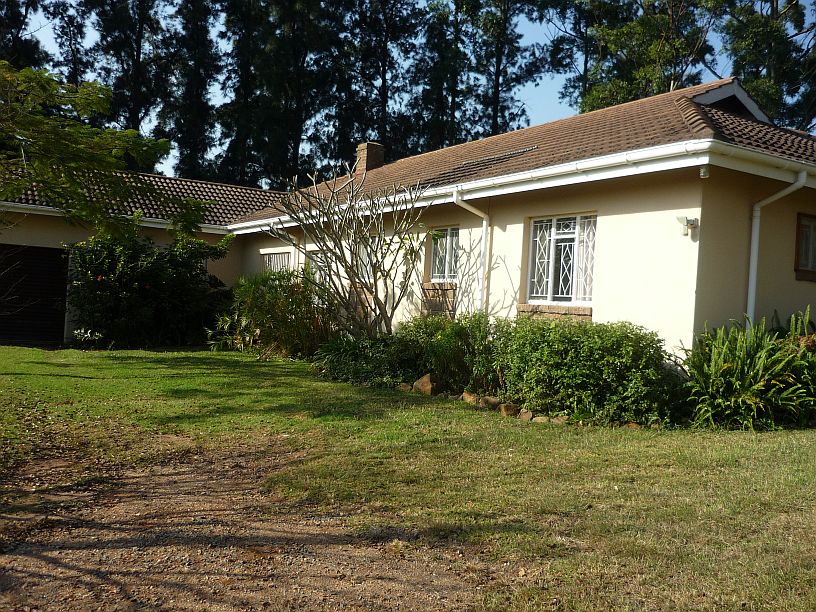
AFTER Virginia trimmed the bushes, there were no more false motion sensor 'squawks'.

AFTER Virginia trimmed the bushes, there were no more false motion sensor ‘squawks’.

When I got home at sunset, I was ready to cut the bushes which we believed to be the source of motion sensor triggering the night before.  To my pleasant surprise, I found that Virginia had already done it and we have had no unwarranted ‘sqawks’ since.

Virginia had written the blog about a ‘typical day’, so I helped add the photos and post it.  Then we headed to bed a little early.  We needed to, after the short and interrupted night before.

WARNING — if you want to skip technical jargon, you will probably want to skip down to the last three paragraphs!  

Tuesday morning, I trained everyone how to calibrate the A-D cards in the metering systems of TX1 and TX3 (TX2 had been calibrated last week to help me remember how to do it).  Several were out of calibration because a wrong method of calibration had been used.  Five out of six cards calibrated nicely, but the RF metering card of TX3 could not be calibrated.  We had to replace the metering input board that ‘reads’ the +/- 15 supply voltage, which voltage is used as a reference for the calibration.

In the afternoon, we started testing a transmitter/antenna combination that has been causing intermittent problems, only to found out that the ‘new’ metering card that we just installed in the morning had a problem and the transmitter would not come on.  Fortunately, we did this testing, otherwise it would have caused lost air time later!   We found a faulty integrated circuit (IC) on the ‘new’ card and four diodes that were installed wrong.  After replacing the IC and correcting the diode problem, we were able to commence the test started earlier.

TX3 was finally brought up on Antenna 6 at a frequency of 7300 kHz and determined that the VSWR was 1.88 and the RF unbalance was 4.2.  Both of these are very close to the shutdown limits.  We did not have time to do additional testing before the evening transmissions.

As TX 2 was coming up we noticed that it had a error message regarding the 2.73 reference voltage used for temperature monitoring.  This was re-calibrated just before programming began.  This has proven to be a full day but worthwhile — finding unknown problems and making many corrections!

Wednesday morning was staff meeting in town, then Selema and I went to the transmitter site, while Graham picked up the 1000 foot reel of cable to replace the antenna control cable temporarily repaired last week.  When Graham arrived at the site, we resumed the testing of TX3 on Antenna 6 to determine at what frequencies the VSWR and RF unbalance problems ‘peak’ around 7300 kHz.  This proved to be excellent training for Graham on how to tune up the transmitter on new frequencies, but revealed nothing conclusive about the antenna problem.

We decided to test TX2, instead of TX3, on Antenna 6, in the afternoon.  This entailed, once again, tuning this transmitter on multiple new frequencies.  Graham was now getting even more experience.

Thursday morning, we completed the testing of TX2 on Antenna 6 and found that it had slightly higher VSWR on this transmitter,  but the RF unbalance was considerably lower.  This seems to indicate the problem is not totally with the antenna.  So what is the problem?!!

In the afternoon, Klaus wanted us to reinstall the original, now ‘repaired,’ A/D converter card and metering input card into TX3.  We ‘happened’ to discover that the water flow indication was showing very high flow without the pump running!  This was finally traced to ‘leaky’ diodes on the metering input card and corrected.  After the repair, it was found that the water flow sender also had a faulty connection (cold solder joint), which was also corrected.  The water flow limits are normally set to about 2.0 minimum and 4.5 maximum, but the maximum limit had been reset to 16 (the maximum possible reading is 10.24) to keep the transmitter running.  With the fault on the metering card and with the maximum set to 16, if water flow would have stopped, the transmitter would not have shut down!  I then checked the other two transmitters and found that the maximum limits on both had been set to 16, also.  I reset them to about 5 and explained that the maximum limit was set specifically to indicate a metering failure.  How long all of the transmitters had been operating this way is unknown!

Friday, we decided to continue investigating the Antenna 6 problem, by testing TX3 on Antenna 8, which is electrically identical to Antenna 6.  Antenna 8 had slightly higher VSWR and much lower RF unbalance.  Actually it looked much like what Antenna 6 looked like to TX2!

After analyzing this information, we decided the problem may be with the routing through the switchbay, since there is a different route to get to Antenna 6 than to Antenna 8.  Since Antenna 4 is also similar to Antenna 6 and is accessed by a common route through the switchbay, we decided to test Antenna 4 on TX3.  The afternoon was spent in testing again on multiple frequencies on Antenna 4.  This time the VSWR was lower and the RF balance was lower.  This seems to prove the switchbay routing is not the problem.  So, once again, what is the problem??!!

As this transmitter, TX3, started the evening transmission, its computer’s CRT monitor failed.  The transmitter will operate without the monitor, but its failure leaves the operator ‘in the dark’ about what is happening.  We quickly installed one of the two new LCD monitors that we shipped from Elkhart in March.  It sure looks bright compared to how the old CRT monitor looked.

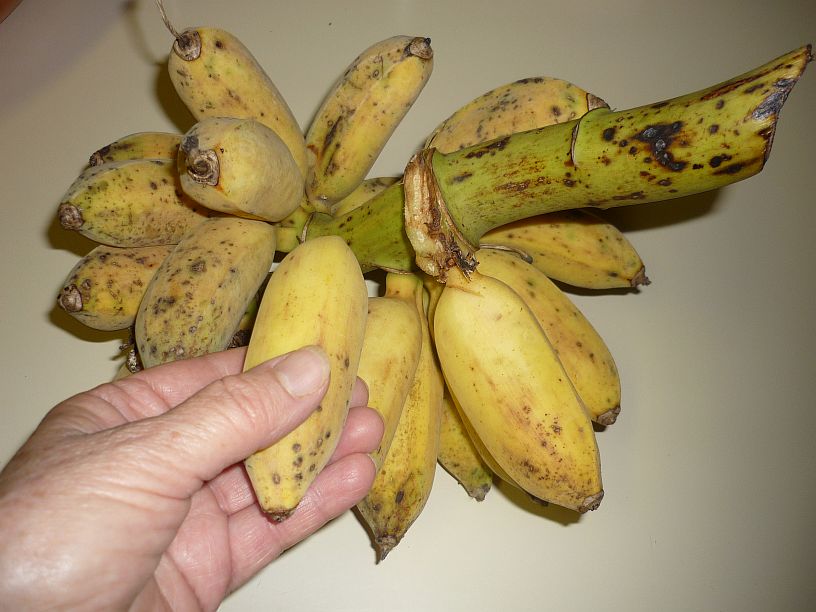
Our grandson, Mark, calls these 'sample' bananas.  They are about half the size of those normally purchased in the store.

Our grandson, Mark, calls these ‘sample’ bananas. They are about half the size of those normally purchased in the store.

It had been a full week, so Saturday provided a nice break.  In the morning we slept in until about 7am, then harvested bananas, nartjies and grenadillas from the garden.  From the other side of the fence, Klaus pointed out another stalk of bananas that we had not seen that were really ripe, so we cut down the whole stalk.  It looks like we will have to give away some, or eat bananas until ‘they come out our ears!

At noon, we were planning on attending the reunion of a  TWR missionary family, who has retired in Swaziland.  They had five girls at the same time we had our five boys.  At the last minute the reunion was postponed, because it was discovered that one of their grand-children’s passport had expired.  Hopefully it will happen before we leave.

This change of plans allowed us to attend the birthday party for Graham’s two daughters that was held in the afternoon.  We had a good time celebrating with them, the other TWR families and a couple from FEBA, former co-workers of Graham.

2013/06/03 — Monday

This Monday was mostly a day of preparation.  The engineers have been finding it impossible to use one of the transmitters on the higher frequencies.  As a result, rearranging the use of the transmitters for each new schedule, which occurs every few months, is more of a challenge.   The schedule must be shuffled in such a way that this one is used only on the middle and lower frequency bands.  Thinking the issue could well be that the THF filter may have migrated from its factory settings, I spent a few hours researching the archives to locate the factory setup information.  This information was then consolidated into a chart to more easily readjustment this transmitter and the other two to their factory settings.

Salema installed a capacitor, that I sent from Elkhart back in February, that finally made it to Swaziland last week.  This required disassembly of some of the driver stage of Transmitter 2.  After Salema got everything back together, I showed him how neutralizing the driver is done.  I hope to review neutralizing of both the driver and power amplifier tubes with the other engineers in the days ahead.

2013/06/02 — Sunday

This Sunday, pastor Deon spoke on James 6 regarding biblical healing (healing of emotional needs, physical needs and spiritual needs) and effectual prayer.

A few of the African animal candles made at Swazi Candles

Last week Ruth had invited us to eat out with her this Sunday, so after church we drove her to Malkerns to a quaint restaurant, Sambane Tea Garden, next to Swazi Candles where we ordered fish to eat.  It was quite nice, especially considering that Swaziland is a landlocked country and fishing is not a vocation.  It was so busy that our waitress seemed quite stressed.  It was obvious that Ruth had been there before and tried to cheer her up.  After dinner, I tagged along with Ruth and Virginia as they checked out the unique candles made here in Swaziland.    http://www.swazicandles.com

We picked up some pizza from Palato’s in Manzini after we dropped Ruth off at her home.  Palato’s pizzas seem to be light on the tomato sauce and heavy on the cheese and are quite good.   We got the pizzas because this evening we had the intern, Jonathan, over for an evening meal.  Jonathan is a mechanical engineering student from LeTourneau University (my alma mater) and plans to be in Swaziland   for eight weeks to help with several more mechanical type projects.

Typical Day in Swaziland…(whatever typical is?) or Virginia’s Ramblings

Since Larry has been doing most of the blogging, I decided that perhaps it is time to give you an idea of what I have been doing.

Our 'home' in Swaziland -- view from auto gate

Our ‘home’ in Swaziland — viewed from auto gate

As I think we have mentioned before, the house we are staying in has 4 bedrooms, none of them tiny, an extra room for an office (the people in this house use it for a playroom), a fairly large area for the

Livingroom -- viewed from dining area -- fireplace to right and two steps up to bedrooms

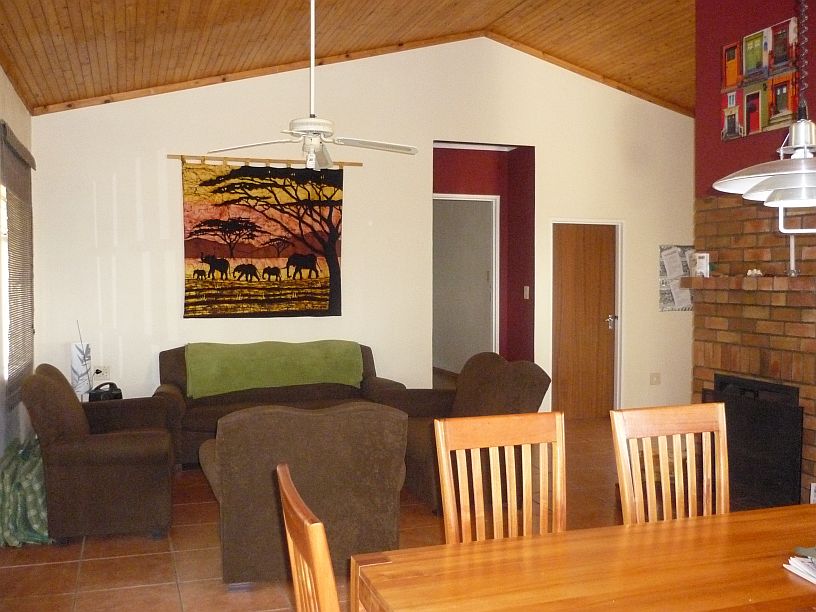
Livingroom — viewed from dining area — fireplace to right and two steps up to bedrooms

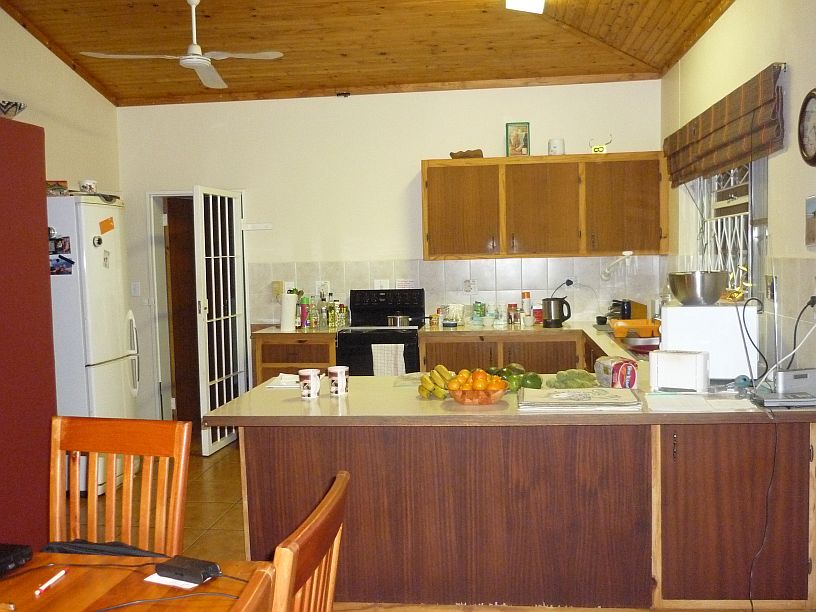
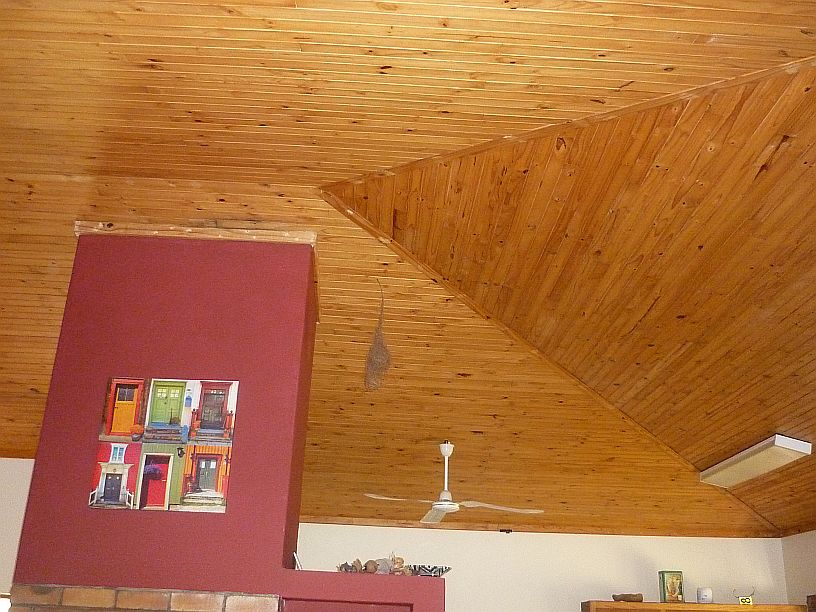
living room and dining area, also a good sized entry area and a bigger kitchen than I have used in quite awhile. The living, dining, entry area and kitchen are all open and the division between the kitchen and the others is a free standing brick fireplace and a bar cupboard in the kitchen. The ceiling in this area looks like knotty pine,

Kitchen -- viewed from dining area -- fireplace to left and gated door to laundry room

Kitchen — viewed from dining area — fireplace to left and gated door to laundry room

but it could be something else. It is a peaked ceiling, and very pretty. We also have a very large laundry

Looking down the hall to the bedrooms with security gate closed

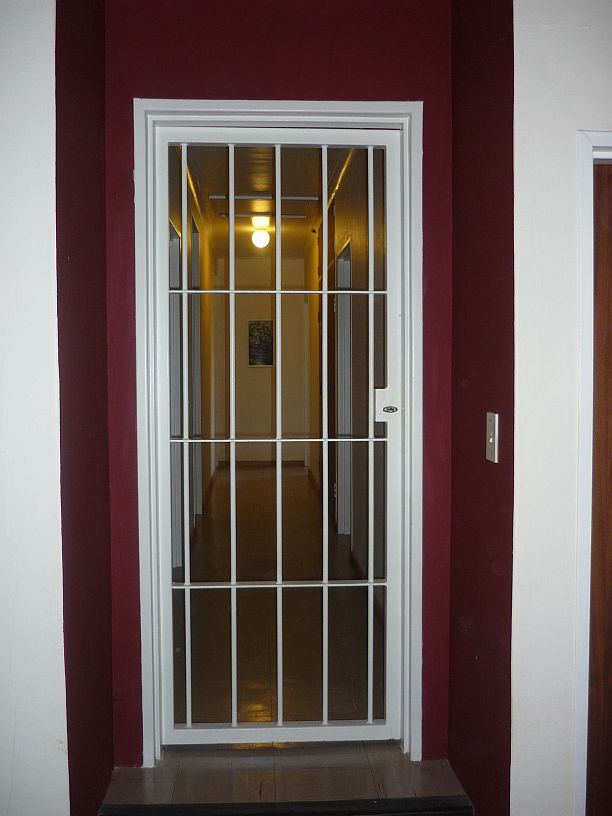
Looking down the long hall to the bedrooms with security gate closed

room with a front-loading, German washing machine. I am grateful for the great instructions that were written out by hand!! There is also a scullery sink, and a half bath in the laundry room. The room is large enough for an ironing board and even a table if one wanted a table for folding clothes. There are two full baths in the main house area. There is also a one car garage and a lovely screened in porch on the back of the house.

View of ceiling over living, dining room and kitchen with fireplace chimney.

View of ceiling over living, dining room and kitchen with fireplace chimney.

One of the previous families who lived here, created some beautiful flower gardens and built a bird aviary, however there are no birds in it and it doesn’t look like there ever were. As you know from previous posts, we also have bananas, granadilla or passion fruit, nartjies or orange mandarins and lemons growing in the yard. We are enjoying them! A neighbor gave us a tree tomato fruit to try. I cut it in half and sprinkled it with a little sugar. Yummy! I think we had some tree tomato in Quito, Ecuador as juice. I really like that.

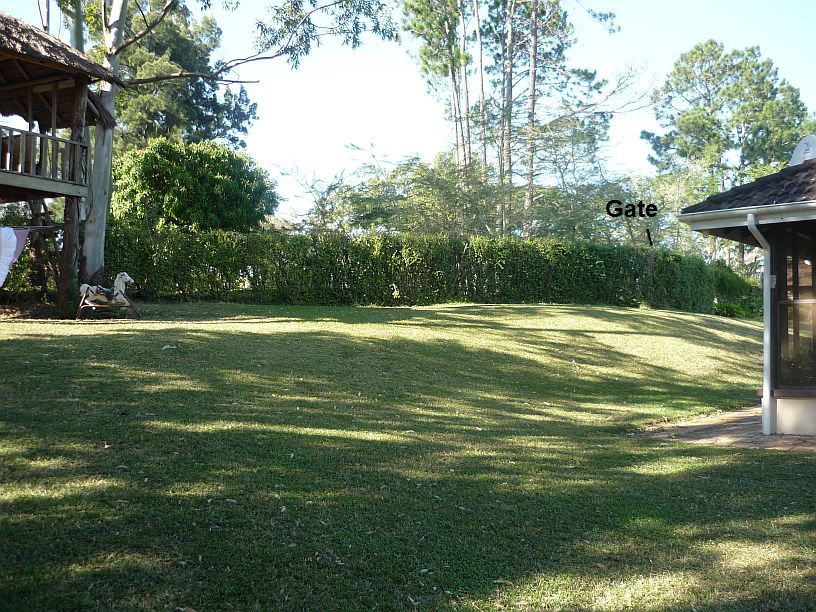
Uphill both ways -- to the clothesline and to the gate to neighbors -- corner of screened porch at right

Uphill both ways — to the clothesline and to the gate to neighbors — corner of screened porch at right

I must also mention that a hill was cut down to make a flat spot for this house. This means that every time I want to visit a neighbor, hang out the laundry, pick fruit, water plants or most things outside, I climb that hill, which is a bit steep. Indiana is not hilly, so the calves of my legs were a bit sore that first week!

Our day usually begins around 5:30 in the morning, before sun up, so we enjoy the beautiful red sunrise every morning. Unfortunately, it is usually to cool to enjoy it and the bird songs by eating breakfast out on the screened porch.

We need to turn the hot water heater on in the mornings for about a half an hour, as electricity is very expensive here and keeping the heater off is a good way to keep costs down. While the water heats, we usually eat breakfast, which is much like home except for the type of juices we enjoy. By the time breakfast is done, the water is hot for showers and we turn off the heater (it is called a geyser here, with a long e and silent y). Larry leaves for the site at 7:00 and I leave at 7:00 one or two mornings a week to go to the office in town and work on inventory of the hostessing equipment. Two mornings a week, I am involved with some of the TWR ladies and others in prayer meetings at 8:00.  The days I am in the office, I enjoy having devotions with our local staff and whoever is in town that day rather than the site.

Most afternoons I am free to do shopping, cooking, and whatever else is necessary. Shopping is much easier to do than it used to be here in Swaziland. It is possible to buy everything at a supermarket. I have been to three large (large compared to the past) supermarkets. Two of them have paid parking and the third (the more expensive, newer one) has free parking. Back when, we had to visit the meat market, the fruit market and then a small supermarket. One also had to be very careful to check for bugs in the dry food that was purchased, which doesn’t seem to be as much of a problem as in the past. We usually got bread at another stop and if any of the places did not have what you wanted, you were most likely out of luck. It is still possible to shop at many different places, but not necessary as it once was. It is so nice to drive to a grocery, buy what is needed and not have to fight the car traffic or human traffic to another shop.

Some days, I am asked to watch the children of the other missionary families. They are sweet children and happy to give out hugs and are FULL of energy! I am glad that I can help out in this way sometimes and make life a little easier for the young moms. We have also had people over for meals, a new mission family and visitors from South Africa. It is more of a challenge with other people’s things, lack of equipment like mixers or similar items. I use a whisk and it works quite well and burns a few calories…maybe. Also, not having a stock of food items to draw from and the fact that I don’t drive here so I can’t run to the store, makes it more of a challenge.

This morning before 8:00, I went out and trimmed a bush that had grown tall enough to set off the motion detector when there was a breeze.  It was buzzing on and off all night. I sure hope the one I cut was the one giving trouble.

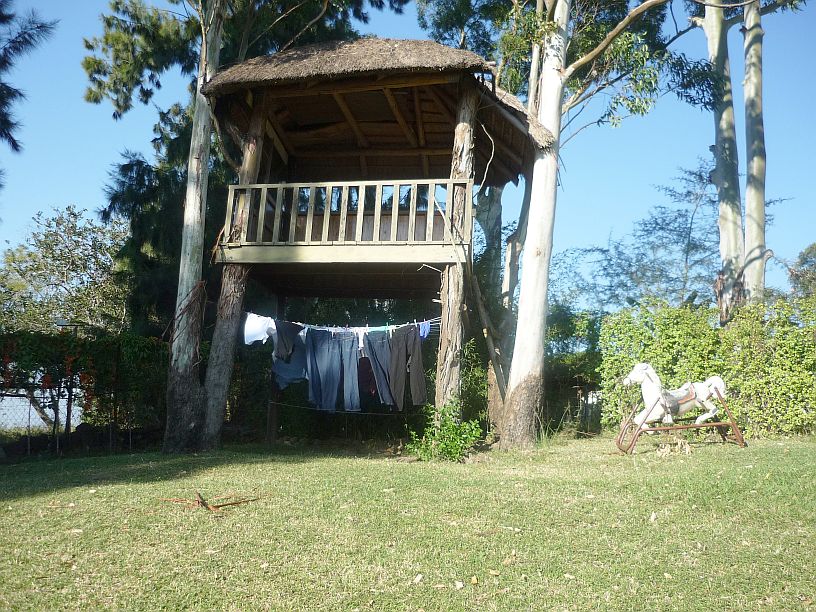
Our Swazi clothes dryer

Our Swazi clothes dryer

I usually have one day a week when I am home all day. That is the day I catch up on laundry, if I have not been able to squeeze it in on another day. Doing the laundry is pretty normal. The machine is different as it heats up the water if it is not hot enough. It also has a digital timer read out, so it is easy to tell how long the load of laundry will take. It is small, so I do more loads than I would do at home. Ialso have to climb that mountain (hill actually) to hang out the clothes. We usually have beautiful sunny, dry days with a nice breeze to dry the clothes, so it is a joy to do and to smell the fresh outdoor smell when they are brought in.

View of Execution Rock (in Mlilwane Game Park) from the Guava Gallery  Lorraine, Inge and I hope to climb it in a couple of weeks.

View of Execution Rock (in Mlilwane Game Park) from the Guava Gallery. Lorraine, Inge and I hope to climb it in a couple of weeks.

After I have done the necessary things for the day, I do have my Kindle to read and I brought along quilt pieces to keep me busy. I have not had much time to work on the quilt, but I do get quite a bit of reading done, waiting for the computer to load. But if the computer is too slow, I wash dishes or sweep the floor instead of reading.  Some days, I take my quilting to another missionaries home and work on it while they work on a project.  If they need help, then I am there to try and be helpful.

Appletiser -- carbonated 100% apple juice

Appletiser — carbonated 100% apple juice

One day last week Lorraine and I took a day off from doing the inventory. We and another friend decided to go to Guava Gallery for lunch. Guava Gallery is an outdoor restaurant with a shade roof that also has an art gallery, Consulate for Finland and you can buy silver jewelry. It is run by a Finnish man and his wife and he is a silver smith who is teaching Swazis how to use silver to make beautiful jewelry using local products and their talents. They also have a few other types of art there for sale and all made locally. I enjoyed an Appletiser with my lunch that day. An Appletiser does not have an equal in the U.S.

One in a blue moon you will see a blue monkey sitting on a turtle!

Once in a blue moon you will see a blue monkey sitting on a turtle!

Sundays, we attend the same church we attended when we lived here.  The pastor is doing a study in Revelation.  I can’t remember when I last heard a study on that book!  Maybe when my father-in-law was pastor at the church I attended growing up?  I know he really liked that book and enjoyed it.  It showed in his teaching of it.   Pray that we can be an encouragement to the local church here.  There are many areas where an extra pair of hands would really be appreciated.  They have a very active AWANA group and ladies and mens groups.  Pray for these outreaches.

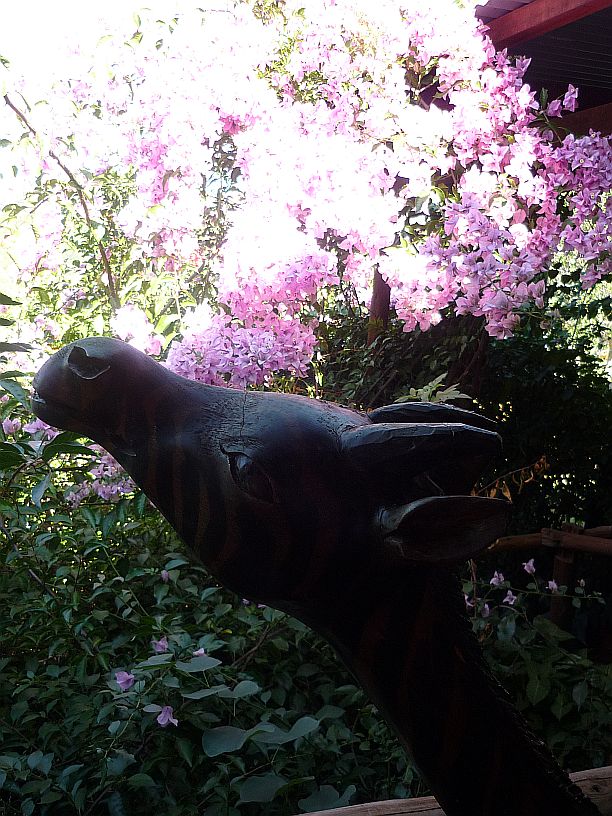
This carved giraffe appears to be smelling the bouganvillia

This carved giraffe appears to be smelling the bouganvillia.

In the evenings after supper, we often play Rummikub, catch up on email, and Larry studies for the class he is teaching.  Usually the sun is down before he returns from work and  goes down as the same red ball of fire as it is when it comes up in the morning.

Great is Thy faithfulness!