22 Oct 2010 Friday

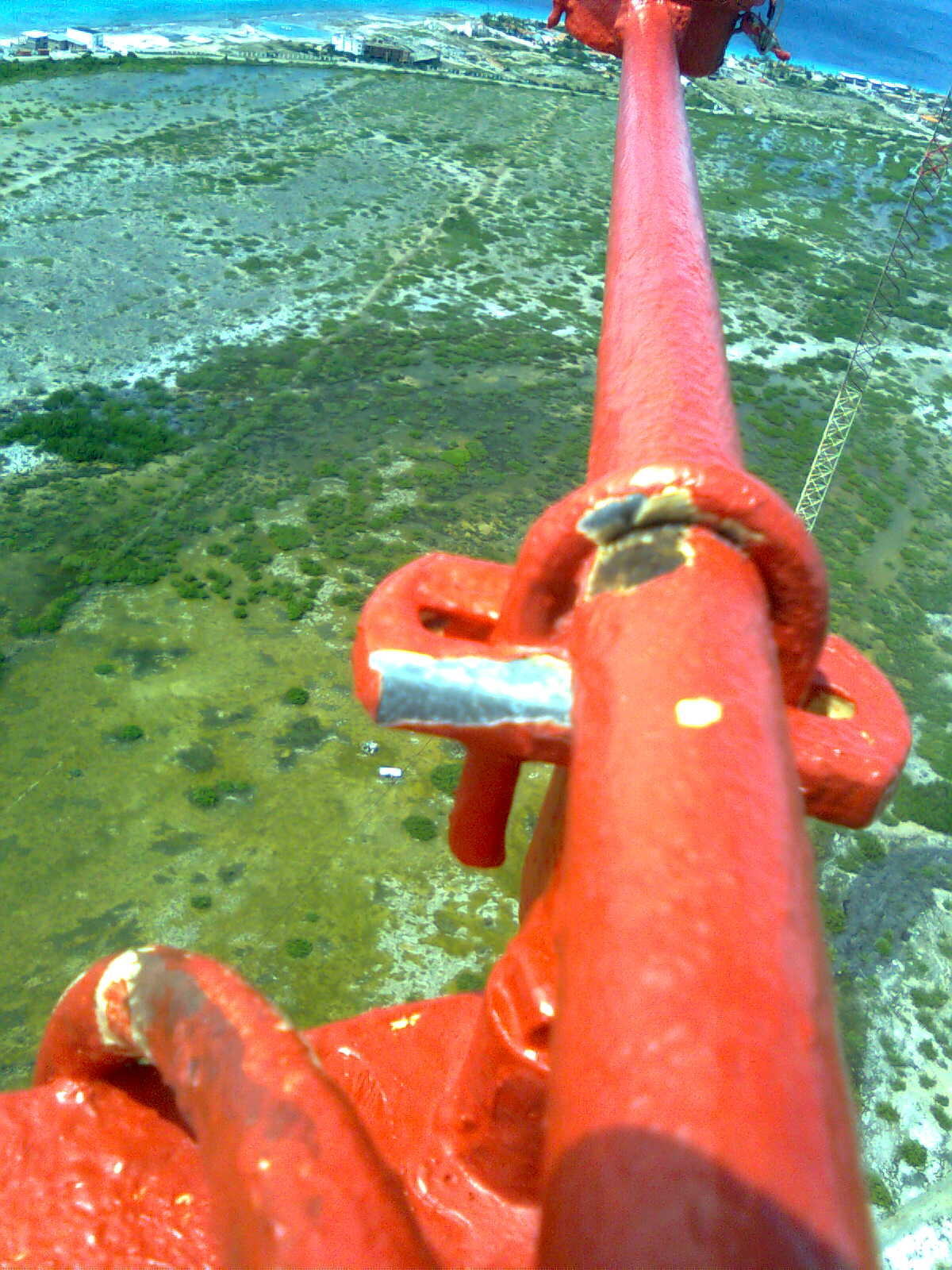
Lighting struck the pipe holding the light fixture (just out of view at top)

When I arrived for devotions, Joe Barker was already involved in a meeting (via conference call) which lasted a good part of the day. The rest of us (Bob, Donna, Benny, Lionel and I) had devotions and a time of prayer before starting our day.

Bob picked up the VCR, that I had ‘repaired’ earlier in the week, for use in the adult class on Sunday.

My first task of the day was to locate prices and availability of parts to repair the tower light that got shattered by a lightning
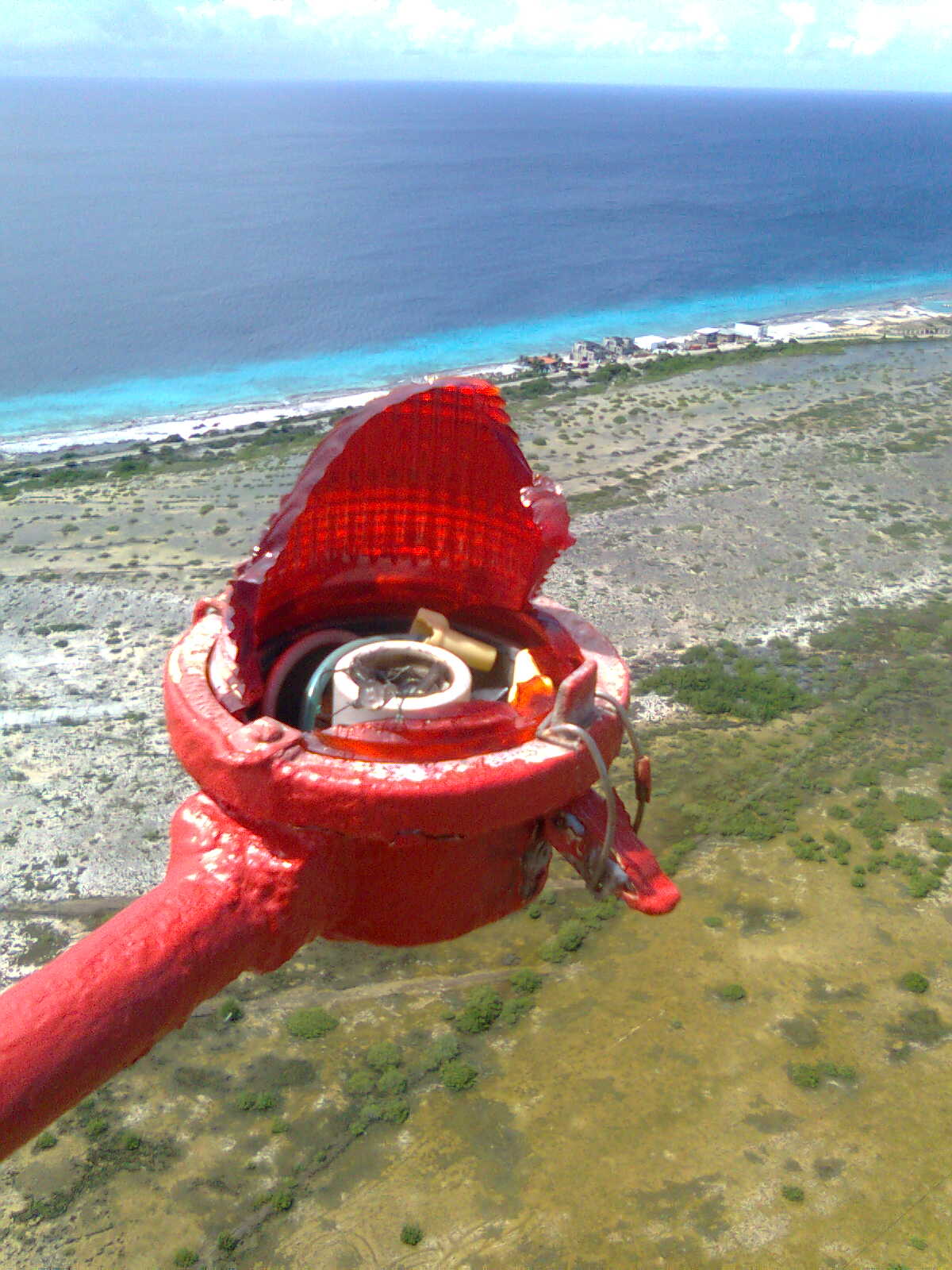
We believe the concussion of the strike shattered the glass
strike. It proved to be an intriguing phone call when they asked the name of our company, because the name of the company I was calling was TWR Lighting! The price of a replacement red glass is $44. There are also little pieces of 1/16 inch stainless steel aircraft cable that are use as safety cables so the red glass will not fall if it slips out of the hands of the one changing the bulb. The atmosphere in Bonaire is so corrosive that these cables fail, so I asked about the cost of replacing them. Also looked at the possibility of using another supplier for the cables.

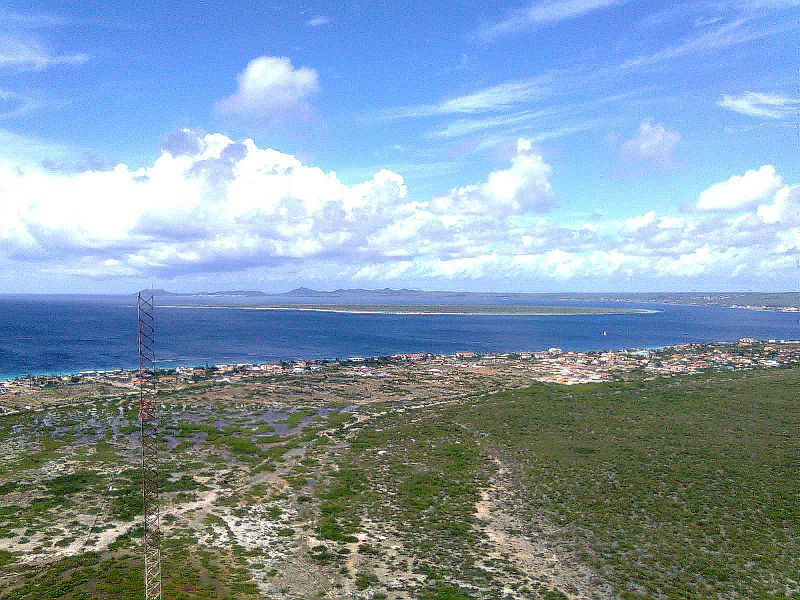
Looking north from tower 3 -- tower 1 in foreground, Klein (Little) Bonaire island off the east coast, and 'mountains' of Bonaire in the far distance.

Yes, it would have cost a little less, but, with the additional shipping cost and hassle of paperwork for a second supplier, decided it was not worth it.

I ate lunch at home with Virginia, then she took me to the transmitter site so she could have the car for the afternoon. I had checked the
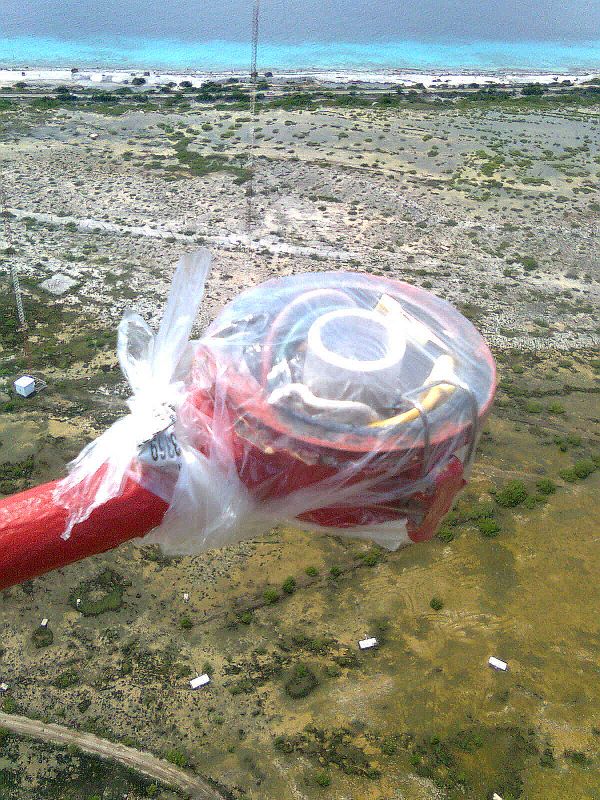
Plastic covering to reduce corrosion -- a replacement glass will be taken from some lower lights tomorrow. Looking west, if you look closely, you can see tower 4 on the left and tower 2 just 'above' the light fixture. Notice how close the Caribbean Sea is!

transmitter at about 6am and found that there were a couple of cutbacks in power since yesterday. Decided to back off the audio by 0.1dBu for the overnight broadcasts so the level is now only 0.1dBu higher than when no cutbacks were experienced a couple of days ago.

Before going to the site, I found two types of electrical cleaners to see if one of them could remove the residue of the insulating material that I attempted to remove yesterday, with no success. Neither one of these cleaners worked any better than the rubbing alcohol, so I decided to search around for some alternatives. Since painting of towers and other structures are an
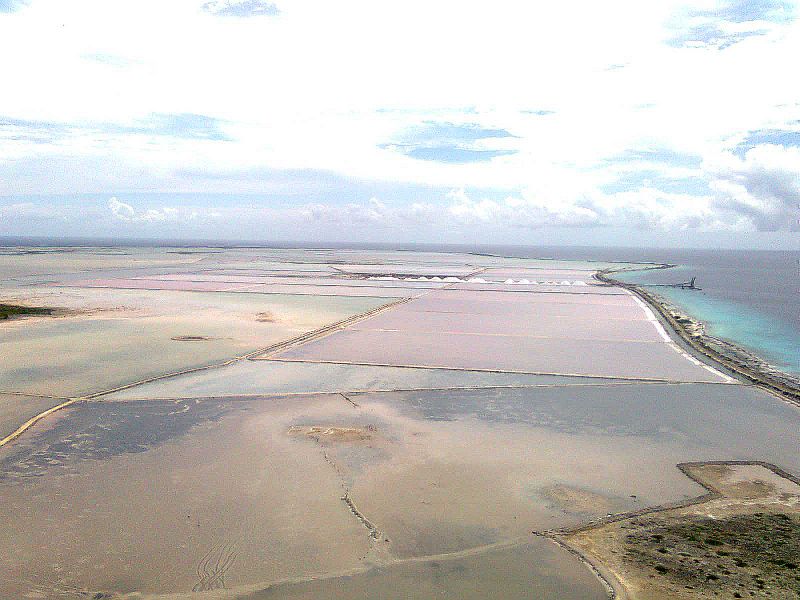
Looking south, there are miles of salt pans starting at the edge of TWR's property, 'mountains' of salt and the facilities for loading ships.
ongoing need, due to the corrosive atmosphere, I figured there must be some thinners for the necessary oil based paints. [Tower manufactures now days use high quality water based paints for environmental reasons. The paints last for many years in most places, so they are astonished when told that rust begins within weeks here

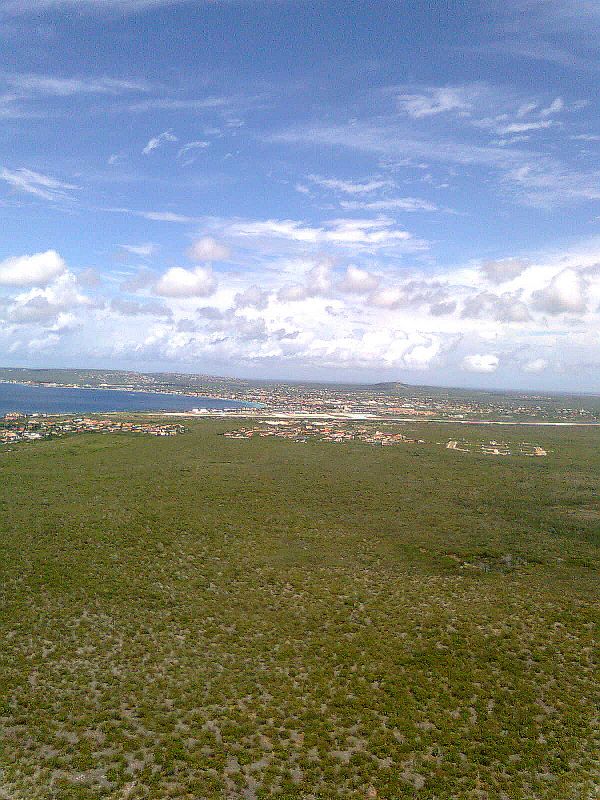
NNE of the tower is the harbor and capital city of Bonaire, Kralendijk. If you look closely, the airport runway is visible, just south of the main part of town. We are staying about 1/2 mile north of the airport about 100 yards from the coast.

on Bonaire.] I found the thinner and it cleaned the residue off completely within a few seconds!

I was now able to complete the reassembly of the modulator module within about an hour. Only hit one snag when the manual stated the nuts for mounting the power transistors were to be torqued to 4 inch-pounds. I found the tool to do this but no adapter to allow it to torque the special socket — remember the thin wall 5mm socket that we had to make? Finally I found a screwdriver bit, which was about 5/16 inch wide, that fit the tool. By inserting the screwdriver end into the 1/4 inch drive end of the 5mm socket, I was able to use the tool to torque the socket. Fortunately 4
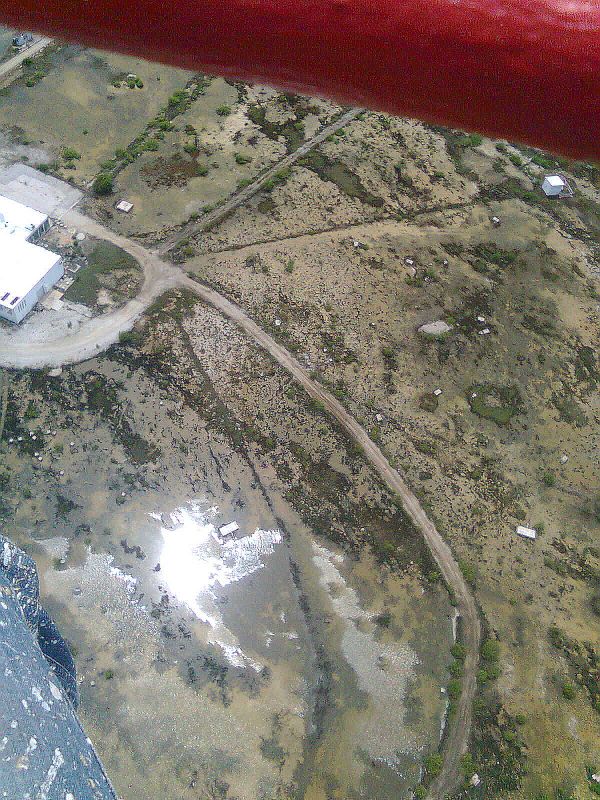
If you are queasy of heights, like I am, DON'T look down! Lionel took these photos. That's his paint-splattered pant leg in the lower left of this photo.

inch-pounds is not much torque!

Now the modulation module was installed back into the PA module and measurements made that showed everything looked OK. The manual mentioned some special cables that could be used to test the PA module at 48 volts before applying the full 300+ volts. I searched all over for these cables and decided there must not be any. Joe checked with Nautel to see if they were supplied with the transmitter and was told that they were not. We decided we would just have to trust our work and apply full voltage, but decided to wait until Monday. Later Joe received a message from Nautel, that special cables had indeed been supplied. Guess that I will be looking some more on Monday.

Virginia picked me up about 5:20pm, we went swimming at Bachelor Beach. I think we used to call it Lime Beach. Virginia then served a birthday supper (beef, gravy, rice and baked french fries) and dessert (brownie and ice cream) for my 64th birthday. God is so good in every way!

NOTE — To see a bigger (and in some cases, expanded) version of any of the images in this blog, just click on the one you want to see.
21 Oct 2010 Thursday

I was at the transmitter site again this morning about 6:30 to see how well the transmitter operated overnight. There were no cutbacks and no other faults on the log. Even though the audio input had only been reduced by 0.5dBu yesterday, this slight reduction seems to have solved the problems we were having. I decided to gradually increase the audio levels over the next few days (today by 0.2dBu) to determine maximum performance with minimum faults. We’ll see tomorrow what effect this has.

I came back home, showered and ate breakfast (my normal Corn Flakes — $3.70 for 12 oz box), then Virginia and I went to the office. Virginia worked as receptionist and I wrote some reports. Also checked on the Swaziland shipment. One document needed to be done yet this morning to avoid delaying the shipment and it looks like it was submitted in time.

After lunch I headed to the transmitter site. I found Benny and Lionel in the building looking at the remains of a tower light fixture. Lionel had climbed Antenna 4 to replace some burnt out light bulbs and found not only that the top light was bad, but that the red glass cover was shattered. Lionel found some obvious burn marks on one of the tower legs close to the light, so we assume lightning had struck the tower and caused the damage (in spite of there being a lightning rod to prevent such damage!). He took a picture of it with his cell phone and I hope to get a copy of it tomorrow to put in this blog entry. Since there are no spare red glass covers, they are planning to take one from the lower level and put it on the top. When a replacement arrives they won’t have to climb as high to replace it.

Now that the water has dried up enough to get to the towers without walking in deep mud, I did an inspection tour of the antenna arc gaps and the antenna tuning units (ATUs) at the the base of each of four towers. I found a few things that seemed abnormal:
–There had been recent arcing on the Antenna 4 gap (could it be related to the above paragraph?)
–The arc gap on Antenna 3 seemed about twice as wide as the others when it should be only about 40% wider. We’ll have to verify and correct this, if necessary.
–Inside the ATUs, some relays to control the RF switches were loose in their sockets, in spite of having special retainers to hold them in. I found some loose screws on the retainers and tightened them.
I didn’t realize how hot it was inside the ATUs until I stepped outside and felt the ‘cool’ 90F breezes!

Next an inspection was done of the phasor inside the building. Everything in it looked fine. The output of the transmitter goes into the phasor which distributes the right amount of power and the right phase to each tower via that tower’s ATU. In the case of this antenna system, there are switches in the phasor and each tuning unit to allow three different patterns of radiation — north, south and non-directional. These switches can make changes in less than one second.

Next I did some more work on the modulation module repair and hit a snag when the manual stated to replace the insulating material under the power transistors. There is new material on hand, so I removed the old. The manual said to use solvent to remove any remaining residue of the old one. Unfortunately, there was a thick residue and all I could find to try to clean it was rubbing alcohol. Worked on this for about 30 minutes, but residue still remained. Will try to find a source of a better solvent before returning tomorrow.

We attempted to go for our evening swim, but found a large group of people in formal attire with fancy cameras taking pictures. We decided they must be taking wedding photos or there was some other kind of news-making event taking place. In either case, we figured we shouldn’t be around and came back home.

Virginia made a nice supper of chicken and rice with curry and gravy. She also found some frozen green beans to go along with it. Of course, there was iced tea to drink. We drink lots of ice tea!

After supper, Virginia decided to make some apple-strudel muffins for tomorrow. She had the batch made and put into paper baking cups in a muffin pan to put in the oven. Even though the oven pilot light was working, the oven would not come on. Fortunately there is a toaster oven in the kitchen (maybe that’s why its there!). Since the muffin pan was too big to fit, she set the paper baking cups in the pan for the toaster oven. The results are still very yummy, but the muffins were square on top and slightly flatter than normal muffins. Virginia took a photo of them, so it might appear in her blog entry or maybe here.

20 Oct 2010 Wednesday

It’s a good thing we went to sleep early last night. This morning I headed to the site about 6am to observe the transmitter operating at full power with programming and under normal operating conditions. I’m glad that I did. Multiple ‘shutbacks’ were observed where the transmitter shuts down for 0.2 seconds to clear a possible arc, or other fault in the system. I also observed that the audio level was extremely high and recorded more than sixty flashes of the 100% negative modulation light in a period of one minute. I would consider this as fairly extreme over-modulation. After breakfast and devotions at the office, this information was conveyed to Joe Barker and we did a test from the office.

The transmitter and audio levels at the site can be remotely controlled via the internet, so we turned on the transmitter with the same antenna, same level of audio and even the same program that caused the most problems two days before. The only difference was the time of day. During this short test we heard multiple ‘glitches’ within a few seconds, which were to us indications of ‘shutbacks’. We then reduced the audio level by 0.5db and heard no ‘shutbacks’. As mentioned in a previous blog entry, a 1db change in level is barely perceptible, so this is half of perceptible! We decided to leave things at this level and see how the transmitter reacts. This means I will likely head to the transmitter site again in the morning at about 6am. Short night tonight.

Today the truck arrived in Elkhart at about 1pm to collect the 50,000-watt AM transmitter for Swaziland. The crew there quickly went to work and got it all packed and secured in just over two hours. Please pray that it will travel safely and on time to the port. Pray also that a couple more pieces of paperwork that must be submitted tomorrow morning can be processed quickly.

Virginia felt much better today and we resumed our evening swims. The sunset was amazing once again, The haze level was low and, with no clouds where the sun was setting, it liked like an incredibly really bright orange ball. Unfortunately we didn’t bring our camera this time! Also, saw at least three crabs scurrying around our feet before we got into the water.

Virginia got to bed at a reasonable hour tonight, but I finished putting photos on two of her blog entries, talked to Allan on Skype for almost 20 minutes, then worked on my blog entry for today. Now it is well past time to say good night!

19 Oct 2010 Tuesday

Maybe I spoke too soon! This past overnight the transmitter had two cutbacks in power to 75kw from 100kw for relative short periods of time, plus a ‘modulator protect’ alarm. After reviewing this information (plus my observation that the transmitter appeared to be over-modulating) with Joe Barker, the audio input was reduced by 0.1db. For comparison purposes, 1.0db is a barely perceptible drop in level. I also reviewed the transmitter manuals about what causes cutbacks and then tried to find, without success, the parameters that allowed its return to full power. We knew that it did, but why, in some cases, did it recover to full power within a few seconds and in other case it took a few hour?. Since this was not in the manual. I finally ended up calling Nautel, the manufacturer, who emailed this information to us. I thought about putting the information in this blog, but there are 6 different levels of cutback and 6 different recovery times. With this new information, we can now proceed with a clearer perception of what is actually happening.

I spent the afternoon at the transmitter site continuing to troubleshoot the faulty modulation module in the PA module. The manual stated to remove resistor R4 and test six different diodes. When I did this all the diodes appeared bad, so I removed them one at a time, finding each one removed was good but the remaining ones were bad. After all were removed and tested good, it appeared the manual had a misprint and that a different resistor should have been removed to do the diode test! So now I had to reinstall all the good diodes. Next step will be to reinstall the three good power transistors and replace the one bad one.

About 4:40pm, I headed to the office to pick up Virginia at 5pm, but wanted to stop by the house to do a little ‘decorating’, since it is our anniversary. Got to the office on time, barely, but Virginia was feeling lousy with a bad cold and runny nose. She said she did not feel like our usual nightly swim and instead of going out to eat, we picked up some Chinese carry out (sweet-and-sour chicken)and are at home at our ‘decorated’ table. It was very good. We both went to sleep early.

18 Oct 2010 Monday

Praise the Lord — not even one cutback in power on the transmitter last night or this morning! The water around the antennas is drying up and it appears the bugs are going away, too.

Just before 9am this morning I called (via the internet) the Technology Center in Elkhart and the men there were waiting for the truck to arrive with the container to pack the 50,000-watt AM transmitter for Swaziland. A short time later, news came that everything was now rescheduled for 9am on Wednesday.

For the rest of the morning at the office/studio, I repaired a VCR player that was giving problems, then searched for the equipment that I needed to proceed with repairs to the spare PA Module at the transmitter site. There are lots of tools and parts here, but, especially for a new person like me, it takes a while to locate what I need.

I stopped by our house* to eat dinner with Virginia. Often she will drive me to the site so she can have a car for the afternoon, but today she had a sore throat and decided she did not want to go anywhere. Pray that she will be able to fight off what ails her!

At the site, I managed to change the crowbar transistor on the filter board between the Modulator and RF Amplifiers. That board now seems to measure OK.

While I was doing this, Benny Saragoza, back for his first day from vacation, turned down the O.D. of a 5mm deep socket to 7mm. This was the tool I needed to take the transistors off the heat sink of the RF Amplifier. Actually I was amazed that a regular cutting tool could do this to a Craftsman socket. I thought the socket material would be harder than that and had been planning to use a Dremel motor with grinding wheel in place of the cutting tool on the lathe.

I then began the process of checking the transistors on the RF Amplifier. Since there are four in parallel, I took them off one at a time. Wouldn’t you know it, the first three that were removed were OK and the fourth was the bad one! Will also need to check a few more devices on the RF Amplifier board to make sure the one transistor is the only thing that is bad.

By this time, it was almost 5:30pm when the transmitter comes on, so I waited a few more minutes and completed some log readings. I then headed home for our 6pm swim, then a light supper.

Talked to Allan, Joyce and Mark on Skype this evening. Modern technology is amazing, especially when it comes to communicating.

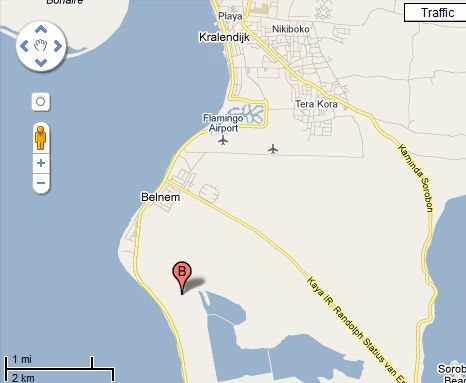
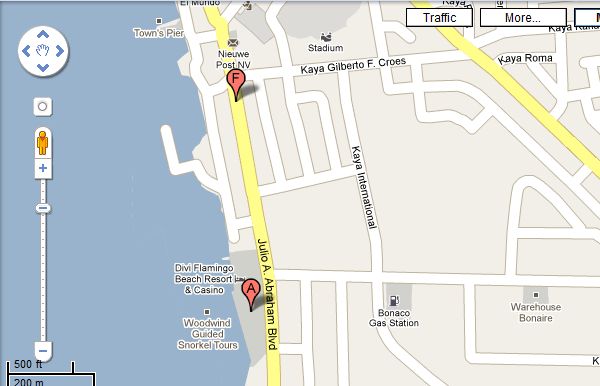
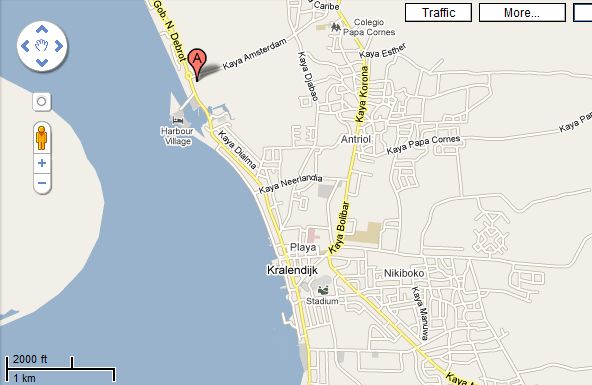
*For reference, our house is about 1/2 mile south of the town of Kralendijk. The office/studio is about 1-1/2 mile north and the tranmitter site is about 6 miles south. Use this link:

http://maps.google.com/maps?f=q&source=s_q&hl=en&geocode=&q=Kralendijk,+Netherlands+Antilles&sll=41.621363,-85.915441&sspn=0.006657,0.01678&ie=UTF8&hq=&hnear=Kralendijk,+Bonaire,+Netherlands+Antilles&z=14

Or go to ‘www.maps.google.com’ and enter ‘Kralendijk, Netherlands Antilles’

If you zoom in one click using ‘map’ view, you should see just south of the city center a label on the coast for Divi Flamingo Beach Resort. Our house is across the street and we use that beach for our evening swims.

If you follow the main coast road north of Kralendijk you will come to a circle (the only one on the Google map, but there are now two more). TWR’s office/studio is on the SE corner. If you zoom

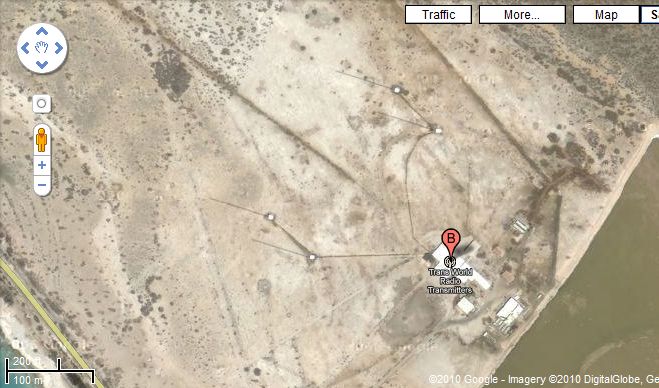
B at Transmitter Site

in enough, there is a label for Trans World Radio Studios. On satellite view you can see the building even through the cloud.

The transmitter site is a little harder to find, but if you use satellite view and go south of town and the airport on the coast road, you will see the outline of salt pans. If you zoom in on north side of the north-most salt pan along the road, you will see one large building and two smaller ones. If you look closely just north and west of the main building, it is possible to see the four towers, with shadows (the photo must have been taken around 8am), and the antenna tuning huts.

NOTE — To see a bigger (and in some cases, expanded) version of any of the images in this blog, just double click on the one you want to see.