2014/07/23 — Wednesday — Connector Fabrication

The proofread copy of our August McGuiReport was returned to us, so I took a few minutes before work to make the suggested corrections and update our travel plan information, now that our air tickets have been purchased.

My first task of the day at the transmitter site was to document what was done on the PA inductor yesterday, and outline what still needed to be done, then submit this information to Mike.  Hopefully, he can have the final improvements done to the coil, once the newer design of leaf springs arrive.

Mike wanted me to verify that TWR Guam’s vector impedance meter (VIM) was measuring correctly.  This needs to be done to insure that it is ready to use when it becomes time to verify that the antenna switch matrix impedance is acceptable before putting the matrix into service.

The probe of the meter has a very fragile tip, which is vulnerable to bending, or breaking.  These tips are obsolete and very expensive to replace, if one can even be found.  I was looking for a special connector that would protect the tip and connect directly to the N connector on the balun.  [Since the transmission lines are unbalanced and the meter has a balanced probe, it is necessary to use a balun to get accurate measurements.]  TWR Swaziland has this same model of VIM and it came with a kit of special connectors.  Unfortunately, the special connector that I was looking for could not been found and no one was aware that there had ever been one.

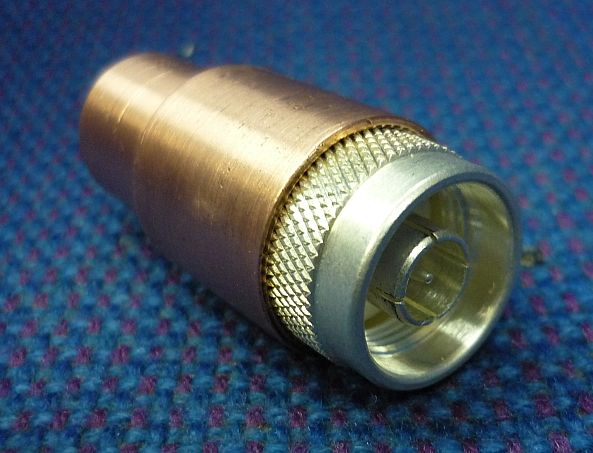
After a bit of searching, I managed to find some parts to make a special connector using a type N cable connector and other parts in the transmitter stockroom and in a back room with plumbing fittings.

The first part used was a 3/4 to 1/2 reducer for rigid copper pipe.  I was amazed -- the large end was a perfect press fit over the N connector and the smaller end was a perfect snug fit over the outside of the probe.

The first part found in the plumbing stock was a 3/4 to 1/2 reducer for rigid copper pipe. I was amazed — the large end was a perfect press fit over the N connector and the smaller end was a perfect sliding fit over the outside of the probe.

This gives some idea of how the special connector will fit together.

This gives some idea of how the special connector will fit together.

The next challenge was to make a contact for the tip of the probe.  I remembered the connector pins that we replaced on the servo motors.  One of these mated perfectly to the probe pin.  The solder end of the center pin of the N connector, that is usually soldered to the center conductor of the coax cable, was then enlarged slightly — just enough for the connector pin (used for the servo motor) to be pressed into it. [Hope to have photos of this in our next blog entry.]

By now, it was quitting time, so we’ll plan to finish this tomorrow.

I did two projects after arriving at our apartment.  The balcony walkway on our apartment tends to flood, especially when rain comes from the west.  I managed to get two of three drains unplugged earlier, but the third one (nearest our door) seemed to be blocked with cement,  It was probably never opened after the concrete forms were removed.  I brought home a long punch this evening.  After a couple taps with the hammer, a 1″ long plug of cement popped out and the puddle of water drained quickly.  No more need to wade out of our apartment!

The second project was replacing the ceiling fan light switch in the second bedroom, where we do all our computer work.  The light switch had gone bad, so we had picked up a replacement switch while in town on Sunday.  After using a table lamp for the past week, It was nice to have plenty of light again!


2014/07/22 — Tuesday — Rainbow Greeting

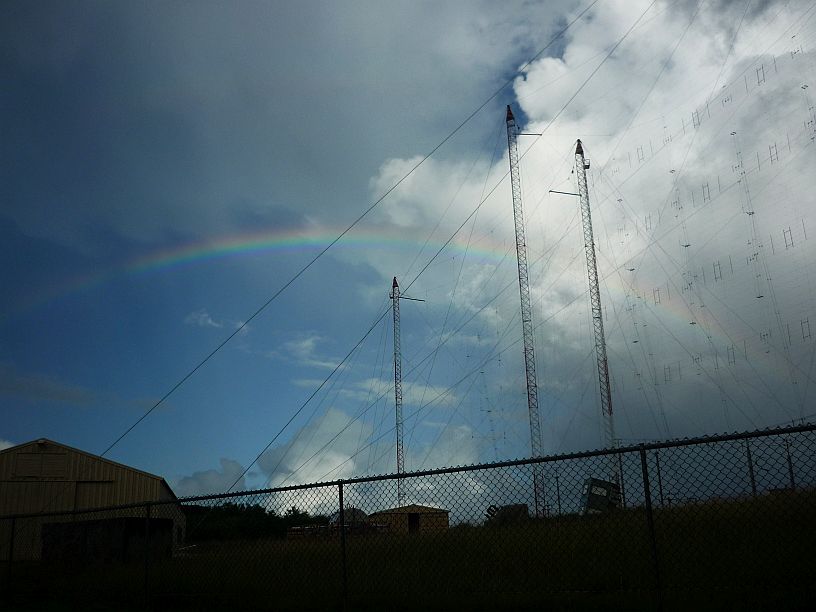
Here is a photo of the beautiful rainbow we saw arching over the transmitter site when we arrived this morning:140722 -- RainbowMy goal for the day was to improve the performance of the PA inductor that I inspected on Friday.  One of two thin shims was removed under one of the idler roller carriers.  The idler rollers now only touched slightly in one spot and the drive shaft of the inductor turned much easier.

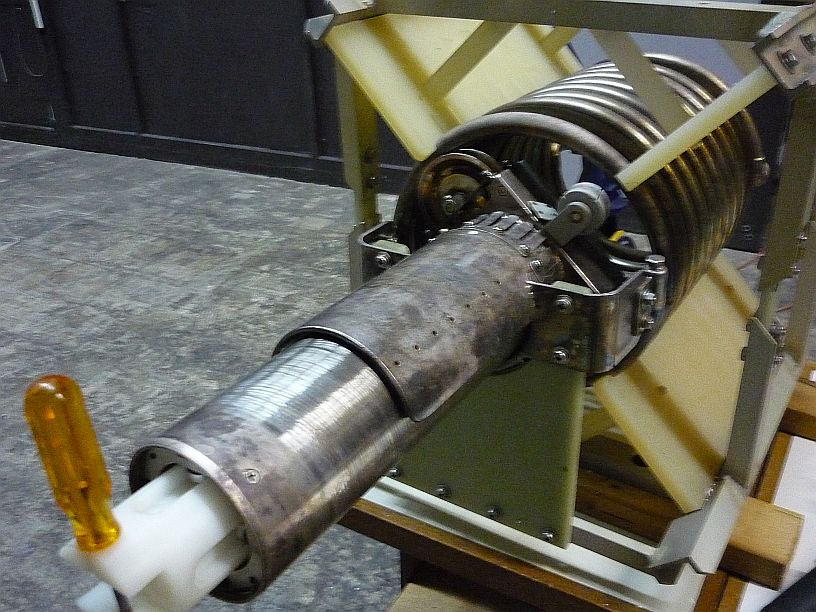
This is the shim that was removed resting against the carrier from under which it had been removed.

This is the shim that was removed resting against the carrier from under which it had been removed.

The plastic splined drive shaft is supposed to move in-and-out freely, but was too tight.  It is supposed to be just tight enough to not allow backlash when changing direction.  Absent a milling machine to slightly widen the slot in the spline, I tried a file, and sandpaper with little success.  Evently, I scraped it with the blade of my pocket knife.  It was a slow, tedious process, but it did the job!

The white plastic drive shaft, at the left bottom of the photo, pulls out about a foot further than seen here.

The white plastic drive shaft, at the left bottom of the photo, pulls out about a foot further than seen here and needs to slide easily with no backlash when rotated.

This evening we took a step of faith and purchased air tickets for our month-long trip to Swaziland starting in mid- October.

2014/07/21 — Monday — Liberation Day 70th Anniversay

We woke up wondering if we would still be going to the Liberation Day 70th anniversary parade.  It had been pouring down rain most of the night.  Everyone decided to give it a go anyway.

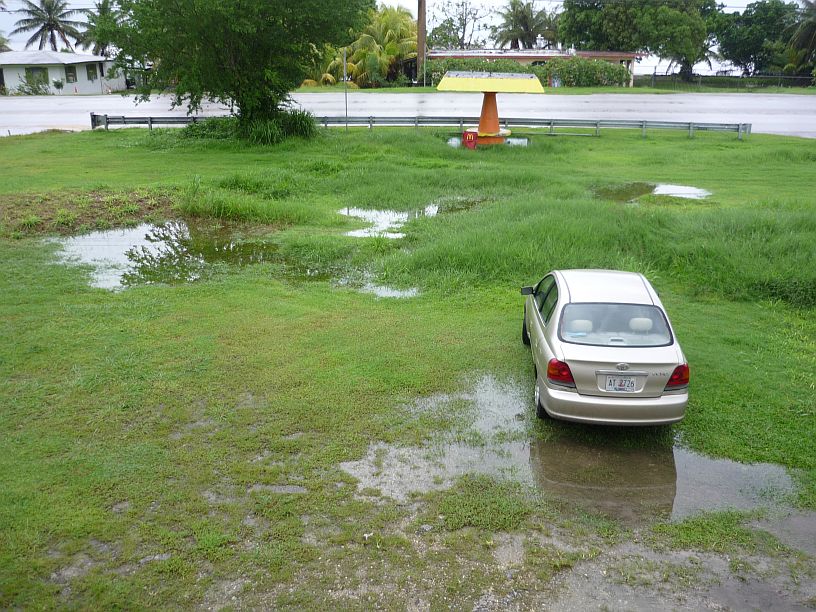
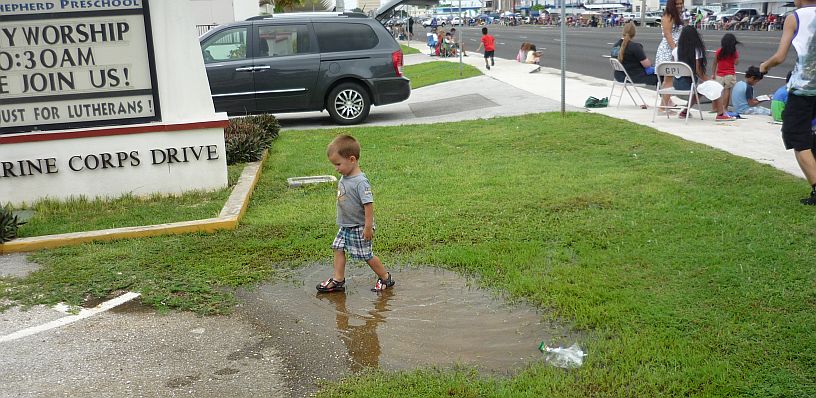
The front yard of our apartment showing the effects of 4 inches of rain.

The front yard of our apartment showing the effects of 4 inches of rain.

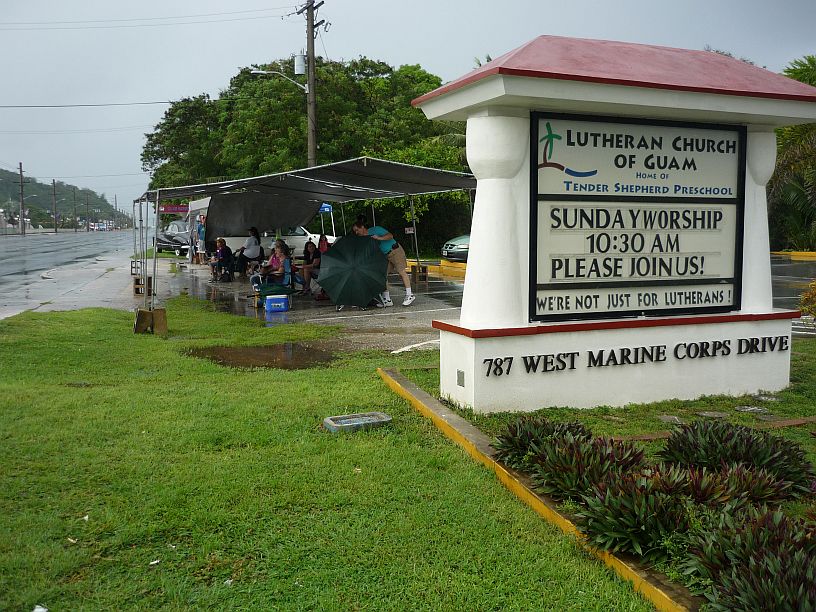
TWR staff, that were going to the parade, met at the apartments.  We all went in two vehicles.  Virginia and I rode with Grant and his family and parked just up the hill from the Pacific War Museum on Route 6.  We walked down the hill to Marine Corps Drive (Rt 1) then east to find a good place to set up our folding camp chairs.  We had walked about 1/2 mile when someone from the Lutheran Church invited us to sit under their canopy.  What a fantastic opportunity to stay out of the intermittent rain storms — much better than just our umbrellas!

Thanks to the hospitality of the Lutheran Church, we had some protection from the rain and/or sun.

Thanks to the hospitality of the Lutheran Church, we had some protection from the rain and/or sun.

Some of the TWR staff that observed the parade.

Some of the TWR staff that observed the parade.

The parade was supposed to start at 9 am.  It rained fairly heavy until about 9:15 am.  It was about 9:45 before the honor guard reached us.  We were near the end of the route, about 1.5 miles from the start.

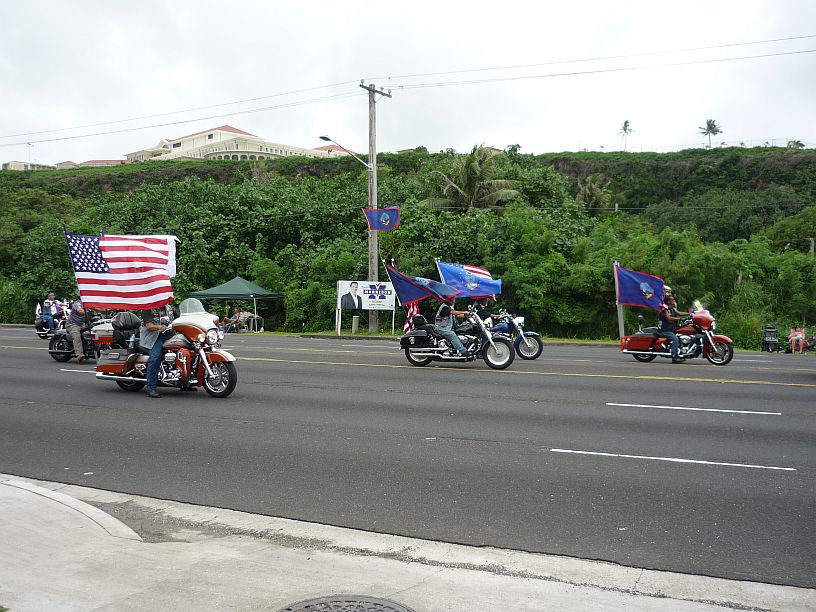
Before the parade officially started, bicyclists and motorcyclists drove the parade route.  Out of about 100 motorcycles, only two were not Harley Davidsons.  The flags are showing the direction and velocity of the wind.

Before the parade officially started, bicyclists and motorcyclists drove the parade route. Out of about 100 motorcycles, only two were not Harley Davidsons. The flags are showing the direction and velocity of the wind.  The building on top of the hill is the new Navy Hospital.

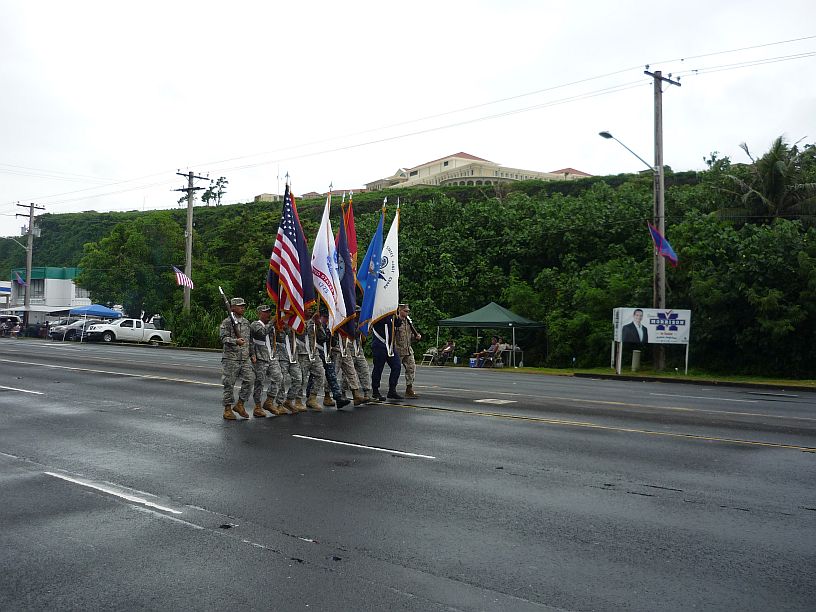
The honor guard reached us about 9:45 am.

The honor guard reached us about 9:45 am followed by several marching military units

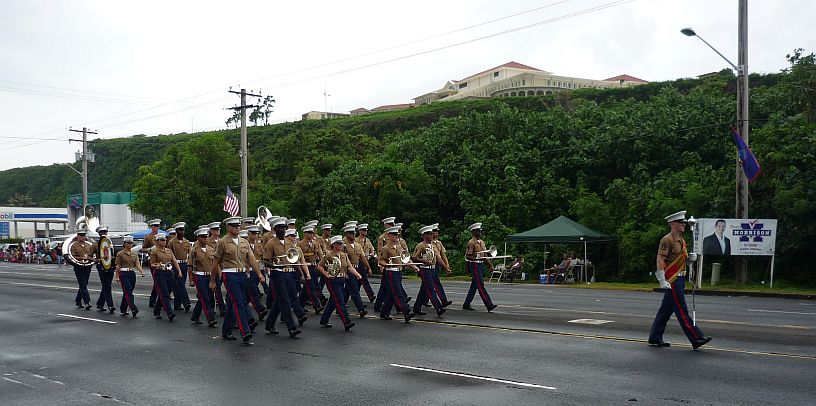
Military Marching Band

Military Marching Bands

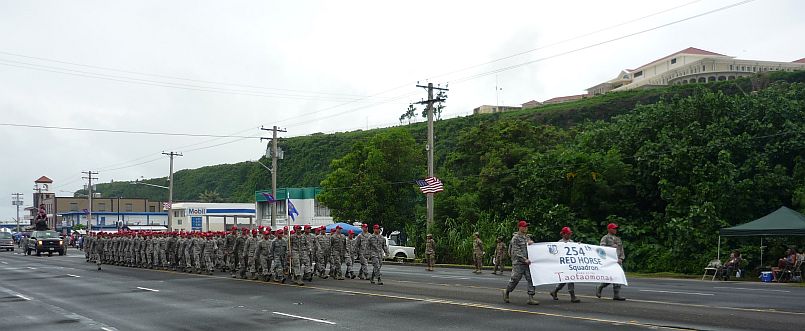
The Red Horse squadrons are the Air Forces equivalent to the Navy Sea Bees.  They are the heavy-construction units.

The Red Horse squadrons are the Air Forces equivalent to the Navy Sea Bees. They are the heavy-construction units.

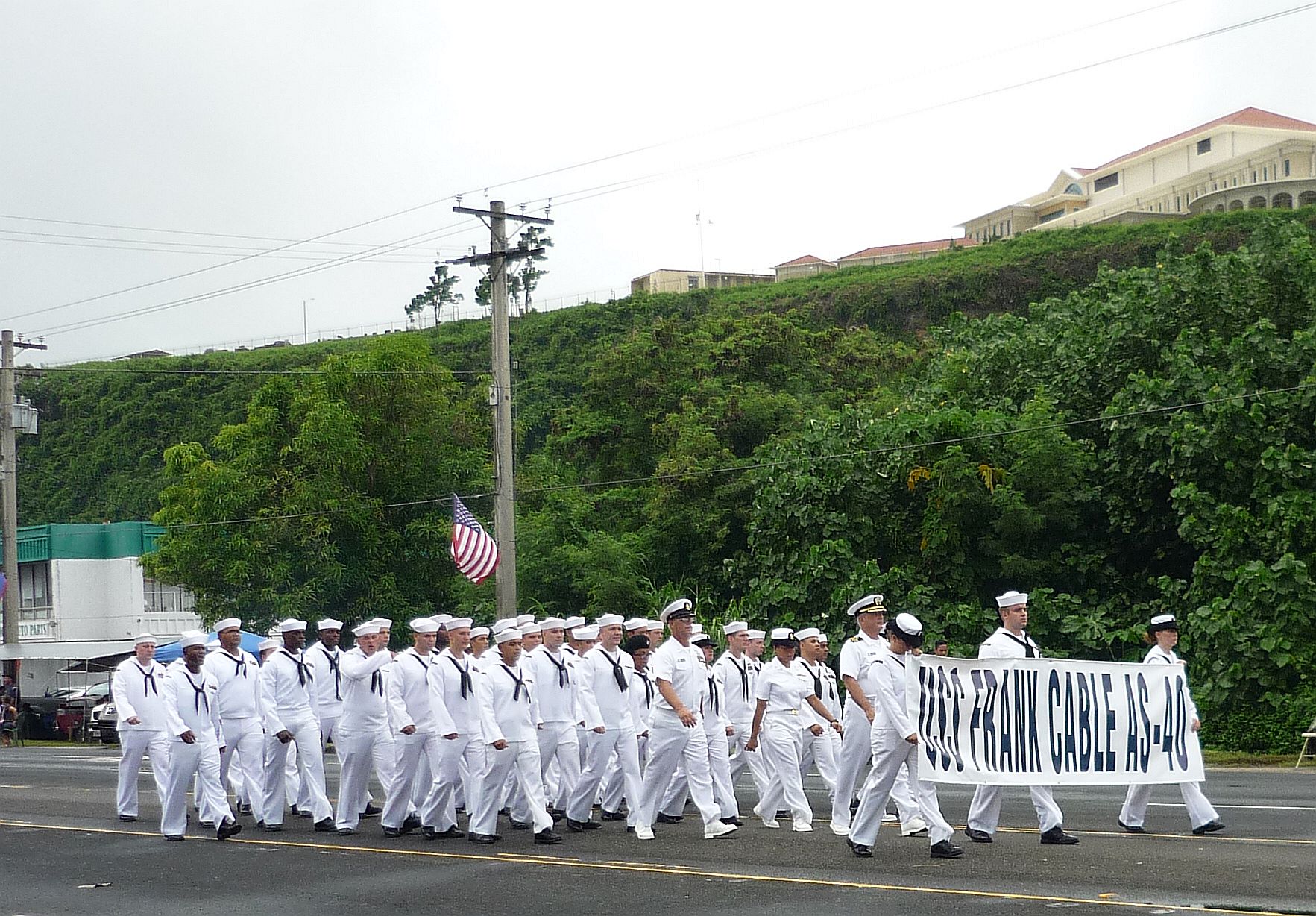
The crew of the submarine tender, USS Frank Cable.

The crew of the submarine tender, USS Frank Cable.

http://en.wikipedia.org/wiki/USS_Frank_Cable_(AS-40)

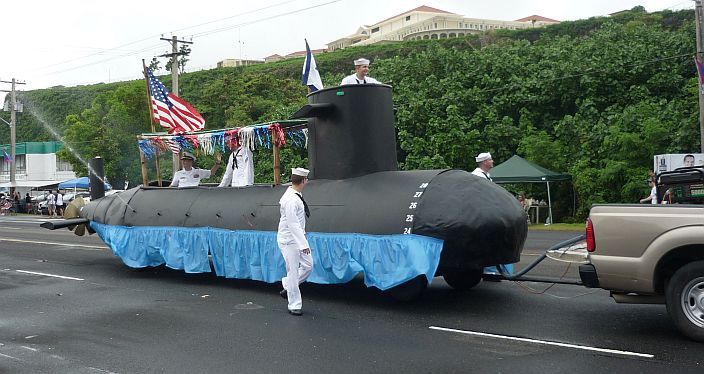
Float entered by the USS Frank Cable crew.  The water squirting from the side of the submarine would have been appreciated even more it the weather had been hot and sunny!

Float entered by the USS Frank Cable crew. The water squirting from the side of the submarine would have been appreciated even more if the weather had been hot and sunny, instead of rainy!

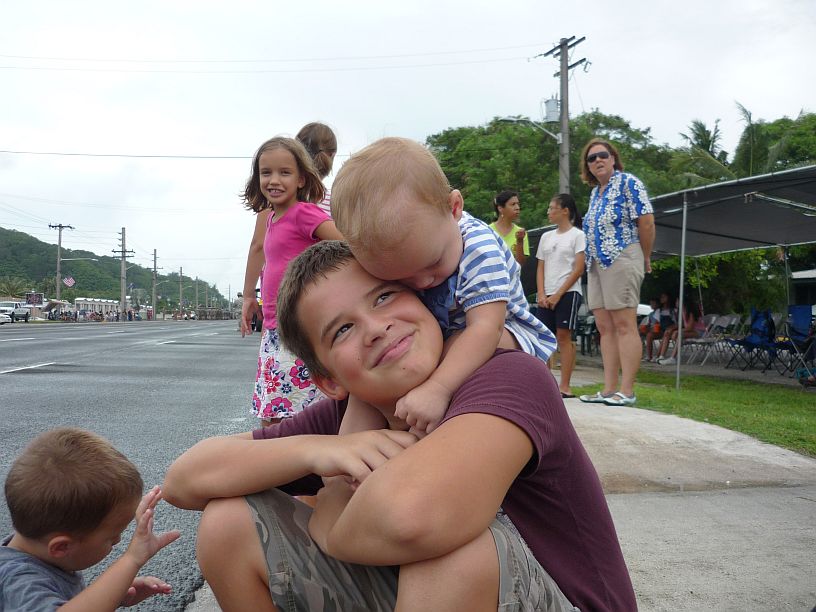
This baby fell asleep with his big brother's head as his 'pillow'.  These brothers are from a well-behaved family of 3 boys and 3 girls.

This baby fell asleep using his big brother’s head as his ‘pillow’. These brothers are from a well-behaved family of 3 boys and 3 girls.

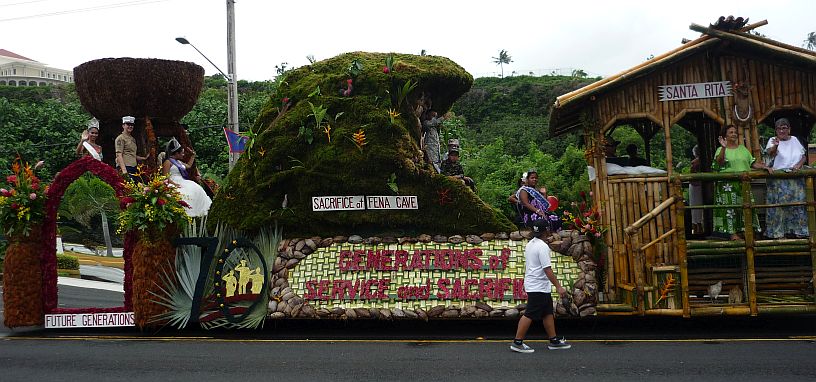
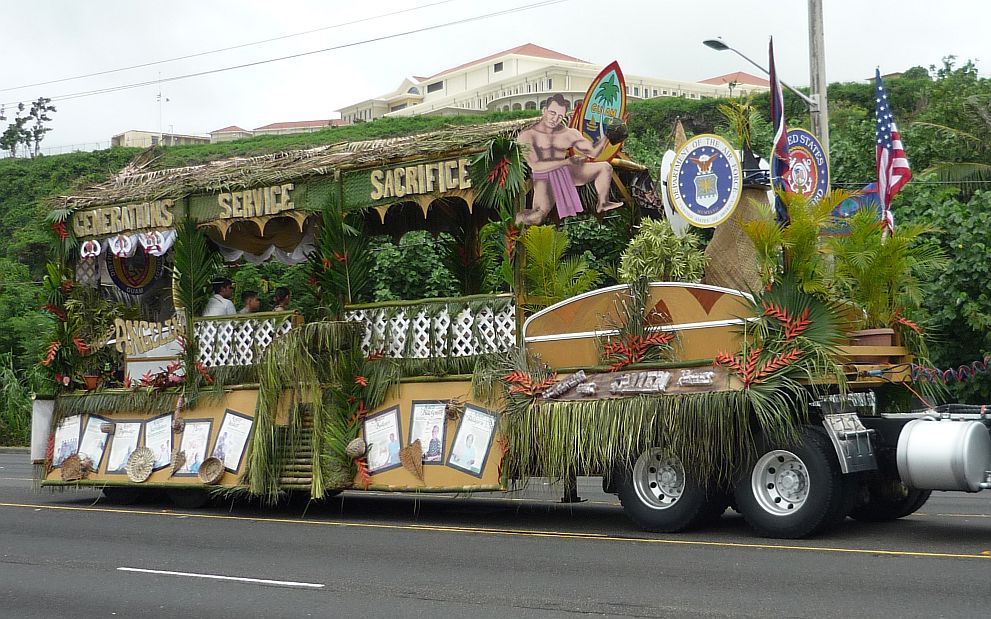
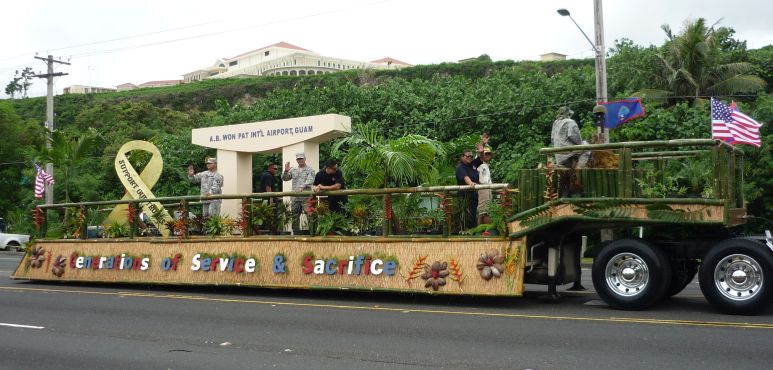
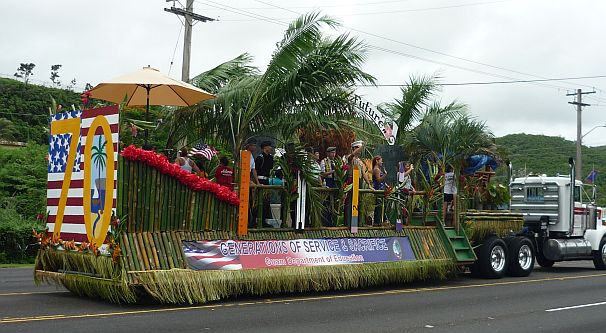
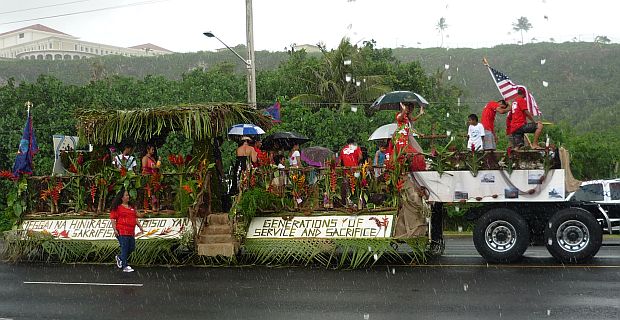
The theme of the parade -- Generations of Sacrifice and Service.  The first village float entry was from Santa Rita.  It was too big to

The theme of the parade — Generations of Service and Sacrifice. The first village float entry was from Santa Rita. It was too big to fit into one photo.

Inside the arch for "Future Generations" is a mirror.  The Santa Rita float ended up winning first place.

Inside the arch for “Future Generations” is a big mirror. The Santa Rita float ended up winning first place for the sixth year running.

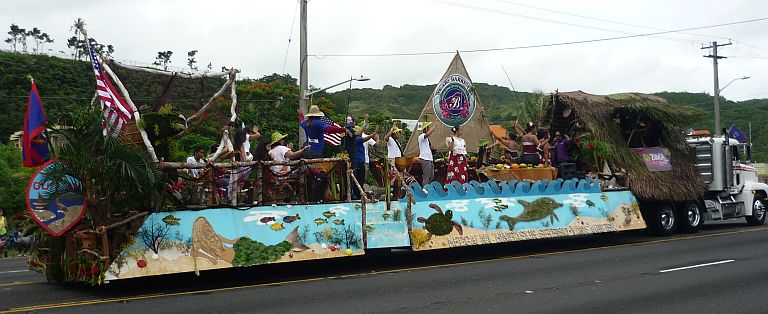
Barrigada village float

Barrigada village float

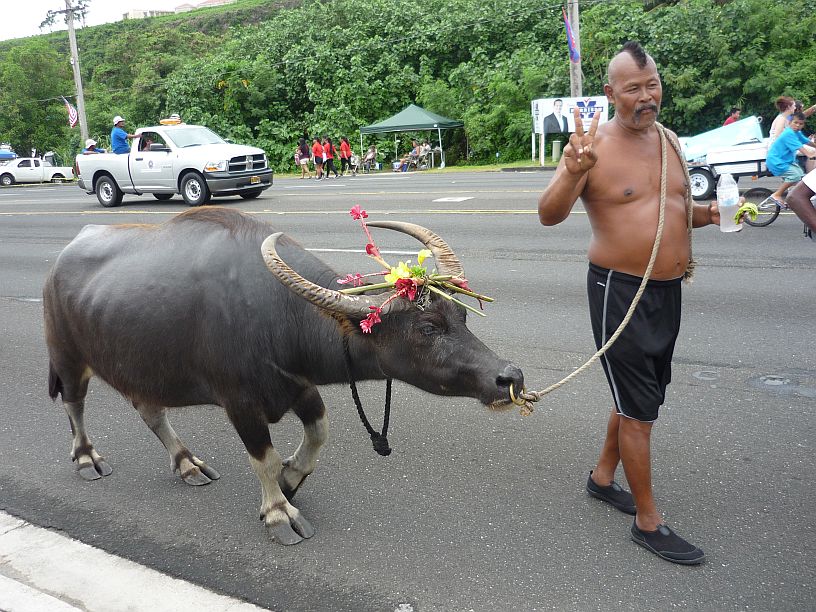
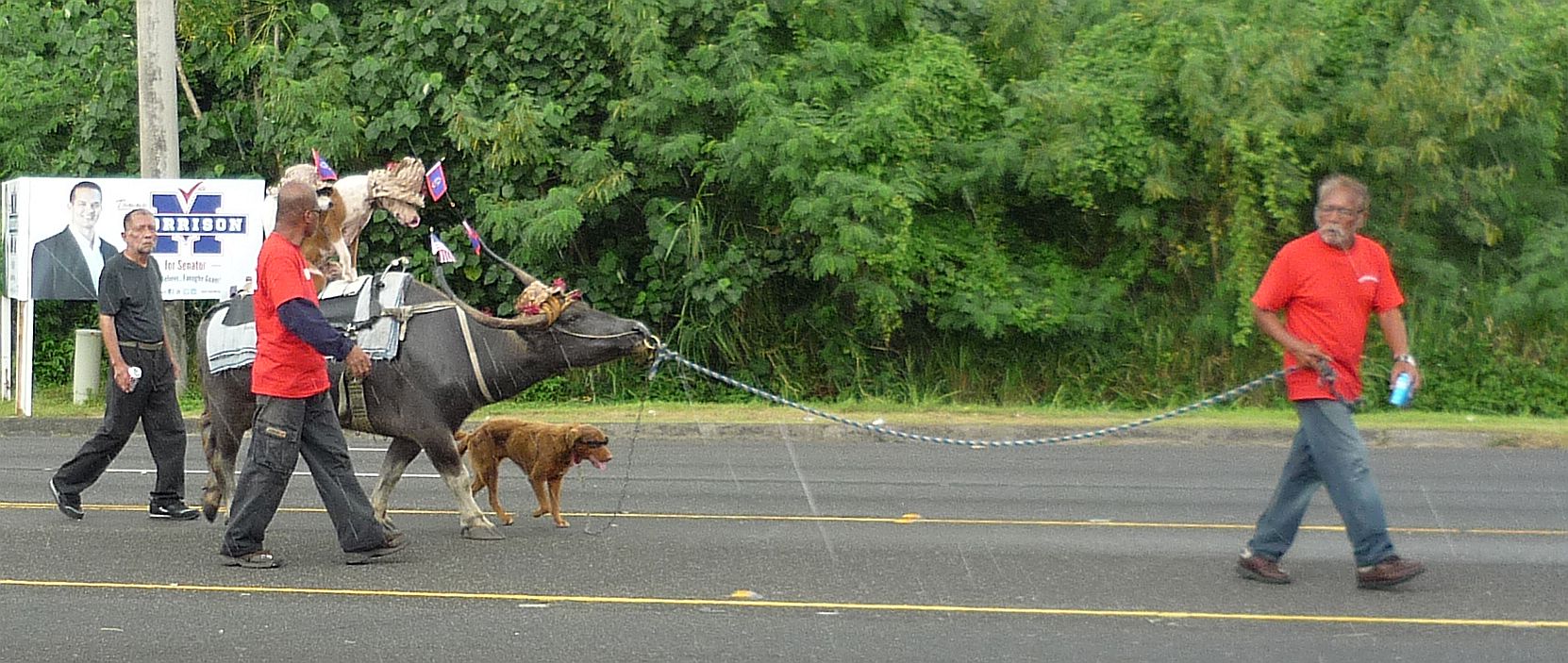
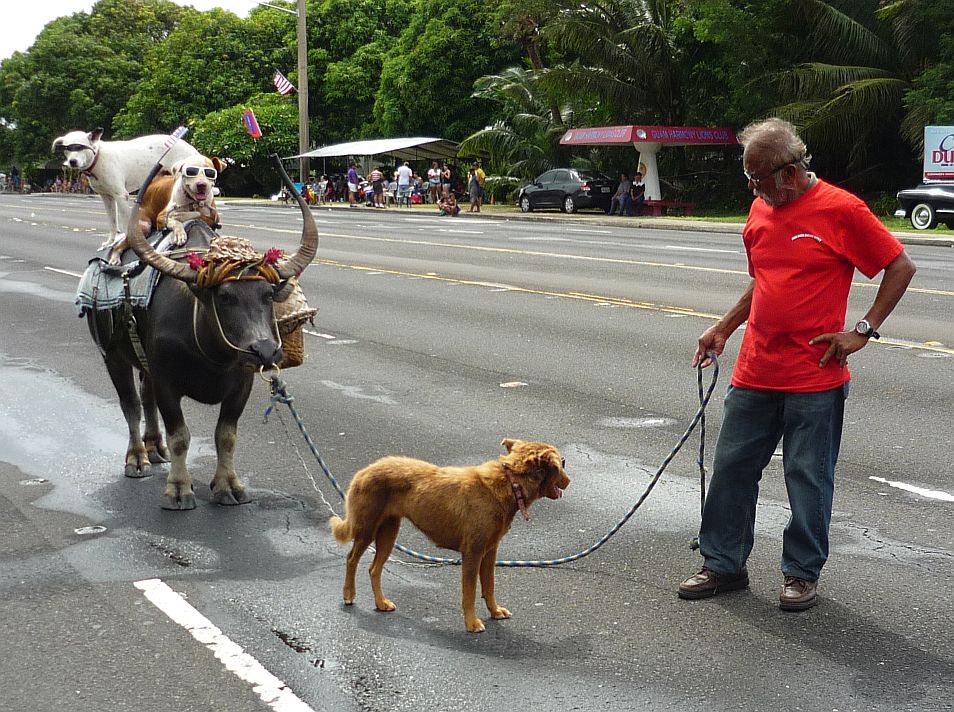
We often see this man and his cariboa in Merizo giving rides to the Cocos Island Resort tourists.  He brought his cariboa about 25 miles to be in the parade.

We often see this man and his carabao in Merizo giving rides to the Cocos Island Resort tourists. He brought his carabao about 25 miles to be in the parade.

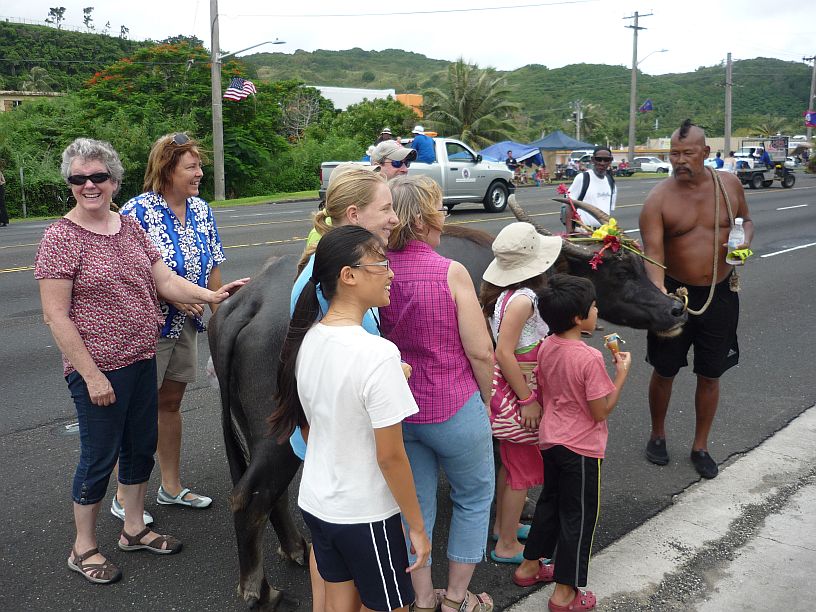
Most of the TWR children and ladies wanted to pet the caribou.

Most of the TWR children and ladies wanted to pet the carabao.

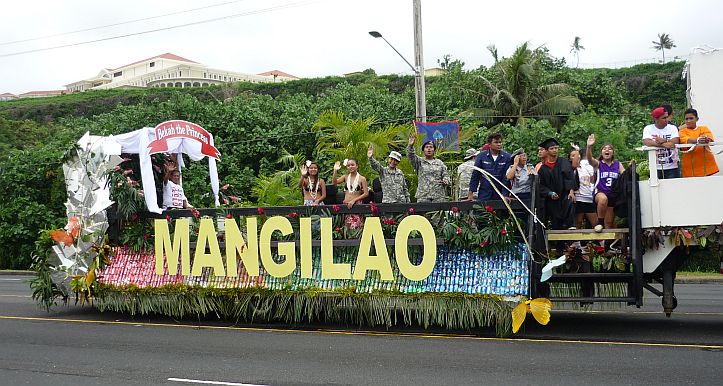
Mangilao village float -- Note that the mayor is under the canopy where the 'village princess' normally sits.

Mangilao village float — note that the mayor is under the canopy where the ‘village princess’ normally sits.  Where’s Bekah?

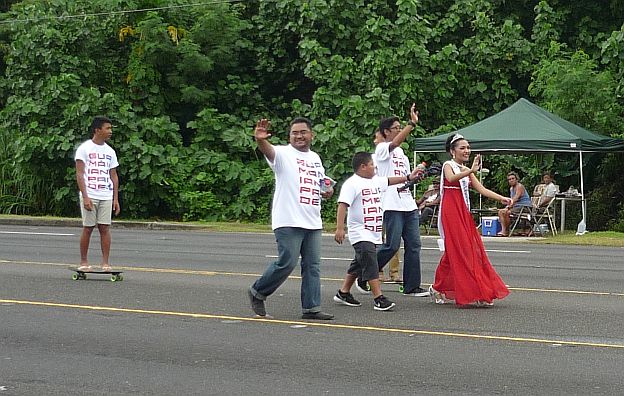
Bekah, the Mangilao princes, is walking in high heels.  Did she do this for 1-1/2 miles?!

Bekah, the Mangilao princess, is walking in high heels. Did she do this for 1-1/2 miles?!

Agat village float -- Agat is the village where our apartment is located.

Agat village float — Agat is the village where our apartment is located.  The emblems of the various armed forces at the front of the float rotate.

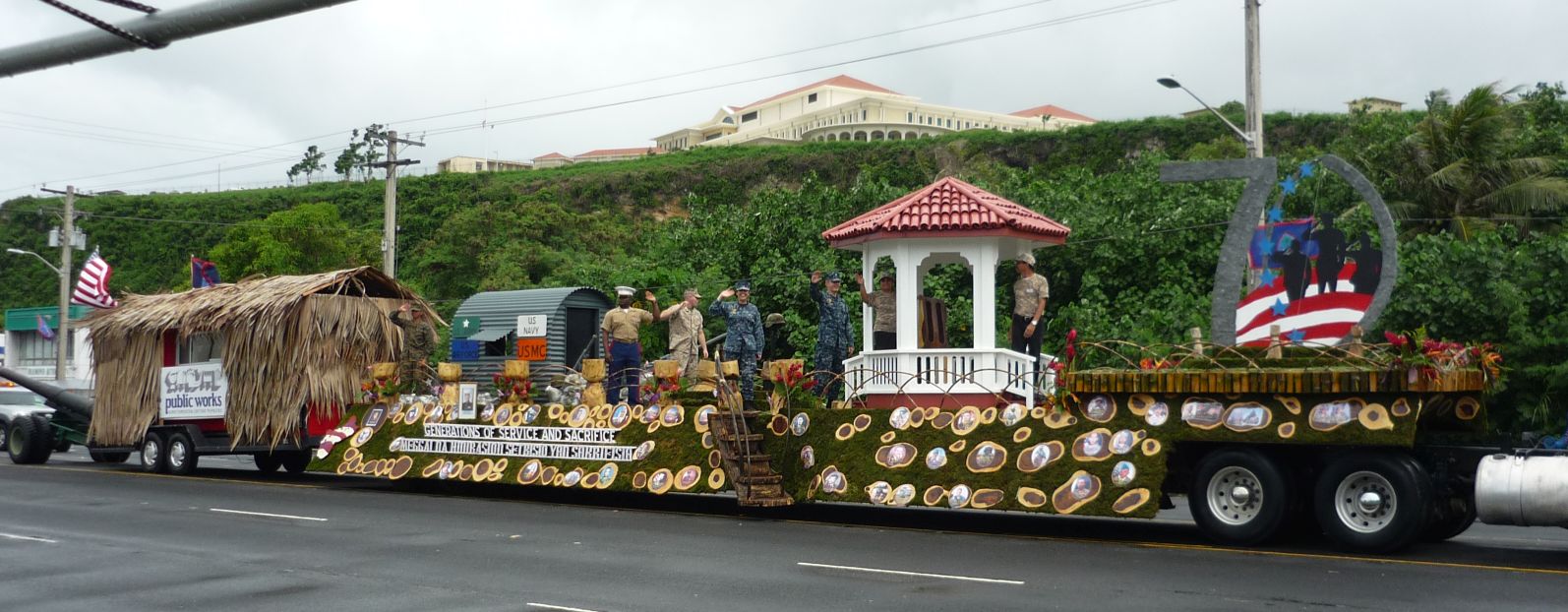
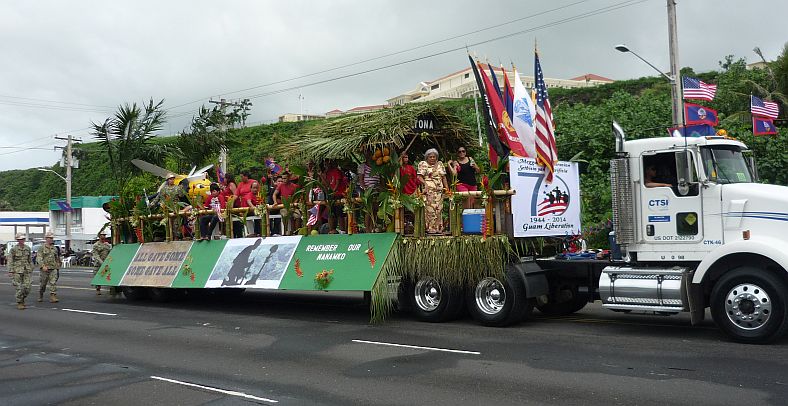
One of several military floats.

One of several military floats.

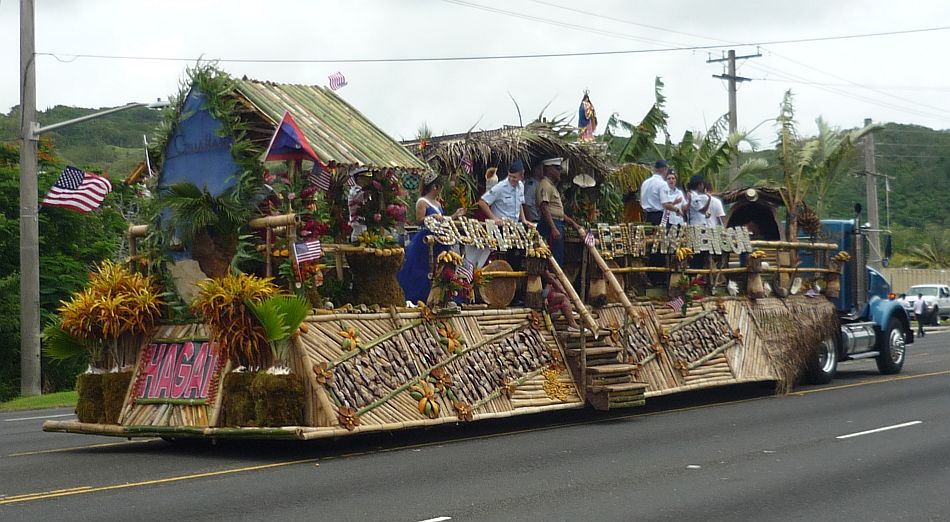
Hagat village float

Hagat village float

Mount Carmel School float -- we saw this one being build down the road from our apartment.

Mount Carmel School float — we saw this one being build down the road from our apartment.

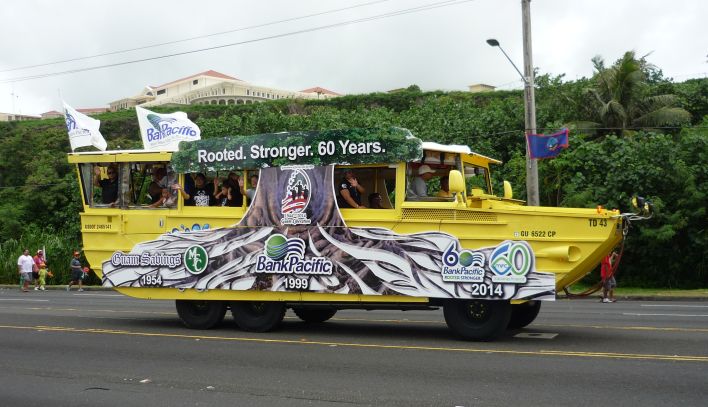
This duck was being used for the Bank Pacific float.

This ‘duck’ tour boat was being used for the Bank Pacific float.

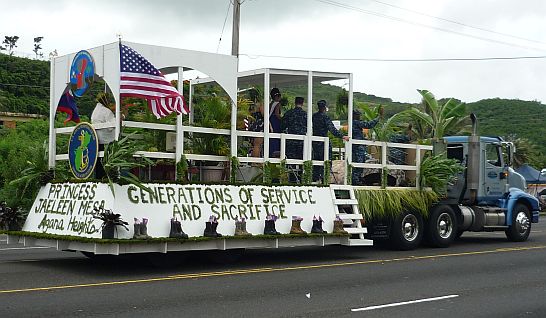
Agana Heights village float

Agana Heights village float

What one boy is doing while his mom watches the parade!

What one boy is doing while his mom watches the parade!

Department of Education float

Department of Education float

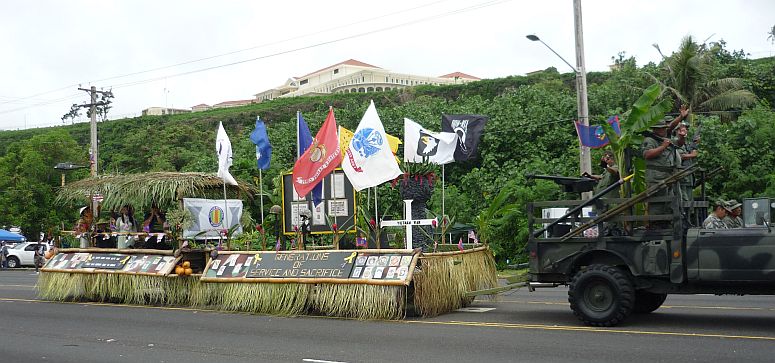
Vietnam Veterans Float

Vietnam Veterans Float

G$S float -- G4S is a security company.  Their float won first place for commercial entries.

G4S float — G4S is a security company. Their float won first place for commercial entries.

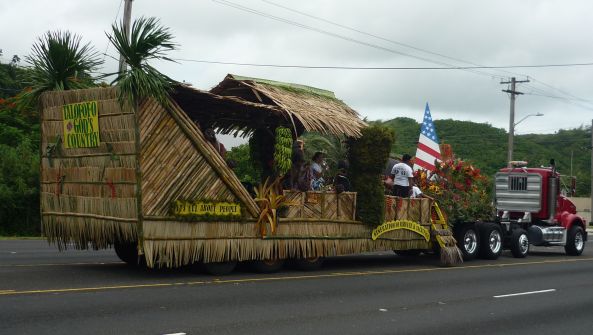
Talofofo village float

Talofofo village float

Port of Guam float

Port of Guam float

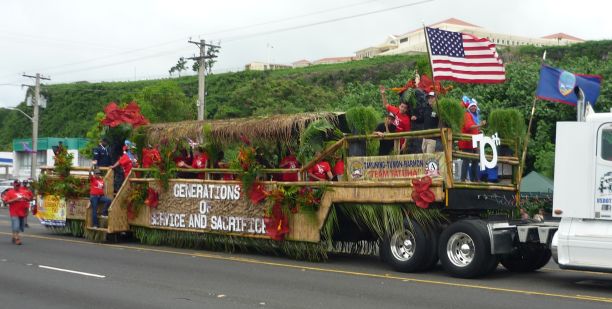
Team Tatuma float -- a team effort of the villages of Tamunig, Tumon and Harmon

Team Tatuma float — a team effort of the villages of Tamuning, Tumon and Harmon.

Three dogs wearing sunglasses.  The two dogs riding the cariboa are wearing hats with small Guam flags.

Three dogs wearing sunglasses. The two dogs riding the carabao are also wearing hats with small Guam flags.

Asan village float

Asan village float

Guam Power Authority using their insulator washing equipment to cool down the parade watchers, while it is raining!

Guam Power Authority using their insulator washing equipment to cool down the parade watchers, while it is raining!

Guam Power Authority float -- note the solar panels on the quonset hut and the wind generator at the front.

Guam Power Authority float — note the solar panels on the quonset hut and the wind generator at the front.

It's campaign time on Guam.  There are big campaign signs going up everywhere.

It’s campaign time on Guam. There are big campaign signs going up everywhere.

Department of Public Works won first place in the government agency floats.  Their float had three trailer units.

Department of Public Works won first place among the government agency floats. Their float had three trailer units.

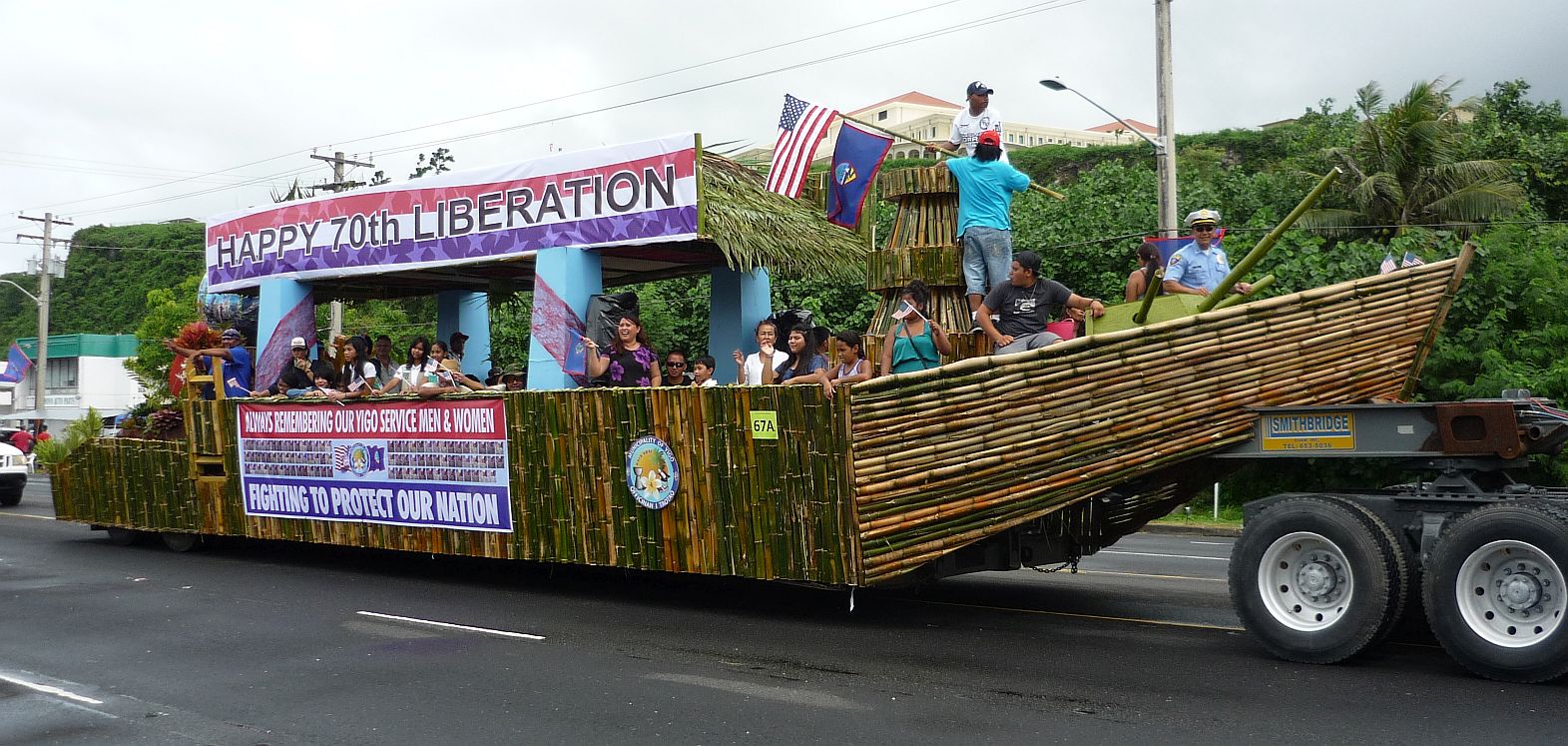
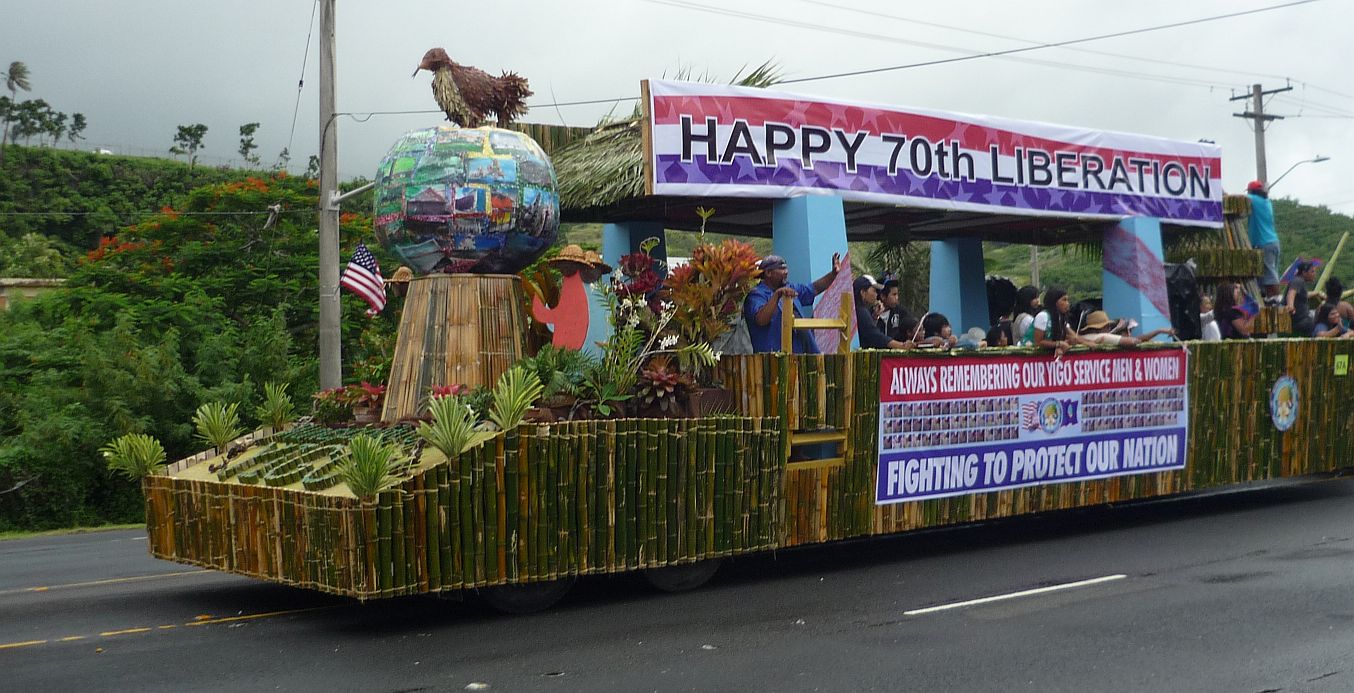
Yigo village float

Yigo village float

The back of the Yigo float

The back of the Yigo float

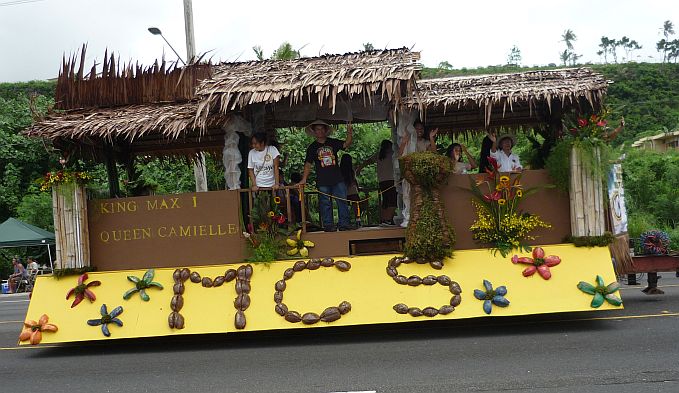
Yona village float

Yona village float

The caribao dogs are back with their hats.

The carabao dogs are back, but without their hats.

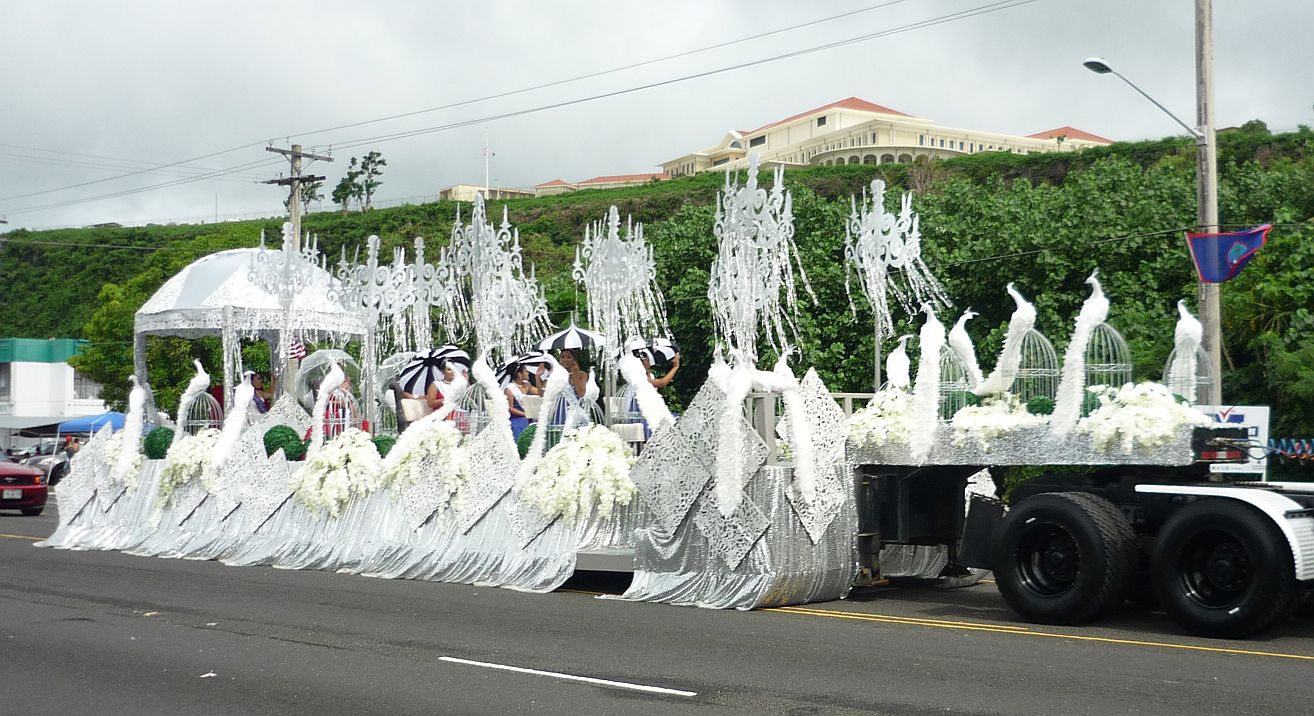
The Liberation Day Queen and her court end the parade.

The Liberation Day Queen and her court bring up the end of the parade.

The parade lasted for almost 5 hours — there were a lot of large gaps between the entries, which allowed lots of time to visit.  We did take some more photos on our walk back to our cars.

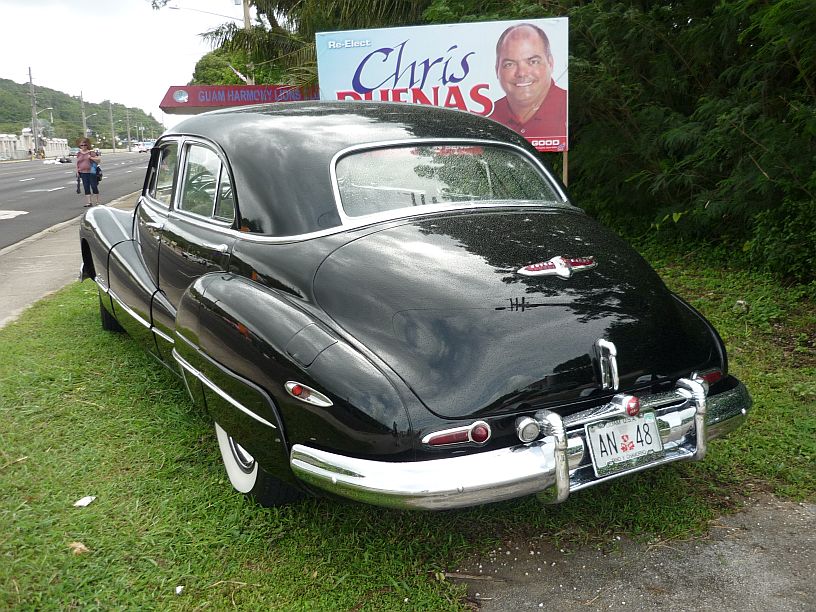
Next to the canopy that we were able to use was parked this beautiful 1948 Buick.  Note the campaign sign behind it.

Next to the canopy, that we were able to use, was parked this beautiful 1948 Buick. Notice the campaign sign behind it.

140721 -- LDP48Buick2

I talked to the owner. He had imported it from Oregon several years ago.

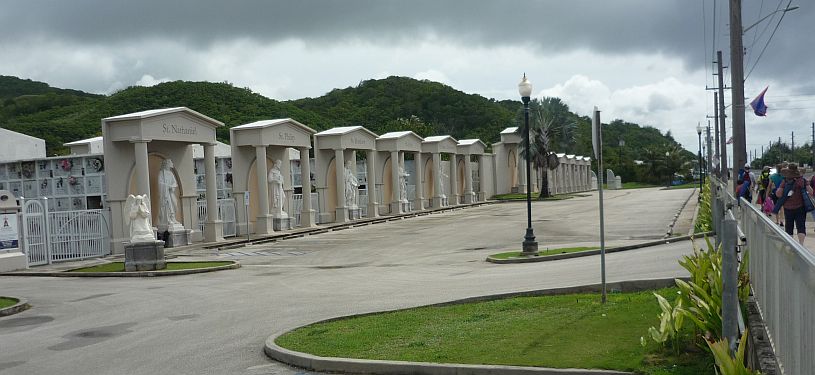
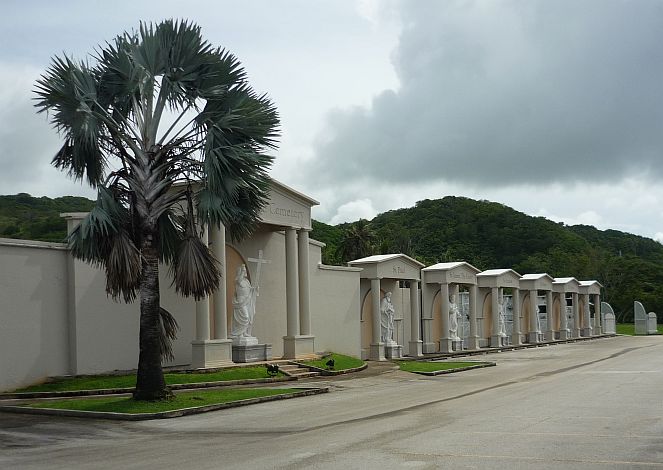
Walking back to the cars, we passed the Pigo Catholic cemetery.  It has 20 foot tall statues of Jesus and the 12 apostles at the entrance.

Walking back to the cars, we passed the Pigo Catholic cemetery. It has 20 foot tall statues of Jesus and the 12 apostles across the entrance.

140721 -- LDPPigoCemetery2


2014/07/20 — Sunday — Memorial & Underwater World

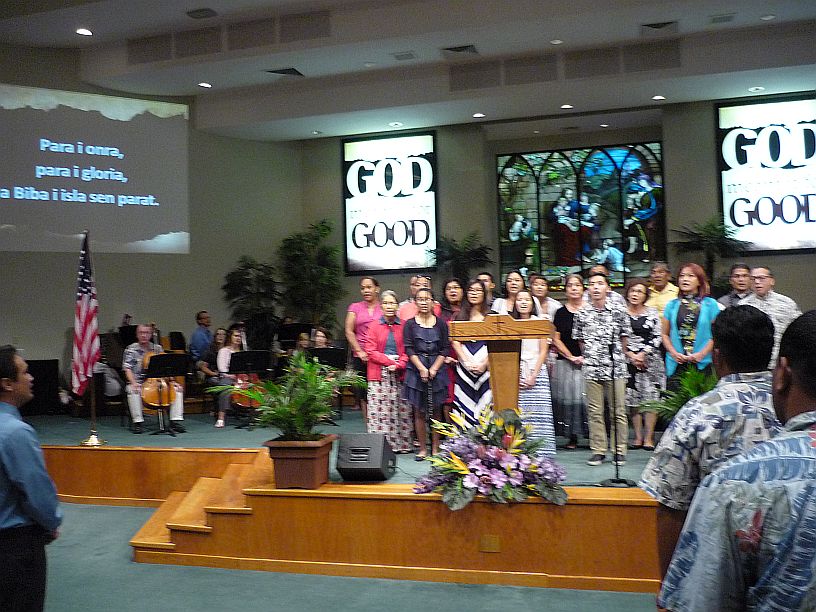
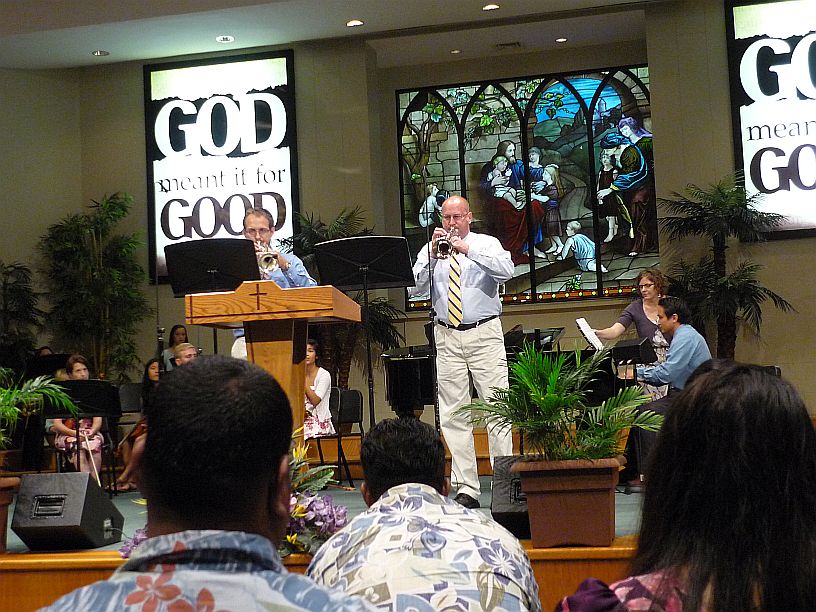
Tomorrow is the 70th anniversary of Liberation Day, the day that American forces returned to Guam to liberate the island.  There are commemorations going on everywhere on Guam and the service at Harvest Baptist Church was no exception.  The service opened with a video of the American forces coming ashore on the western beaches.  One could feel the emotion of gratitude for the freedom resulting from that sacrifice, which was being displayed on the screen.  The people of Guam consider themselves American and are U.S. citizens.  One of Guam’s mottoes is “Where America’s Day Begins.”

First this Chamorro adult choir led the congregation in the National Anthem, then sang Guam’s Hymn (their territorial anthem)

http://en.wikipedia.org/wiki/Stand_Ye_Guamanians

Then the Harvest youth choir (mostly Chamorro) sang  about freedom, especially their freedom in Christ.

Then the Harvest youth choir (mostly Chamorro) sang about freedom, especially their freedom in Christ.

Trumpet Duo

Trumpet Duet

After church, I wanted Virginia to show me what she had seen at the South Pacific War Memorial.  She had gone there a few weeks ago, with Kathy and Joanna.  On the way, we stopped by Wendys.

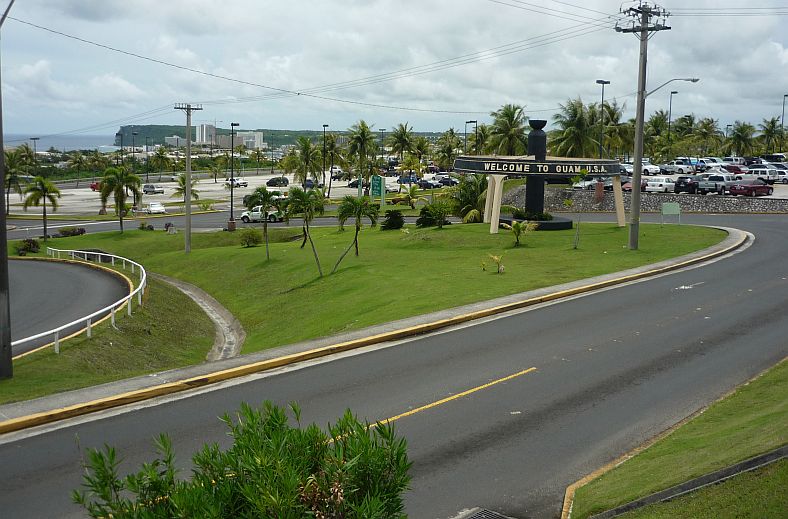
The shortest way from the church to the memorial was the road around the airport.  We decided to take a photo of the welcome sign that is seen upon leaving the airport.  I was asked what I was doing by an airport policewoman, just after taking this photo!

The shortest way from the church to the memorial was the road around the airport. We decided to take a photo of the welcome sign that is seen upon leaving at the airport.  Two Lovers Point can be seen across Tumon Bay.  I was questioned about what I was doing by an airport policewoman, just after taking this photo! 

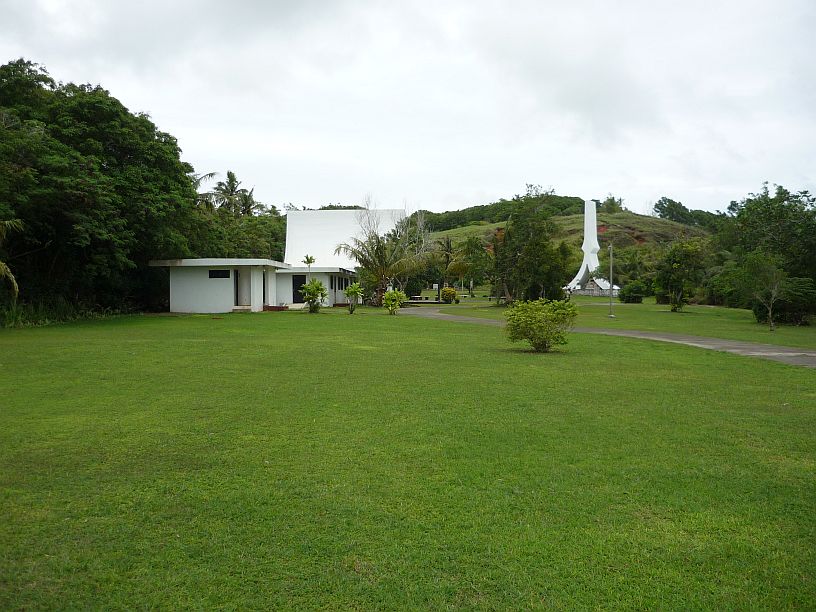
View of the South Pacific War Memorial from the entrance.

View of the South Pacific War Memorial from the entrance.

The building that housed the Japanese shrine (shown in out earlier blog).  This building had some artifacts from the war, but there was little to no labeling of the items.

This is the building that housed the Japanese shrine (shown in our earlier blog). This building had some artifacts from the war, but there was little to no labeling of the items.

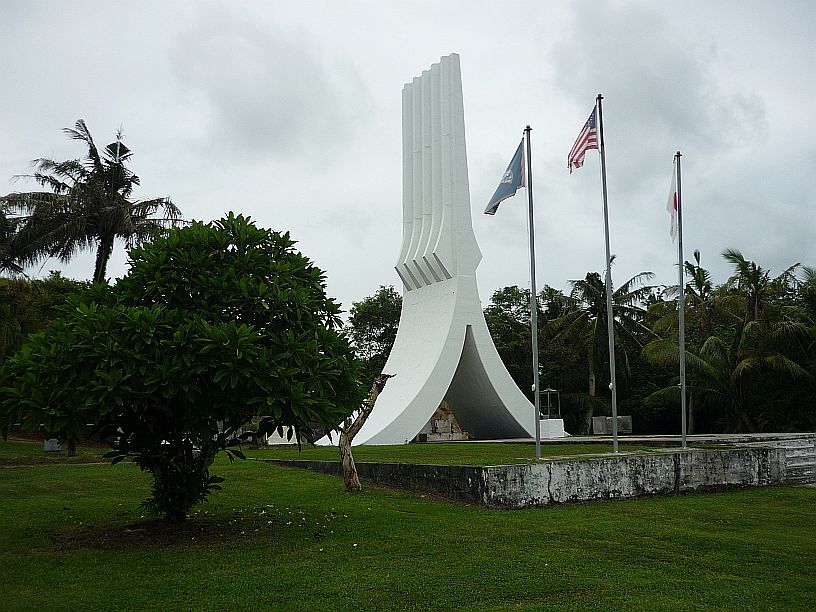
The memorial spire at the South Pacific War Memorial is supposed to represent praying hands.  To the right of the memorial is the trail to the caves that were used by the Japanese as their  command center in the last battle by American forces to liberate Guam

The memorial spire at the South Pacific War Memorial is supposed to represent praying hands. To the right of the memorial is the trail to the caves that were used by the Japanese as their command center in the last battle by American forces to liberate Guam.

140720 -- SPacificWarPlaque

Stairs leading down to the ravine where the command post caves are located.

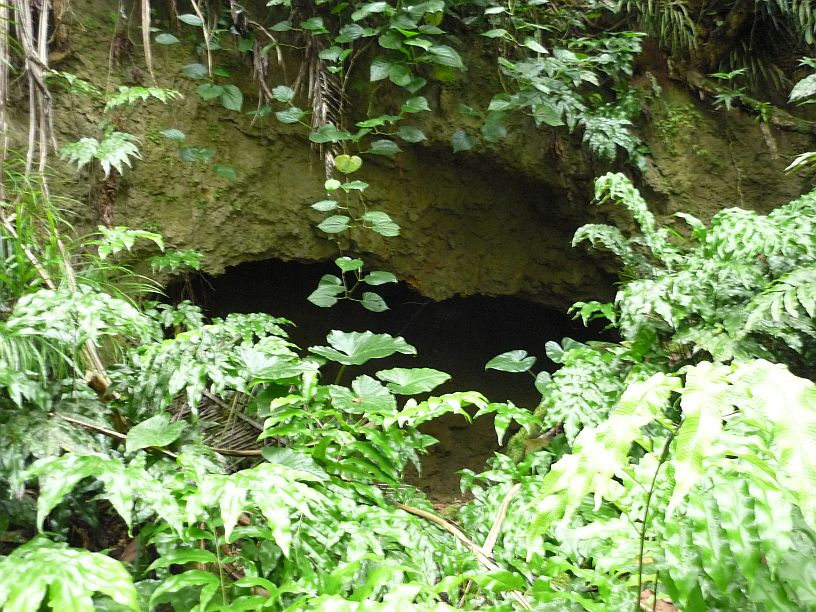
The first of the four caves used as the command center.  This opening would require crawling to enter.

The first of five caves in this ravine.  This opening would require crawling to enter.  We think the next four were the ones used as the command center.

This is the second cave, where the Japanese commander apparently committed suicide. This entrance would require bending down to get into. There is a closer photo of this cave in our earlier blog entry.

The third cave entrance was tall enough that person could walk into it standing up.

The third cave entrance was tall enough that a short person could walk into it standing up.

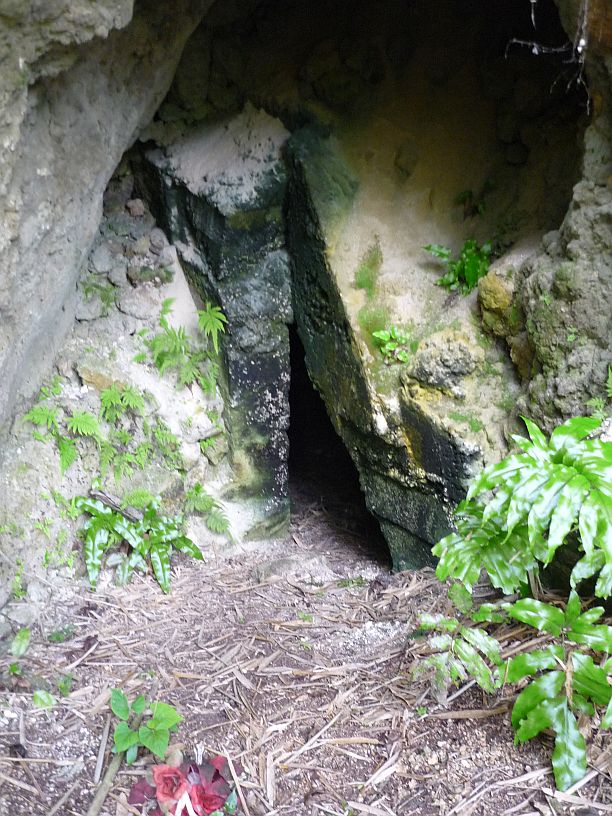
The fourth cave has partially collapsed, possibly as a result of the explosives used by the American forces to seal up the caves.  It looks like it would be possible to just squeeze into this entrance by crawling on one's belly.

The fourth cave has partially collapsed, possibly as a result of the explosives used by the American forces to seal up the caves. It looks like it would be possible to just squeeze into this entrance by crawling on one’s belly.

The fifth cave was very low to the ground, requiring entrance by crawling on one's belly.

The fifth cave was very low to the ground, requiring entrance by crawling on one’s belly.

Close up view of the fifth cave.  It looks like it has a concrete roof.

Close up view of the fifth cave. It looks like it might have a concrete roof.

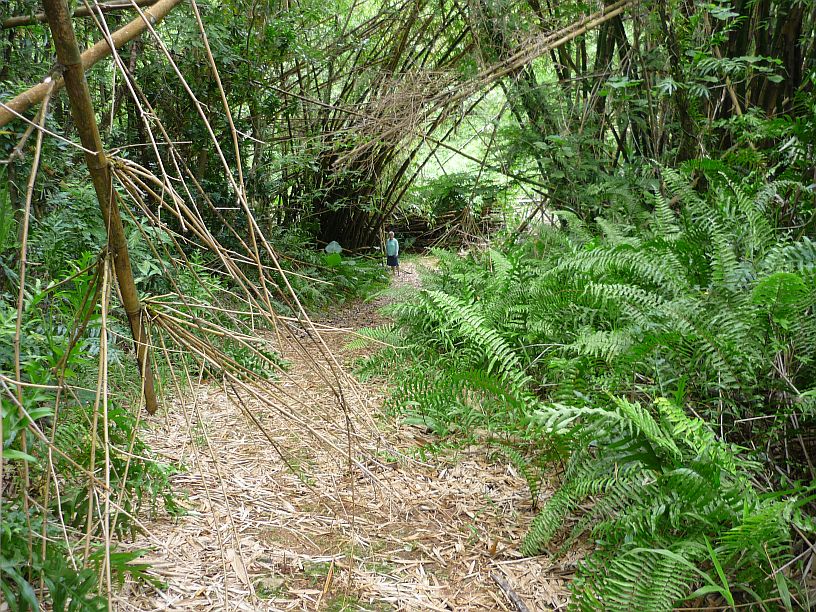
This gives some perspective of the height of the bamboo forest.

This gives some perspective of the height of the bamboo forest.

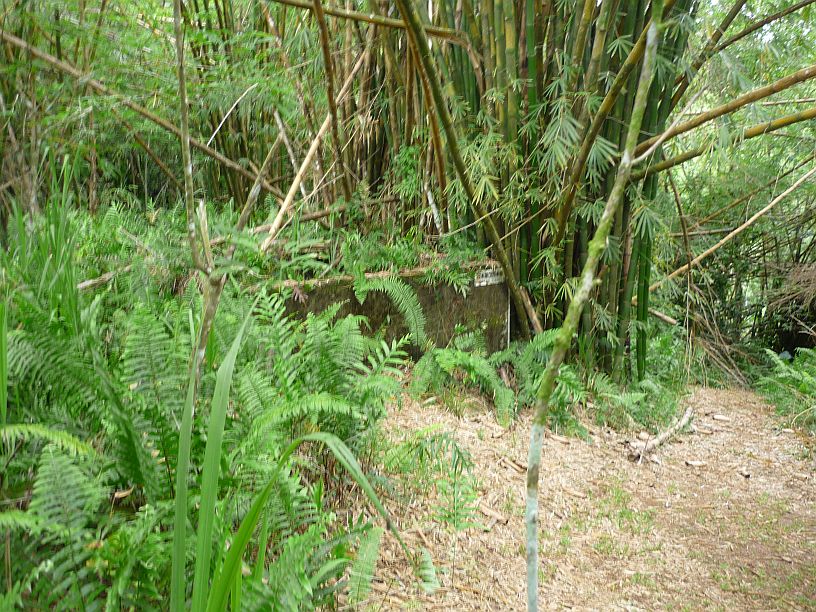
The remains of a cistern that probably was used to supply water to the caves using gravity.

The remains of a cistern that probably was used to supply water to the caves by gravity feed.

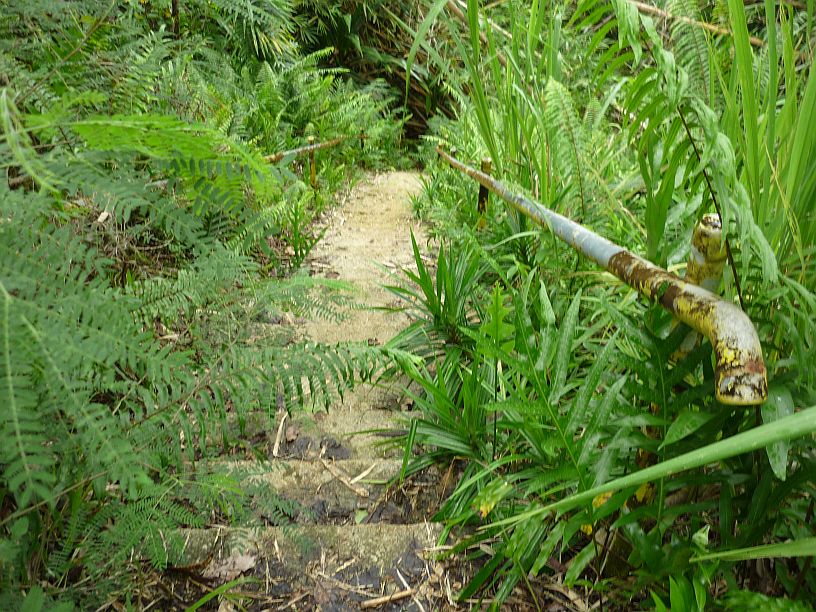
These overgrown stairs lead down to a spring, probably used to fill the cistern.

These overgrown stairs lead down to a spring, probably used to fill the cistern.

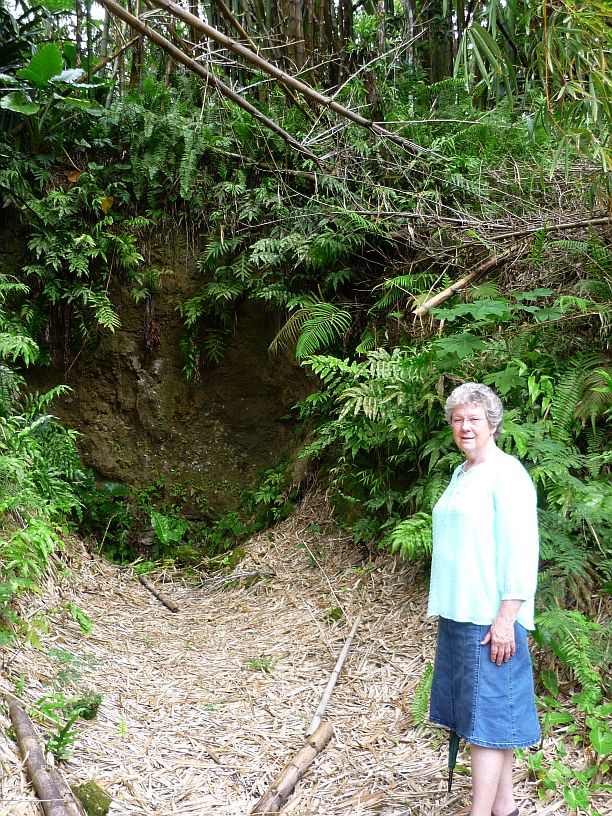
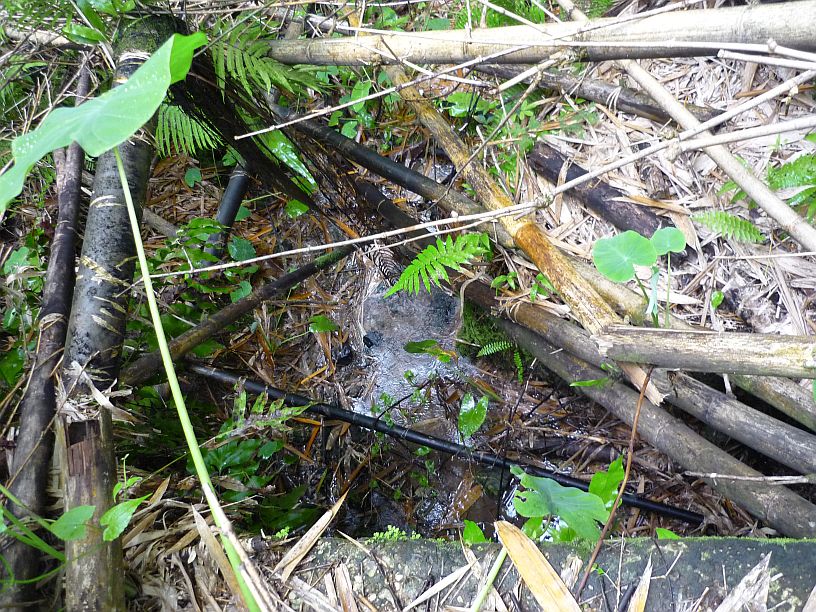
The spring is covered by lots of fallen bamboo, but if you look carefully, you might see a couple of water pipes.

The spring is covered by lots of fallen bamboo, but if you look carefully, you might see a couple of water pipes.

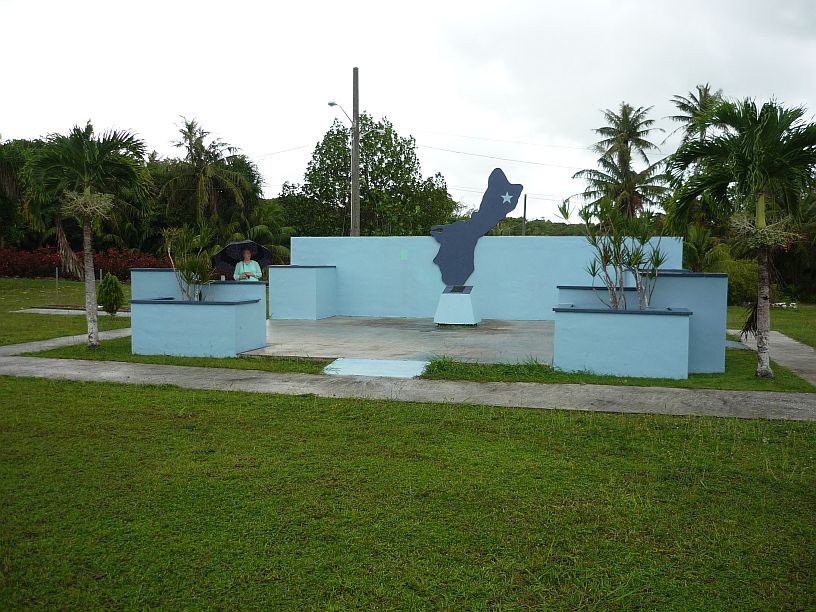
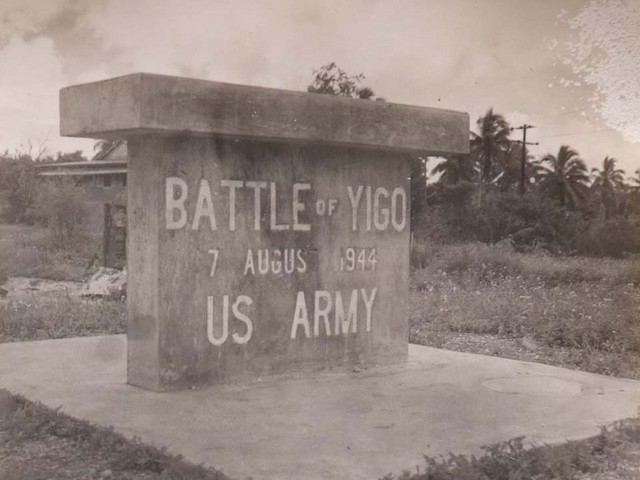
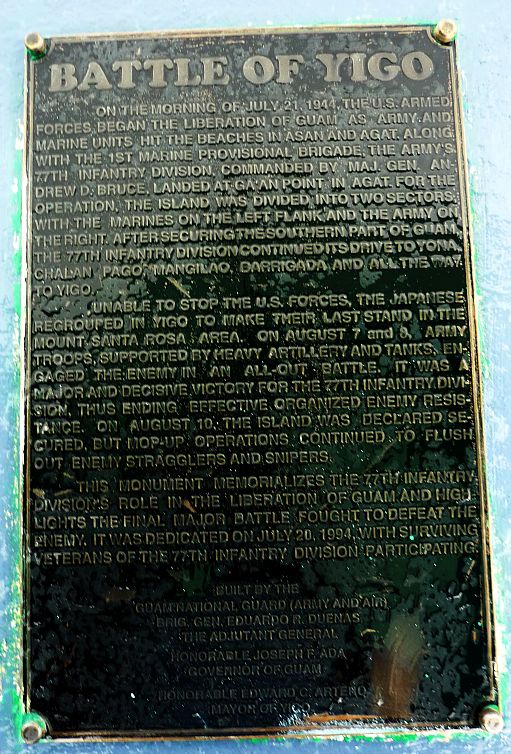
From the South Pacific War Memorial, we decided to again try to find the Yigo (pronounced gee-go) Monument.  We found it near the back entrance to Anderson Air Force Base on Route 15.  It is at the second road to the left going south from the AAFB gate.

The Yigo Monument as seen from the road.

The Yigo Monument as seen from the road.

The reason we did not find the monument earlier was that we were looking for this. We presume that it no longer exists.

http://www.guampedia.com/yigo/

140720 -- YigoPlaqueFrom Yigo we headed south on Route 15 as it was a new road for us to explore — very rural.

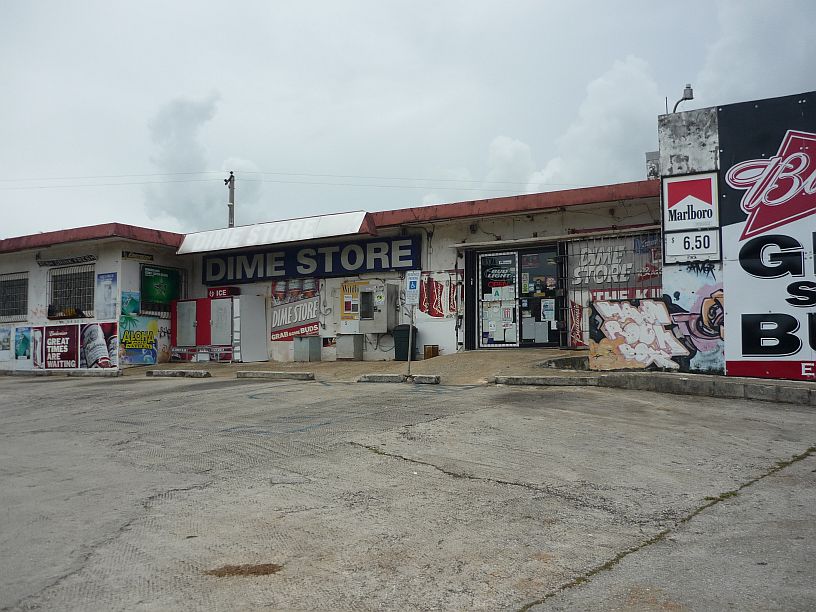
Near the end of Route 15 we parked at this Dime Store to read our map.  This does not fit our description of a dime store!

Near the end of Route 15 we parked at this Dime Store to read our map. This does not fit our perception of a ‘dime store’!

At the end of Route 15, we decided to double back to town on Routes 10 and 16.  Virginia had one extra complimentary ticket to Underwater World.  Since she had already been there, she went window shopping while I went to Underwater World.  Here are photos of that adventure:

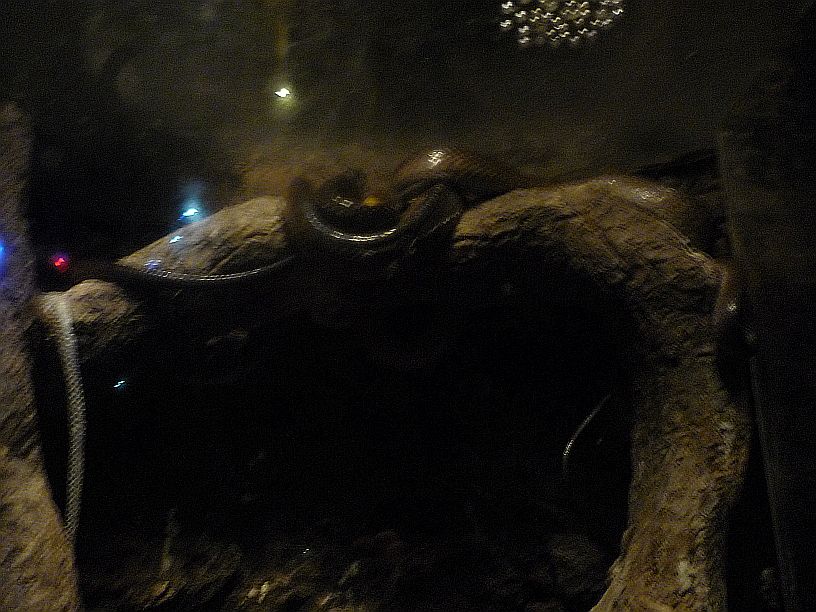
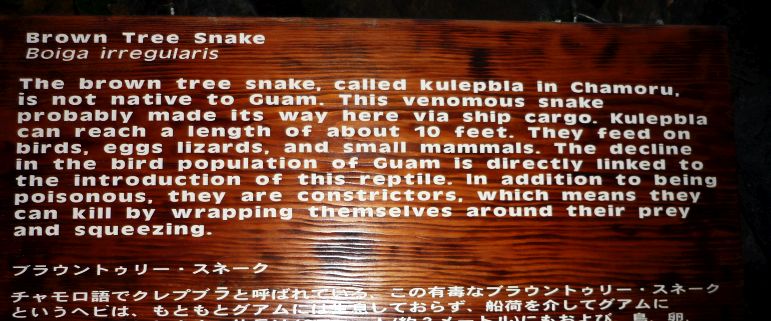
The first display on entering Underwater World was this brown tree snake!  I don't think it lives underwater!!

The first display on entering Underwater World was this brown tree snake!   I don’t think it lives underwater!!

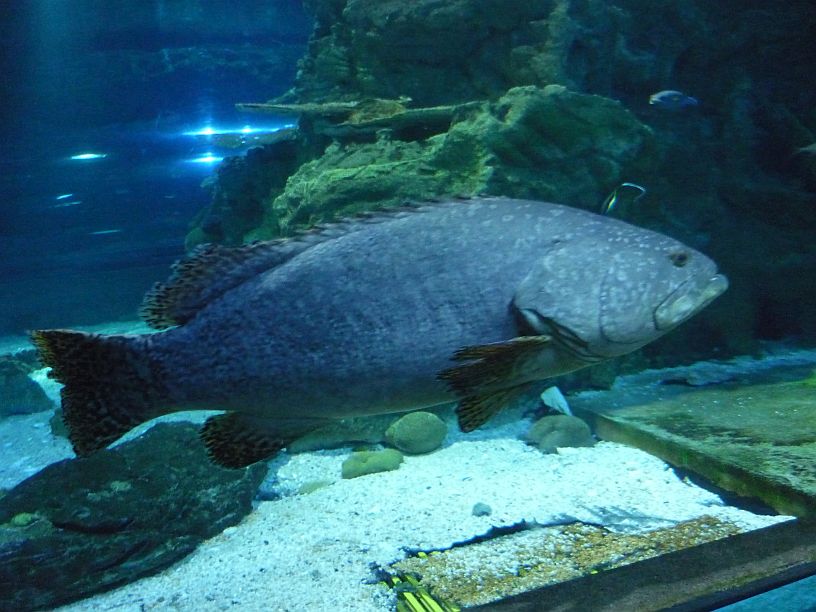
140720 -- UWBrownTreeSnake2This huge fish was about 4 feet long.

This Giant Grouper is about 4 feet long.

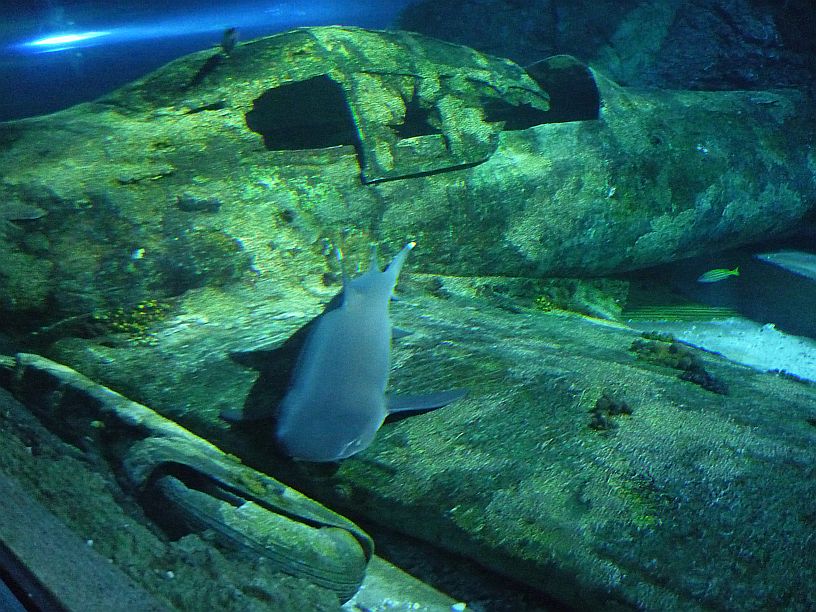
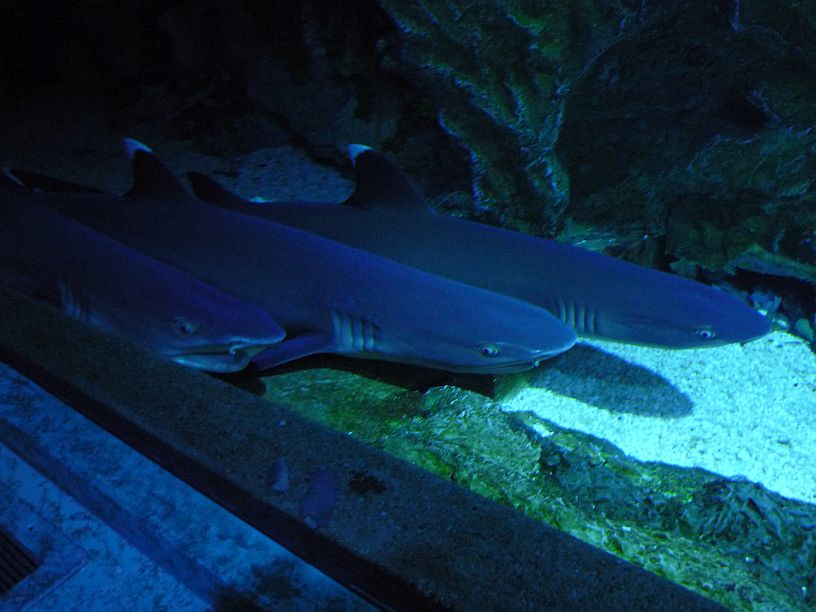
There were several varieties of shark.

There are four species of shark at Underwater World.

Sharks in formation!

Grey Reef Sharks in formation!

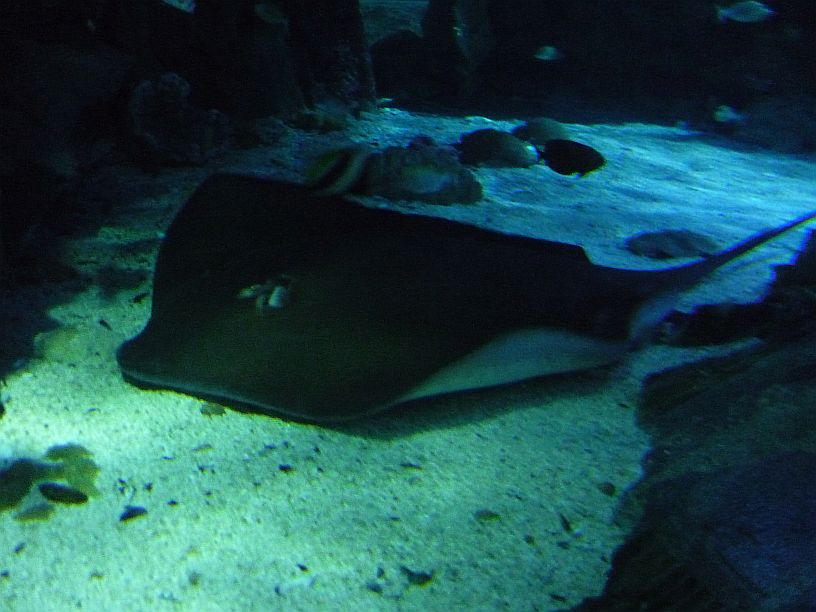
Stingray

Black Whiptail Ray

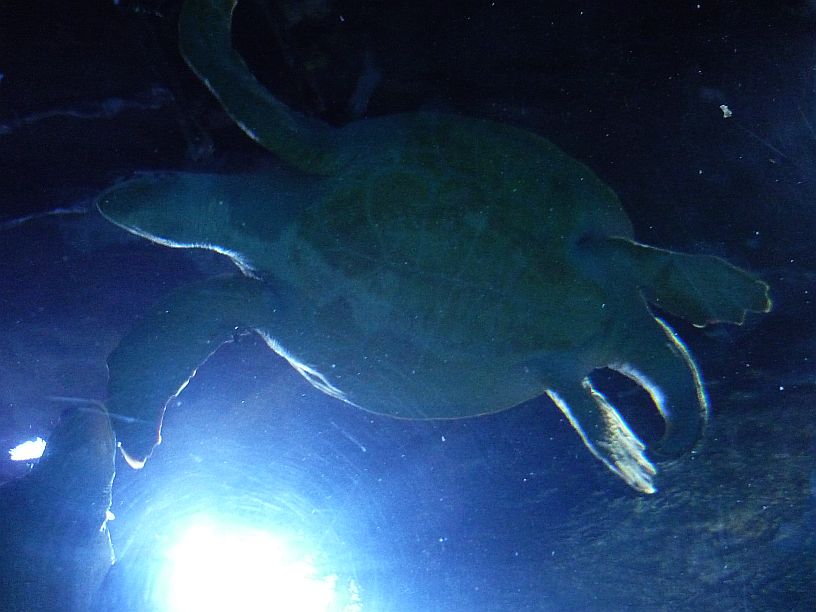
One of two 300 pound Green Sea Turtles

One of two 300 pound Green Sea Turtles

Shovelnose Guitarfish resting on top of the underwater tunnel.  Definitely not its glamorous side!

Shovelnose Guitarfish resting on top of the underwater tunnel. Definitely not its glamorous side!

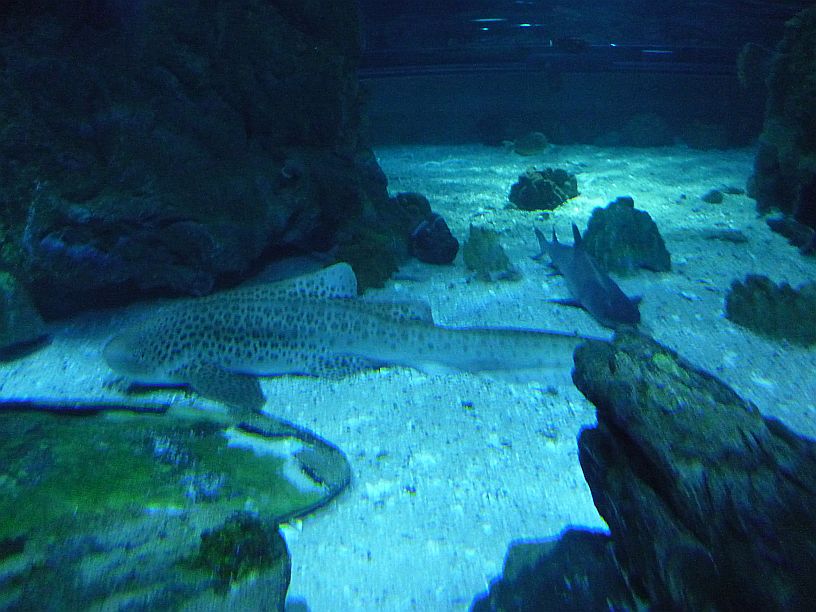
A leopard shark (or zebra shark, because juveniles are stripped) does not need to continuously swim to breath, unlike other sharks.

A leopard shark (or zebra shark, because juveniles are striped) does not need to continuously swim to breath, unlike other sharks.

After leaving the 319 foot long tunnel under 800,000 gallons of water, there are numerous smaller aquariums.

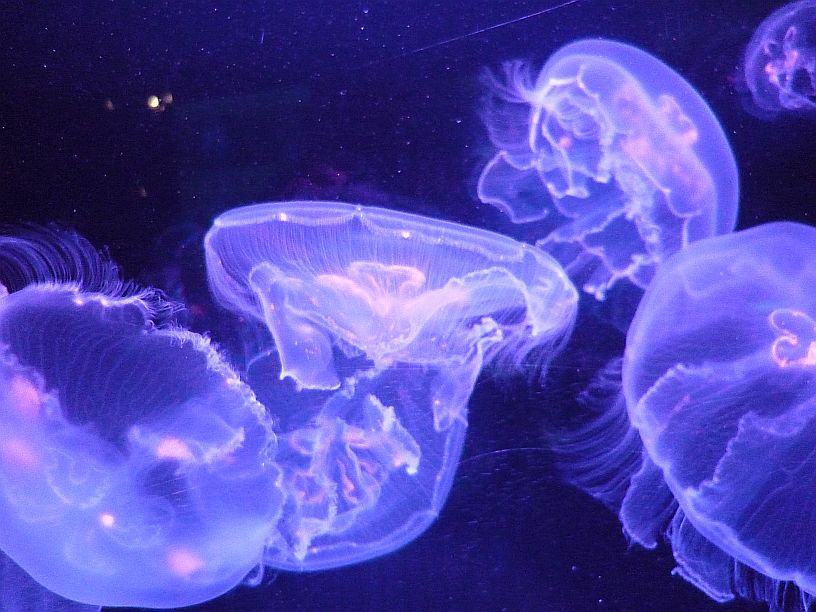
Moon Jellyfish

Moon Jellyfish

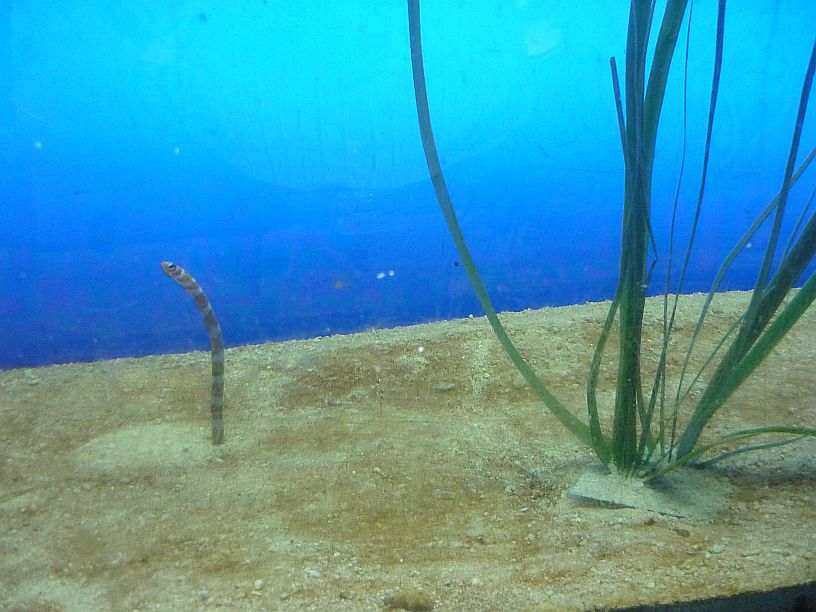
Striped Garden Eel -- It imitates the grass and can retract into the sand when in danger.

Splendid (or Orangebarred) Garden Eel — It imitates the grass and can retract into the sand when in danger.

http://en.wikipedia.org/wiki/Splendid_garden_eel

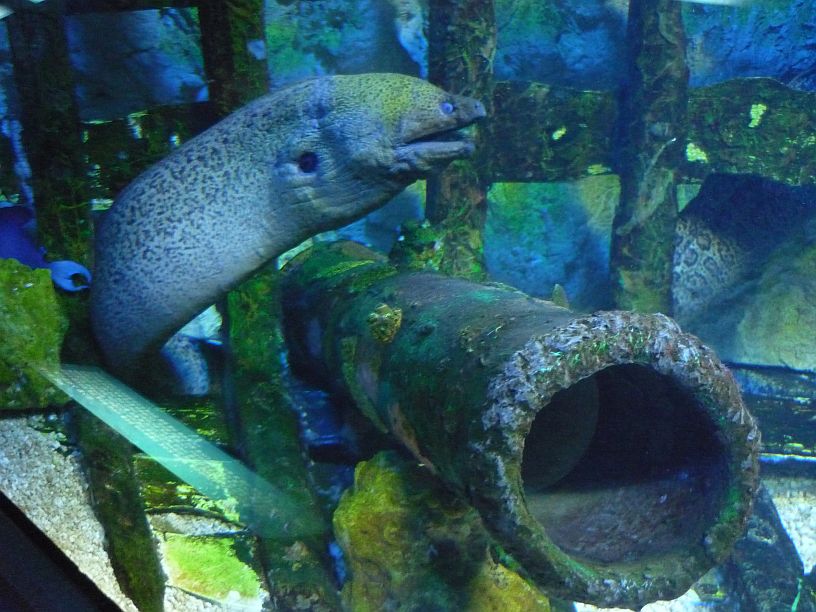
One of five Morey Eels -- I remember a startling encounter with a morey eel while snorkeling near a Bonaire reef in 1967!

One of five Morey Eels — I recall a startling encounter with a morey eel while snorkeling near a Bonaire reef in 1967!

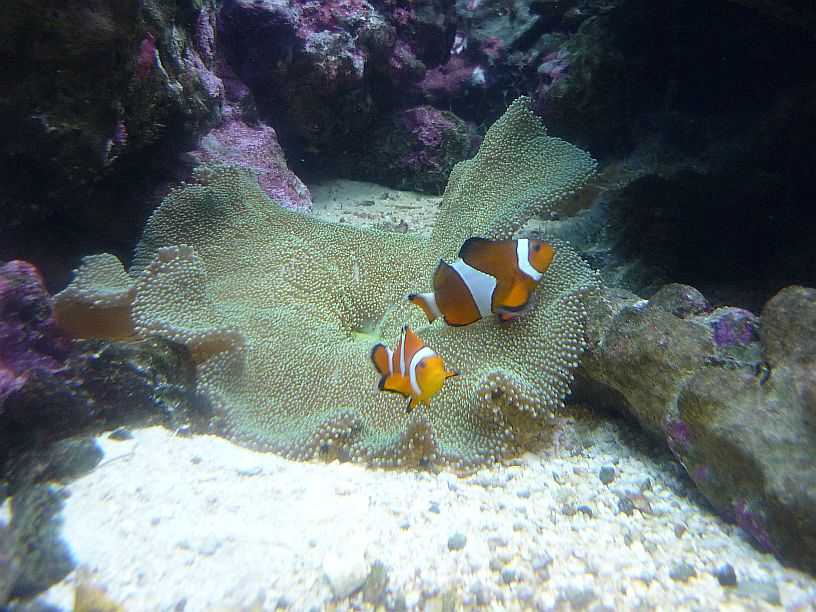
Clownfish or anemonefish --  today's children from around the world know them by a universal name.  A family, speaking Japanese, was at this tank and the children were exclaming, "Nemo, Nemo!!"

Clownfish or anemonefish — today’s children from around the world know them by a universal name. A family, speaking Japanese, was at this tank and the children were exclaming, “Nemo, Nemo!!”

Yellow Tang

Yellow Tang

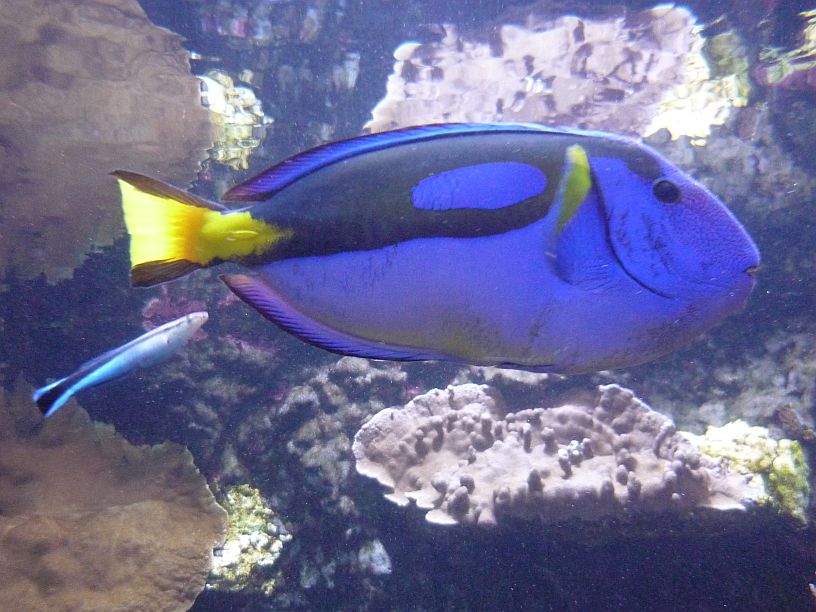
Not sure what this foot-long fish is -- one site identified it as a Blue Marine Parrotfish, but I am fairly sure this is wrong!

Not sure what this foot-long fish is — one website identified it as a Blue Marine Parrotfish, but I am fairly sure this is wrong!

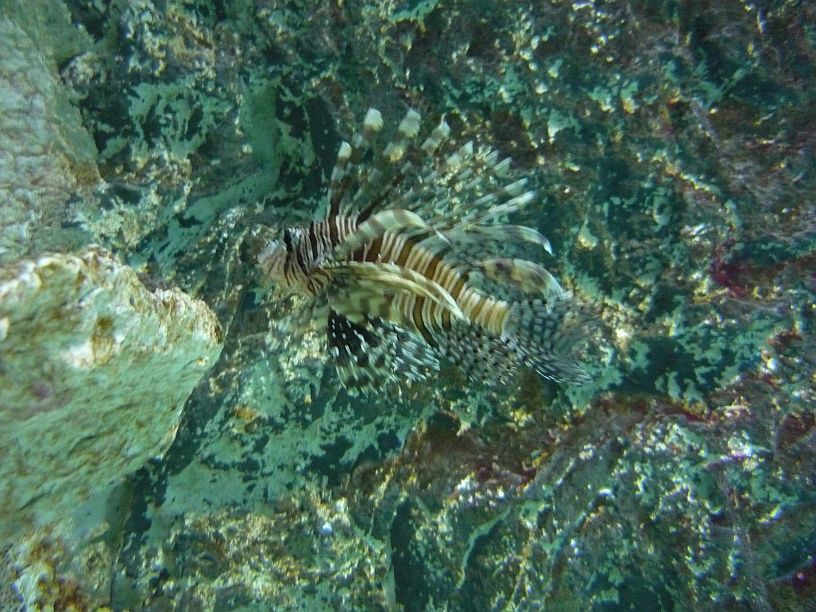
Lionfish -- poisonous and now an invasive species to the Caribbean and East Coast of the U.S.

Lionfish — poisonous and now an invasive species to the Caribbean, Gulf of Mexico and East Coast of the U.S.

From Underwater World, we returned to out apartment via the west side of Guam (Rt 4) and the Cross Island Road (Rt 17).

Pago Bay is quite picturesque -- unfortunately it is difficult to get a picture to do it justice because of new apartment buildings obstructing the view.

Pago Bay is quite picturesque — unfortunately it is difficult to get a picture to do it justice because of new apartment buildings obstructing the view.

We found beautiful and secluded Taga’chang Beach Park just south of Pago Bay and west of Yona village.


2014/07/19 — Saturday — Fort Santo Angel & More at Merizo

Grant and Jenna’s crates, with their personal effects from the U.S., were delivered early this morning.  All the available mission men helped open the crates and carry boxes into their apartment.  Their children were really excited that their ‘treasures’ had finally arrived!

We decided to do some more exploring towards the south today.  Our first stop was at Fort Santo Angel.  I wanted Virginia to see what I had only briefly seen last week.  As we pulled into the parking area, I shifted the car into park.  The car began to roll, so I quickly applied the parking brake and then discovered that the gear lever had become disconnected somewhere in the console.  Well, we were already on location, so decided to explore and sort out the problem later.

As seen from Umatac's Magellan monument, Fort Santo Angel is on top of the rock at the entrance to Umatac Bay.

As seen from Umatac’s Magellan monument, Fort Santo Angel is on top of the big rock at the entrance to Umatac Bay.

From the parking area, we made our way down to be beach.

From the parking area, we made our way down to the beach.

We had to carefully work our way over about 100 yards of sharp rocks to the stairs at the base of Fort Santo Angel.

We had to carefully work our way over about 100 yards of sharp rocks and concrete rubble to the stairs at the base of Fort Santo Angel.
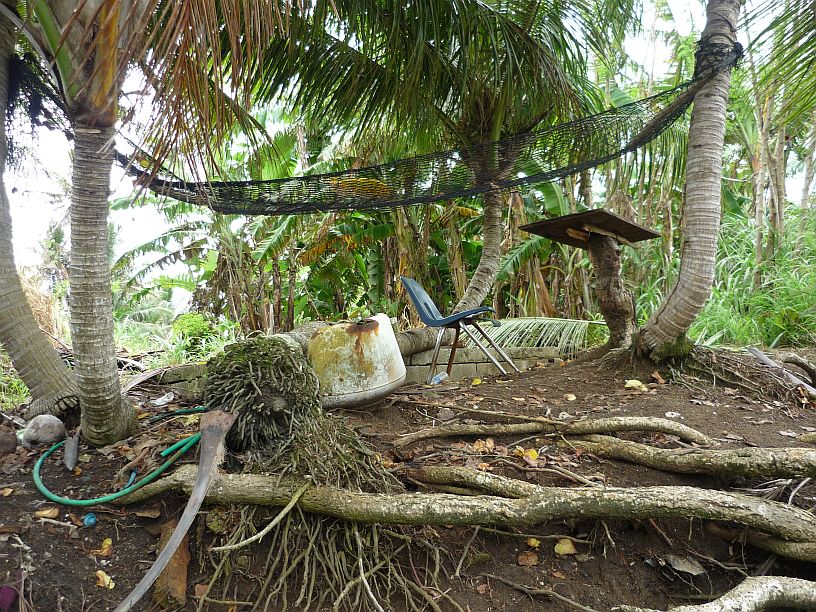
Looking up on the bank above the beach, we saw that someone had set up their own private getaway.  A hammock, a chair and a desk.  What more do you need?  Maybe a shelter from rain!

Looking up on the bank above the beach, we saw that someone had set up their own private getaway. A hammock, a chair and a desk. What more do you need? Maybe a shelter from rain!

We finally arrived at the steps going up to the fort.

We finally arrived at the steps going up to the fort.

In some places, the steps were not so obvious!

In some places, the steps were not so obvious!

Virginia made it to the top.  Her first time here.  These are the remaining walls to Fort Santo Angel.

Virginia made it to the top — her first time here. These are the remaining walls to Fort Santo Angel.
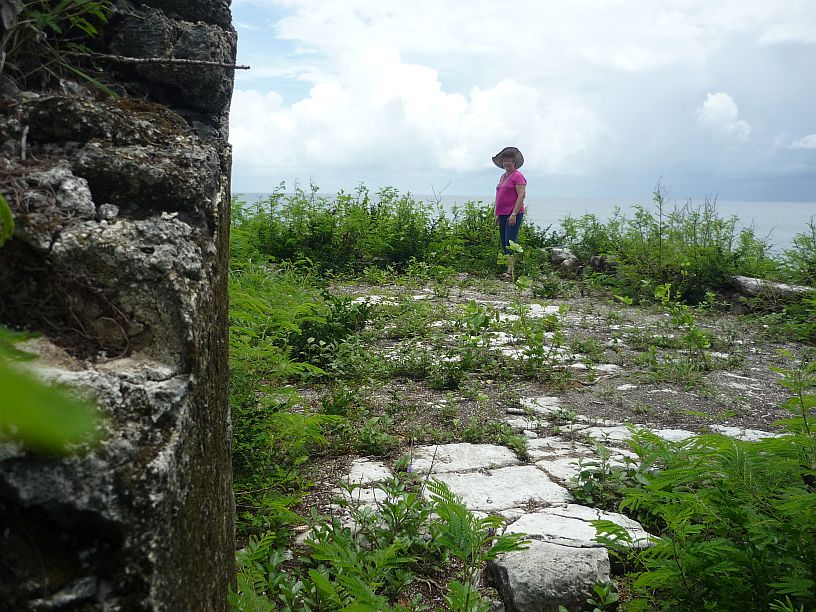
Looking from the fort across the courtyard surrounded by a low wall.

Looking from the fort across the courtyard which is surrounded by a low wall.

Another view of Fort Santo Angel -- note the stairs which must have led to a higher lookout or a second floor of the fort.

Another view of Fort Santo Angel — note the stairs which must have led to a higher lookout or a second floor of the fort.

There were several places around the fort that were sheer cliff edges with not rails.  It was about 80 feet to the beach below.  Note the concrete block pillar laying below.

There were several places around the fort that were sheer cliff edges with no safety rails — maybe this is why this site is not well marked for tourists.  It was about 80 feet to the beach below. Note the concrete block pillar laying at the bottom.

The 'newer' Fort Soledad as seen from Fort Santo Angel.
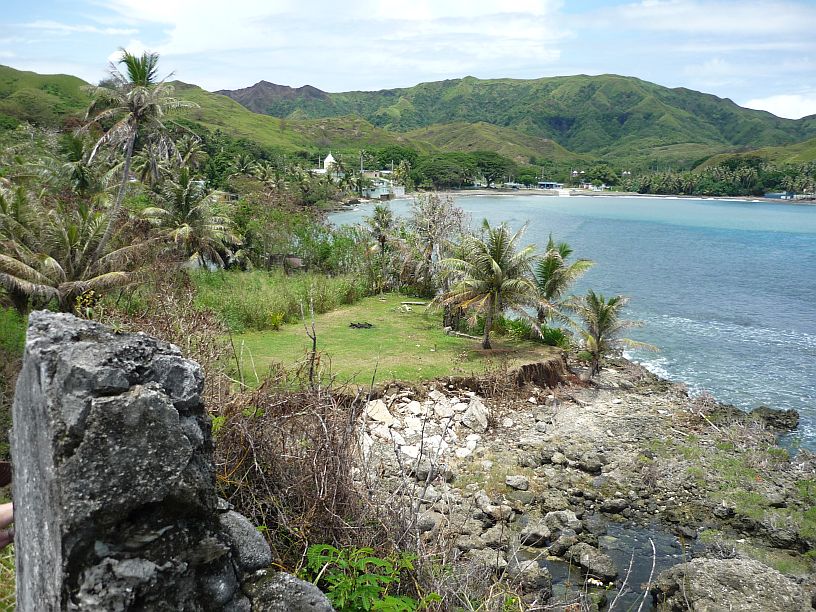
The ‘newer’ Fort Soledad as seen from Fort Santo Angel.

Looking from Fort Santo Angel toward Umatac Bay and the village of Umatac.  The rocky beach that we transversed can be seen here.  Note the grass clearing.  We decided to take an easier route back by climbing the bank to the clearing, then taking a road that enters from the left.

Looking from Fort Santo Angel toward Umatac Bay and the village of Umatac. The rocky beach that we followed to the steps can be seen here. Note the grass clearing. We decided to take an easier route back by climbing the bank to the clearing, then taking a road that exits from the left of the clearing.

We followed the road to another clearing behind two houses, then followed the tree line parallel to the beach to this dilapidated to the parking area.  We did have to ignore some barking dogs at the houses.

We followed the road to another clearing behind two houses, then followed the tree line parallel to the beach to this dilapidated bridge to the parking area. We did try to ignore some barking dogs at the houses.

Now, back to original challenge of the broken shift linkage!  We decided to go home and see if we could somehow get it repaired.  Because another car had parked in front of ours, it was now not possible to drive out forward.  We set the parking brake extra tight and Virginia stepped on the foot brake just to be safe.  We started the car and I reached under the open hood and shifted the transmission lever into reverse.  We then released the parking brake briefly to reverse just enough to be able to drive out going forward. Using the same method as before, I shifted the transmission lever into drive, closed the hood and drove the ten miles back to the apartment.

Since Joel had repaired this problem before, I had him show me how to get the gear lever console open.  The bushing, that he had repaired last month, had completely disintegrated. A trip down the road to a Napa store confirmed our fears — this is a dealer part!  The counter person said that his Toyota failed similarly and he temporarily repaired it with a cable tie until a part could be obtained.  Back at the apartment we called the Toyota dealer who informed us that the bushing is part of the transmission cable — cost over $400.  We decided the cable tie repair would do for now.  I looked in a tool kit that the mission provided for use in the apartment.  Lo and behold, there were cable ties in it!  Joel came up with an idea to use two cable ties in such a way that they would hold the cable on the gear lever pin, yet keep the cable ties from tightening up when shifting, as would happen with one cable tie.  Next week, I hope to make a bushing for a more permanent repair for a lot less than $400!

Back on the road again, we started where broke down — Umatac.
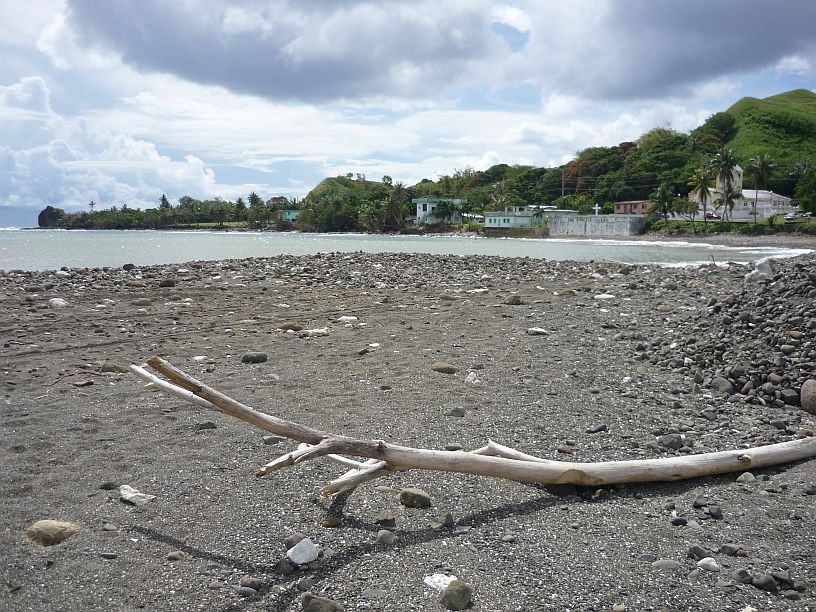
From Umatac Beach Bay looking toward Fort Santo Angel, Umatac village and the church.

From Umatac Beach Bay looking toward Fort Santo Angel, Umatac village and the church.

A simple, but functional, stage at Umatac Beach Park.

A simple, but functional, stage at Umatac Beach Park.

Many of the retaining walls in Guam are painted with murals.  Umatac has one of them.
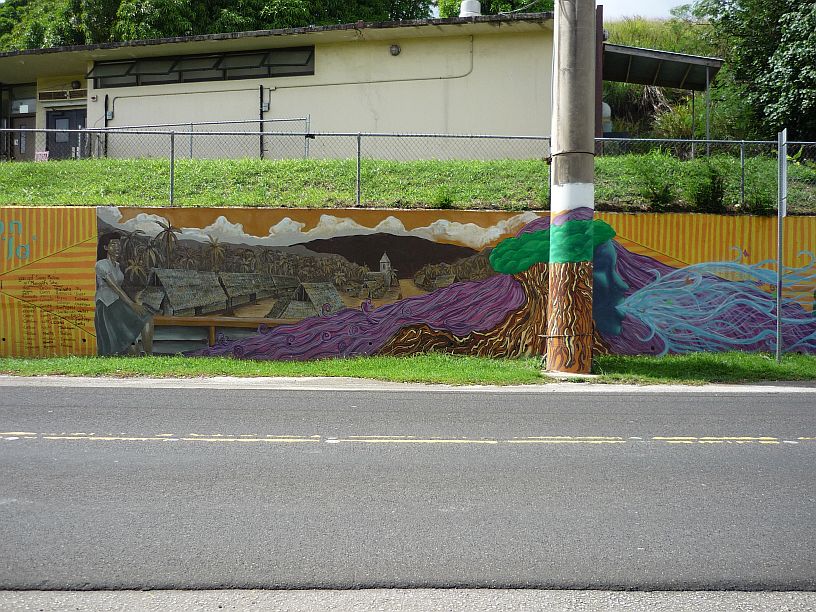
Many of the retaining walls in Guam are painted with murals. Umatac has one of them.

The Umatac mural continues to the left.

The Umatac mural continues to the left.  Note that the light pole is part of the mural!

To the left of the mural was what some might call a poem.  It is supposed to be the Chamorro account of creation -- http://www.guampedia.com/puntan-and-fuuna-gods-of-creation/

To the left of the mural was what some might call a poem. It is supposed to be the Chamorro folktale about creation — http://www.guampedia.com/puntan-and-fuuna-gods-of-creation/

http://www.guampedia.com/puntan-and-fuuna-gods-of-creation/

From Umatac we continued on Route 4 to Merizo.  Since last week, we learned of two massacre sites, Faha and Tinta, in Merizo, which were commemorated events in the days before the 70th anniversary of Liberation Day   —   http://www.guampedia.com/war-atrocities-tinta-and-faha-cave-massacres/
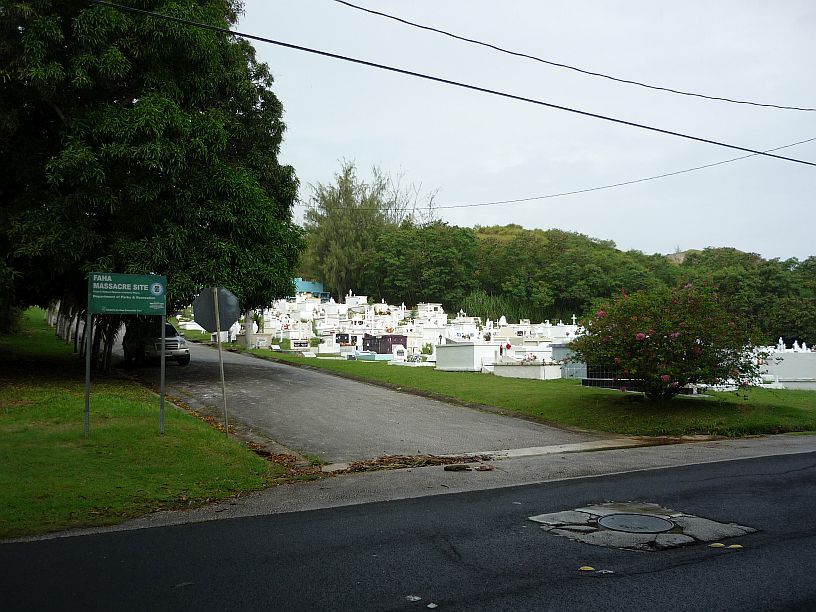
The start of the trail to the Faha massacre site is located behind the Merizo cemetery.  Larry goes by this cemetery everyday, but this is the first time he has noticed the Faha sign because it is parallel to the road.  It might save money to have a one-sided sign like this, but it definitely is not easily seen when driving by.  Larry learned the location of Faha by researching, then noticed the sign,

The start of the trail to the Faha massacre site is located behind the Merizo cemetery. Larry goes by this cemetery everyday, but this is the first time he has noticed the Faha sign because it is parallel to the road. It might save money to have a one-sided sign like this, but it definitely is not easily seen when driving by. Larry learned the location of Faha by researching websites, then noticed the sign!

The Merizo cemetery was running out of space, so this is how it has been expanded.

The Merizo cemetery was running out of space, so this is how it has been expanded.

This is the start of the Faha trail behind the cemetery.  It had been recently maintained for the 70th anniversary ot the event.

This is the start of the Faha trail behind the cemetery. It had been recently maintained for the 70th anniversary of the event.
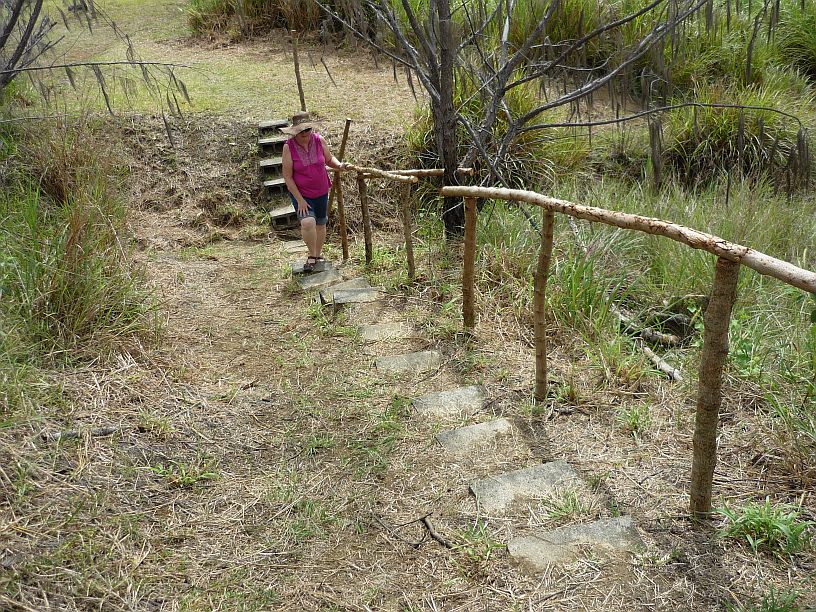
The trail continues for about 400 yards.

The trail continues for about 400 yards.

Faha Massacre Site

Faha Massacre Site where the Japanese soldiers killed 30 Chamorro men, who they feared might rebel.

140719 -- FahaSignThis plague lists the 30 victims of the massacre.

This plague lists the 30 victims that were killed in this massacre — no one survived.

TWR Guam's antennas are only about 1/2 mile from the Faha site.  In the valley below are Priest Pools, where we will go next.

TWR Guam’s antennas are only about 1/2 mile from Faha. In the valley below are Priest’s Pools, where we will go next.

We took the road up the hill to the area southeast of the transmitting site and took this photo that shows all the towers.  The most interesting part of the photo is the little 'tent-like' structures in this yard.  A rooster was tethered by his foot to each 'tent'.  Since chickens are usually allowed to roam all over the island, we believe these must be someone's fighting gamecocks.  Guam is mentioned as one of the countries that has facilities to watch cock fights -- http://en.wikipedia.org/wiki/Cockfight

We took the road up the hill to the residential area southeast of the transmitting site and took this photo that shows all the TWR towers. The most interesting part of the photo turns out to be the little ‘tent-like’ structures in this side yard. A rooster was tethered by his foot to each ‘tent’. Since chickens are usually allowed to roam all over the island, we believe these must be someone’s fighting gamecocks. Guam is mentioned as one of the countries that has facilities to watch cock fights — http://en.wikipedia.org/wiki/Cockfight

http://en.wikipedia.org/wiki/Cockfight

There are no signs indicating the location of Priest’s Pools.  We found out how to get to them by researching websites.  Turn off Route 1 in Merizo by the church and drive up the hill (towards TWR) and turn left onto the second street.  Drive to the end of the street and park.

This old street sign (Fanugmakan Pale?) is at the start of the trail to Priest's Pools.

This old street sign (Fanugmakan Pale’) is at the start of the trail to Priest’s Pools.

The trail is mostly on open grassland and is obviously used by 4-wheelers.  We met at least 3 in the 1/4 mile walk.  The pools are only 1/4 mile from the TWR towers.

The trail is mostly on open grassland and is obviously well used. We met at least three 4-wheelers in the 1/4 mile walk. The pools are only 1/4 mile down the hill from the TWR towers.
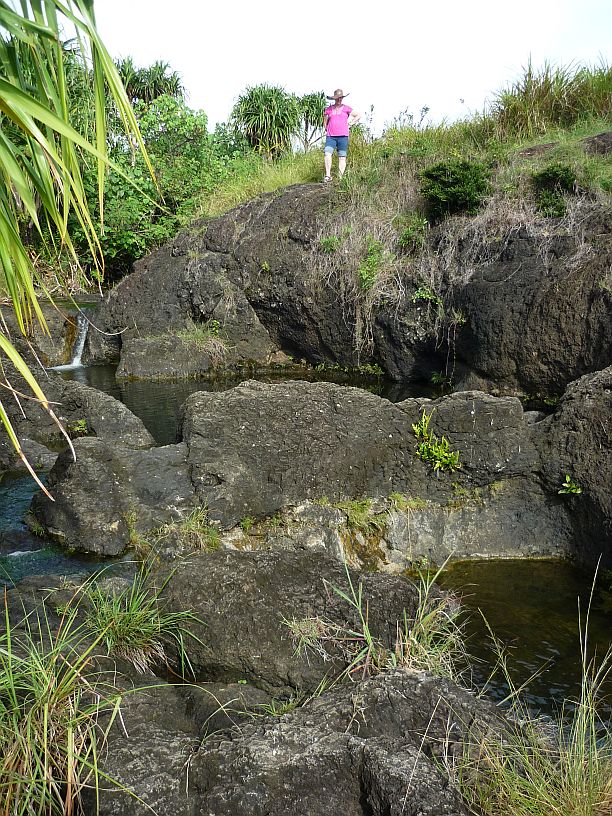
There are several pools at this location.  Can you see the small waterfall?  There are several small water falls and more pools behind the photographer.

There are several pools at Priest’s Pools. Can you see the small waterfall? There are several small water falls and more pools behind the photographer.
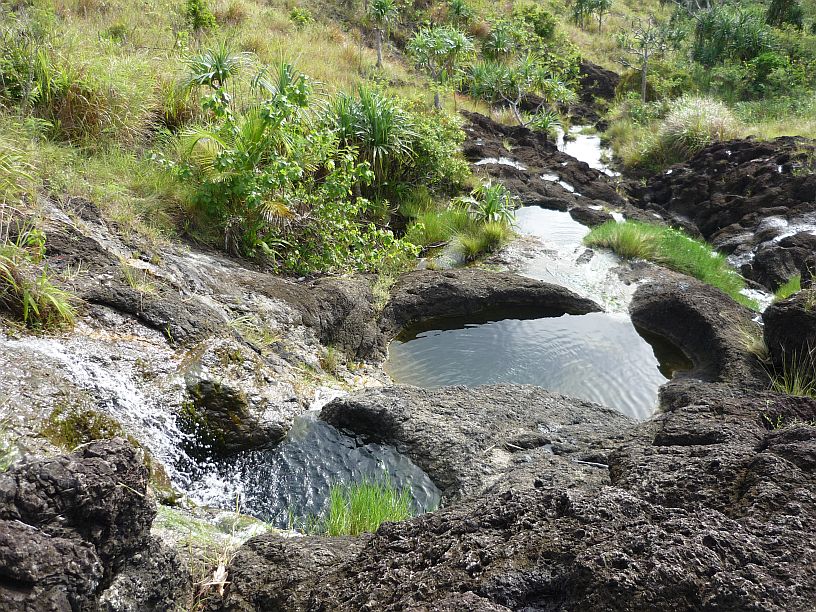
The other pools, at Priest Pools, not seen in the photo before this one.

These other picturesque pools, at Priest Pools, are just downstream from those in the previous photo.

http://hubpages.com/hub/Priest-Pools-Hike-Best-Hikes-in-Guam-USA

Shortly after arriving at Priest Pool's, four boys arrived and began jumping into the deepest pool.

Shortly we got to Priest’s Pools, four boys arrived and began jumping into the deepest pool.

The boys had a waterproof video camera with them and were using it a lot.  Their videos might already be on youtube.com.

The boys had a waterproof video camera with them and were using it a lot. Their videos might already be on youtube.com.

On the walk back to the car, we saw this flower.  It is not on the chart that we have of Guam's wildflowers.

On the walk back to the car, we saw this flower. It is not on the chart that we have of Guam’s wildflowers.  We think it might be an introduced, invasive species called rattleweed.

Driving south in Merizo on Route 4 we noticed a hand written sign with an arrow to “Tinta”.  Thinking this might be a sign pointing to the Tinta massacre site, we turned left, just past the Shell station, onto Espinosa Ave.  About 150 yards down this road we saw a similar sign pointing to the right.  This was a driveway passing an abandoned house on the left and ending at the garage door of a newer home, that had a ‘For Sale’ sign on it.  We felt uneasy about going into someone’s driveway.  After someone at the Shell station confirmed that this was indeed the right place, we returned and parked in the front yard.  We could see a trail leading off to the left of the house and followed it.

The trail had recently been mowed fot the 70 anniversary observation.  We walked past a grazing cow tethered to a long rope, and across a small creek ["Papatguan River"] using stepping stones  At one point there was a huge mud hole across the trail.  Virginia was wearing sandals and had to turn go back, but I managed to get across without getting my feet wet.
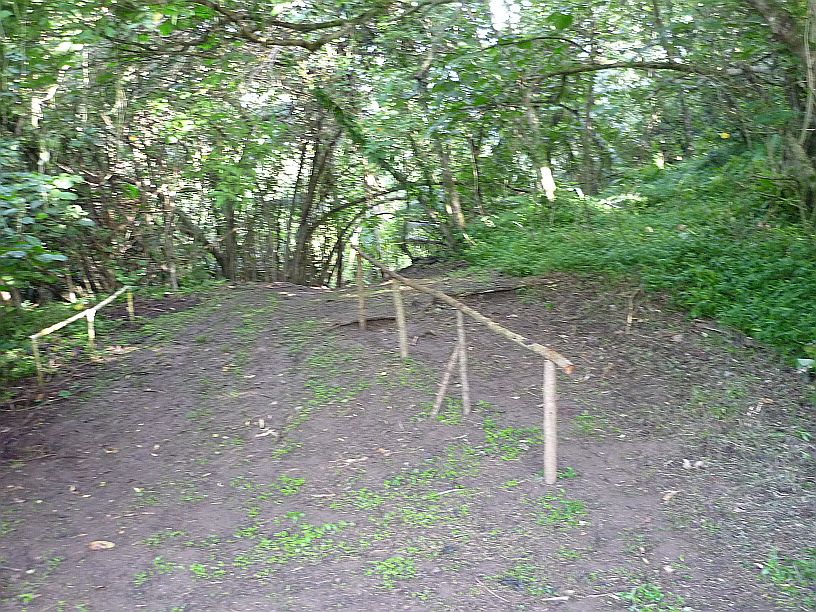
The trail had recently been mowed for the 70 anniversary commemoration. We walked past a grazing cow tethered to a long rope, and across a small creek [“Papatguan River”] using stepping stones At one point there was a huge mud hole across the trail. Virginia was wearing sandals and had to turn go back, but I managed to get across without getting my feet wet.

After the mud hole, about 1/2 mile into the hike, the trail started up a small rise.

After the mud hole, about 1/2 mile into the hike, the trail started up a small rise.

Just a little further down the trail, is the Tinta Massacre Site with its memorials.

Just a little further up the trail, is the Tinta Massacre Site with its memorials.

140719 -- TintaPlaqueThis memorial lists the names of those who died and those who survived the massacre.  "Buck" Cruz, the mayor of Merizo, commissioned both these memorials and the ones at Faha.  His father Ramon Cruz was one of those killed at Tinta when "Buck" was a young boy.

This memorial lists the names of those who died and those who survived the massacre. “Buck” Cruz, the former mayor of Merizo, commissioned both these memorials and the ones at Faha. His father Ramon Cruz was one of those killed at Tinta while “Buck” was still a young boy.
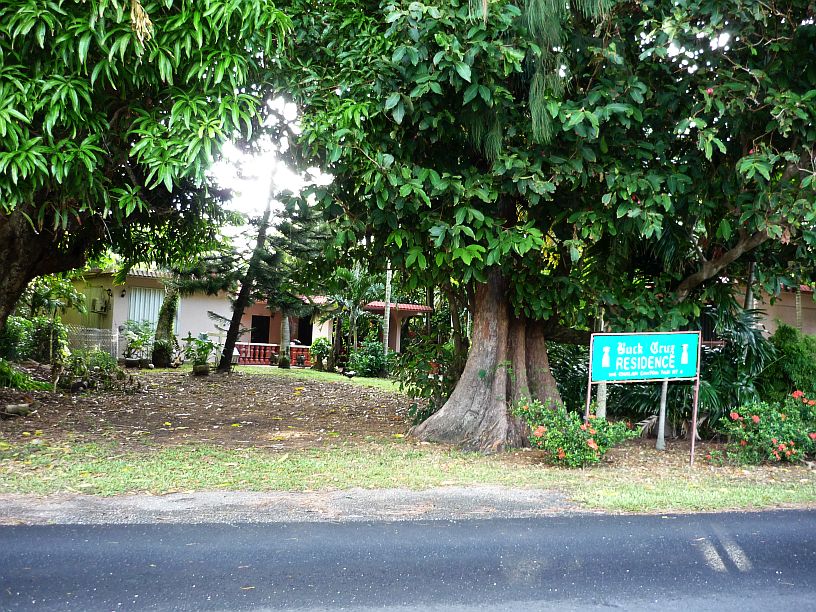
On the way home, we drove past "Buck" Cruz's home on the far south end of Merizo.  Buck was the mayor of Merizo for many years between 1979 and 2000.

On the way home, we drove past “Buck” Cruz’s home on the far south end of Merizo. Buck was the mayor of Merizo for many years between 1979 and 2000.
Interesting history – “Merizo [was] the first village on Guam to be liberated, and the only one to be liberated by the Chamorros themselves”.  http://guam.stripes.com/travel/get-know-guam-merizo